The Minions and their ‘top boss’ Chris Meledandri keep the blockbuster engine running strong
NEW YORK (AP) — When Illumination founder and CEO Chris Meledandri was honored earlier this month with a star on the Hollywood Walk of Fame, he joked about how often it might actually be noticed.
“Years from now, people strolling down Hollywood Boulevard will see my name,” he told the crowd. “And unless they’re family, they’ll probably wonder, ‘Who was that?’”
Still, in an industry defined by constant change, the low-key Meledandri has quietly built one of Hollywood’s most dependable hit-making machines. As family films increasingly dominate ticket sales, Illumination has become one of the driving forces behind that success.
Since releasing its first feature, 2010’s “Despicable Me,” the animation studio has generated more than $11 billion worldwide. Its “The Super Mario Galaxy Movie” stands as 2026’s only billion-dollar release so far. Its upcoming film, “Minions & Monsters,” debuting Sunday at the Annecy Film Festival in France, appears poised to join that club.
The Minions — Illumination’s equivalent to timeless cartoon icons like Mickey Mouse or Bugs Bunny — have been central to that rise. Yet the Universal Pictures division has broadened its reach, partnering with Nintendo for the “Mario” films, developing an animated “Barbie” movie with Mattel, and building franchises such as “Sing” and “The Secret Lives of Pets.” Above all, Illumination has become known for bright, playful entertainment.
“From the beginning, our goal was to make films that felt joyful above all else,” Meledandri said in a recent interview. “I gravitated toward filmmakers who loved that classic Looney Tunes spirit and wanted to weave it into modern animation.”
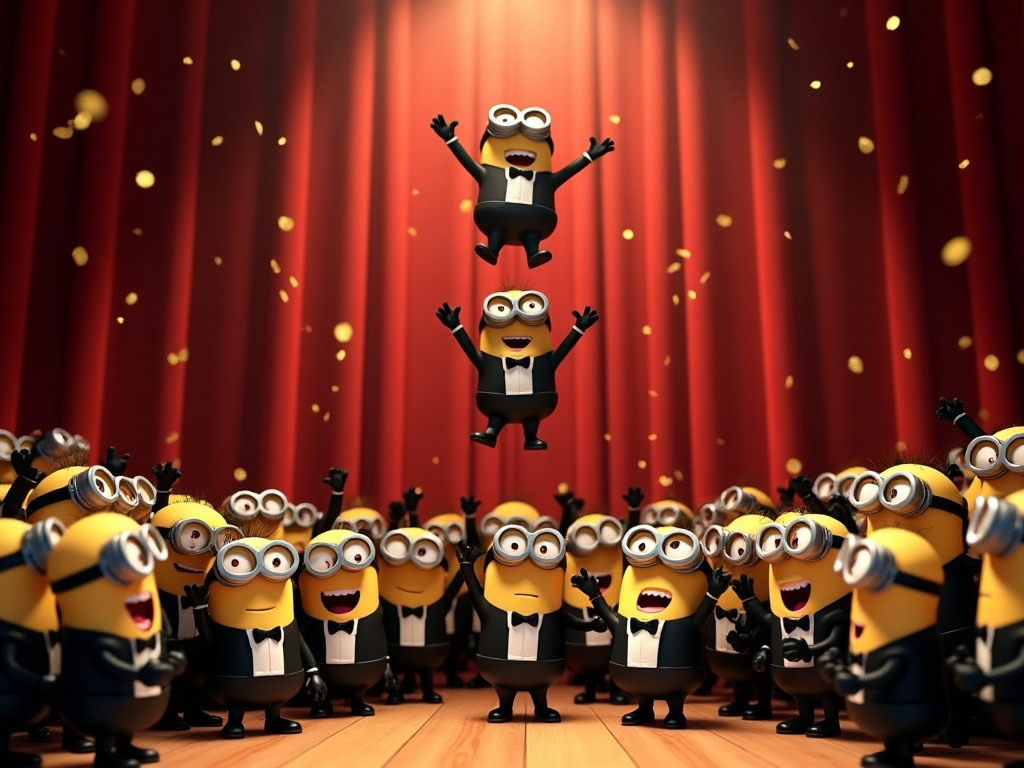
Opening July 1, “Minions & Monsters” may represent Illumination at its most gleefully absurd. The seventh entry in the “Despicable Me” saga and the third standalone Minions film follows the mischievous yellow characters as they attempt to become filmmakers. Giving some of cinema’s most accident-prone creatures access to a movie camera proves as chaotic as expected.
Set during the 1920s heyday of Hollywood, the film playfully nods to silent-era slapstick in the tradition of Charlie Chaplin and Harold Lloyd. Jeff Bridges lends his voice to a studio executive. In a humorous touch, one especially imaginative Minion named James is credited — at least in an early draft — as the film’s director, making the project feel like the Minions’ own answer to “The Muppet Movie.”
The Minions go behind the camera
The actual director is Pierre Coffin, a longtime Illumination collaborator who has helmed several of its films and famously provides the Minions’ voices. Though Coffin has occasionally felt conflicted about returning to the ever-expanding Minion universe, Meledandri was determined. This is, after all, a producer who successfully reunited the cast of DreamWorks’ “Shrek” for an upcoming fifth installment.
“He called me one weekend and said, ‘You’ll probably say no, but I have to ask,’” Coffin recalled from Paris. “Then he said, ‘It’s about the Minions trying to make a monster movie. They summon creatures, and those creatures turn on them — and the world.’”
“He had me at ‘Minions making movies,’” Coffin said. “After that, I just wanted to know more.”
Arriving two weeks after Pixar’s “Toy Story 5,” the film will test the full strength of Illumination’s box-office power. After overseeing Fox’s animation division and producing the “Ice Age” series, Meledandri launched Illumination with the support of a Paris-based animation studio formerly known as Mac Guff. While the company’s headquarters are in Santa Monica, much of its production work still happens in France.
Today, its partnerships extend globally, including collaborations in Japan through Nintendo — a fitting international footprint for characters who speak in cheerful, nonsensical hybrid language.
“From day one, I wanted our creative leadership to reflect our ambition to make movies for the whole world, not just for American audiences,” Meledandri said.
He never set out to compete directly with Disney or Pixar, calling those aspirations unrealistic at the time. Instead, he encouraged filmmakers to focus on mischievous antiheroes and energetic humor. Illumination’s films lean toward comedy and irreverence rather than emotional catharsis. Audiences are expected to laugh — not necessarily cry.
That strategy has paid off financially. In addition to theatrical success, streaming arrangements have expanded the studio’s audience. Yet major awards have largely eluded Illumination. The company has never won an Oscar, and only “Despicable Me 2” received a nomination for best animated feature — a fact lightly poked at in “Minions & Monsters.”
Still, the film’s affectionate tribute to moviemaking could win broader industry appreciation. Even George Lucas makes a vocal cameo.
Making blockbusters on a budget
Whatever its awards fate, “Minions & Monsters” is almost guaranteed to turn a profit — a rarity in today’s high-cost blockbuster environment. After experiencing the financial disappointment of 2000’s “Titan A.E.” while at Fox, Meledandri adopted a strict philosophy of cost control. “At the time, everyone expected I’d be fired,” he said. “And maybe they weren’t wrong.”
While many tentpole films now exceed $200 million in production costs, and even prominent directors have warned about runaway budgets, “Minions & Monsters” was made for approximately $85 million. Illumination’s priciest project to date, “The Super Mario Galaxy Movie,” cost around $110 million — modest by comparison. Meanwhile, “Toy Story 5” reportedly carries a $250 million price tag.
“In nearly two decades, I can’t recall a single director telling me we needed more money,” Meledandri said. “We talk about solving problems or adjusting timelines, but increasing the budget just isn’t part of our culture.”
As some studios explore generative AI to reduce expenses, Meledandri remains cautious.
“Right now, my priority is protecting jobs, even if that means we’re not on the cutting edge of every new technology,” he explained. “It’s usually better to lead a wave than resist it. But we’re not integrating AI into our creative pipeline.”
He added that comparisons to past technological shifts don’t fully apply. “People say the industry has survived previous innovations, and that’s true. But those technologies didn’t operate with their own agency.”
Prominent animation executives have often become synonymous with their studios, yet figures like Jeffrey Katzenberg and John Lasseter are no longer at the companies they helped shape. At 67, Meledandri — raised on Manhattan’s Upper East Side — now stands as one of the industry’s enduring leaders, effectively the head of the Minion empire.
His Hollywood career began modestly, when a customer of his father’s clothing store hired him as an assistant on “Footloose.” He later produced the 1993 Disney hit “Cool Runnings.” Today, he oversees an animation studio that has transformed from underdog to powerhouse.
Yet the competition he finds most concerning isn’t Disney or Pixar — it’s short-form digital content.
“That challenge pushes us to be more inventive and more surprising,” Meledandri said. “We can’t rely on formulas that worked before. With ‘Minions & Monsters,’ Pierre Coffin has created something wildly imaginative and unexpected — exactly where I believe Illumination should be right now.”