US set to overhaul military presence in Japan in 'landmark' shift as regional tensions escalate
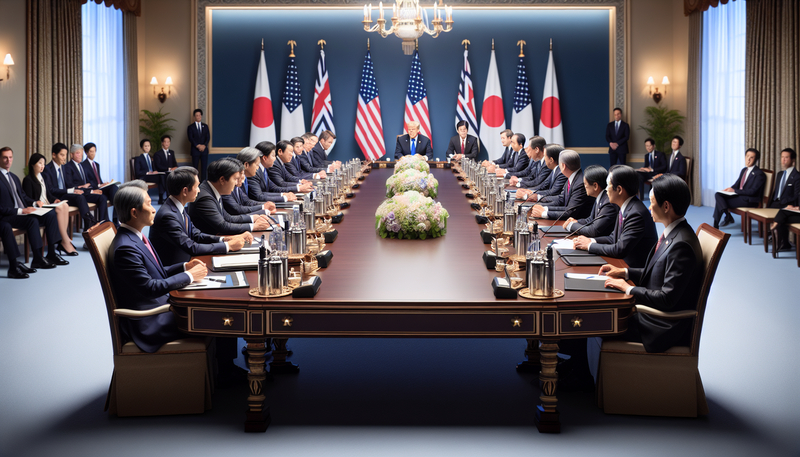
The United States is set to revamp its military presence in Japan as both nations work to enhance defense collaboration, Washington and Tokyo announced on Sunday. This comprehensive move aims to modernize their security alliance in response to escalating threats in Asia.
This decision arrives amidst growing concerns about regional security, where China has been perceived as increasingly assertive in its territorial claims, while North Korea continues to advance its unlawful weapons development. Simultaneously, both China and North Korea have been solidifying relations with Russia as it engages in the war with Ukraine.
After a meeting in Tokyo, US Defense Secretary Lloyd Austin, Secretary of State Antony Blinken, and their Japanese counterparts—Minoru Kihara and Yoko Kamikawa—issued a joint declaration. The group identified China’s “political, economic, and military coercion” as the “foremost strategic challenge” for the Asia-Pacific and the wider global community.
The decision is expected to provoke further criticism from Beijing, which has been deeply suspicious of the growing US relationships with regional allies in an area over which China seeks dominance. Beijing has accused Washington of fostering divisive, Cold War-style alliances in opposition to China.
According to the announcement, US forces in Japan will be “reconstituted” under a joint force headquarters reporting to the Commander of US Indo-Pacific Command. This change seeks to enhance their “interoperability” and collaboration during both peacetime and critical operations.
In a press briefing post-meeting, Austin praised this overhaul as a key step in the “modernization” of the alliance’s command structure, calling it a “historic decision.”
“This marks the most significant adjustment to US Forces Japan since their inception, and one of the most consequential enhancements to our military partnership with Japan in 70 years,” Secretary Austin said.
He pointed to the newly announced “upgrade,” which broadens the operational scope of US Forces Japan. Alongside Japan’s newly established Joint Operations Command, the changes will afford a stronger ability to deter and respond to acts of coercion within the Indo-Pacific region and beyond, said Austin.
This move follows a Washington summit in April between President Joe Biden and Prime Minister Fumio Kishida. During that meeting, the US and Japan pledged to strengthen their command-and-control frameworks to bolster deterrence, ensuring the region stays free and open amidst rising security challenges.
Details on the rollout are expected to be managed by working groups spearheaded by US Indo-Pacific Command. However, a senior US defense official made clear before Sunday’s announcement that there is no plan to integrate Japanese forces into US command.
Related article: Japan’s Kishida warns world at ‘a historic turning point’ while advocating for US support before Biden summit.
Headquartered at Yokota Air Base, US Forces Japan (USFJ) currently includes around 54,000 military personnel. The force has been stationed in Japan under the mutual cooperation and security treaty signed in 1960.
The envisioned restructuring aligns with Japan’s shift in defense posture, as the nation gradually moves away from the pacifist stance laid out in its post-World War II constitution. Japan aims to increase its defense expenditure to around 2% of its GDP by 2027, while also pursuing counterstrike capabilities.
These developments position Japan even more centrally within the US’ regional security strategy, emphasizing stronger ties with allies in response to escalating tensions in Asia—and recognizing the interconnections of security in Europe and Asia following Russia’s invasion of Ukraine.
This latest maneuver also takes place as the US eyes its upcoming presidential election. With the possibility of political shifts looming, many of America’s allies remain watchful, especially as former President Donald Trump, now a Republican candidate, has frequently questioned the costs associated with maintaining US alliances.
When asked if the election results might affect US-Japan relations, Secretary Blinken stressed that the longstanding alliance remains “the strongest it’s ever been” and would endure “regardless of the outcome” in either country's elections.
“The reason for this is simple: it’s fundamentally in the interest of both the American and Japanese people, as well as those beyond our borders,” Blinken explained.
Tensions Rise in the Region
The joint statement made frequent and explicit references to China, with the ministers outlining mutual concerns over what they described as Beijing’s “increasing efforts to unilaterally alter the status quo” in the East China Sea. They also denounced provocative actions by China in the South China Sea and accused the country of supporting Russia’s defense industry.
China has continued to press its territorial claims in the contentious waters of the South China Sea while maintaining a persistent presence around Japanese-controlled islands in the East China Sea, which Beijing continues to claim. Western leaders have also criticized China for “enabling” Russia’s war on Ukraine, particularly through the provision of dual-use goods, a claim China denies.
The ministers further noted that Taiwan’s “political transition period should not become an excuse for provocative actions” in the Taiwan Strait. This follows Chinese military exercises encircling Taiwan shortly after the island inaugurated a new president in May. China claims sovereignty over the self-governed democracy.
In response to questions about whether the strengthened US-Japan command structure is in response to China, Austin said the move was not “based on any direct threat” from Beijing. Instead, he explained it was motivated by the need for closer cooperation and improved effectiveness.
The ministers also took a firm stance against North Korea’s continuing missile testing and nuclear weapons programs, while condemning recent North Korea-Russia cooperation. Specifically, they referenced Russia’s procurement of ballistic missiles and other military supplies from North Korea for use in its conflict with Ukraine.
The announcement comes on the heels of a trilateral defense meeting Sunday involving the US, Japan, and South Korea—the first such meeting at this level in 15 years. It represents a notable sign of tightened coordination among US regional allies.
This follows nearly a year after the landmark summit hosted by President Biden at Camp David, where the three nations agreed to strengthen their mutual security ties. The deepening trilateral cooperation between the US, Japan, and South Korea reflects a noticeable shift in regional relations. Observers note that Tokyo and Seoul, both historical antagonists, are now working toward overcoming their differences to confront shared threats.
On Sunday, defense chiefs from the three nations vowed to enhance collaboration to defend against “nuclear and missile threats” from North Korea. They formalized a trilateral agreement that underscores the “steadfast” nature of this new era of partnership, according to their joint statement.
The agreement aims to “institutionalize” trilateral security collaboration across their defense spheres, including policy consultations, intelligence sharing, joint exercises, and defense exchange programs.