How to spot the hunter’s moon this weekend — and possibly Saturn, too
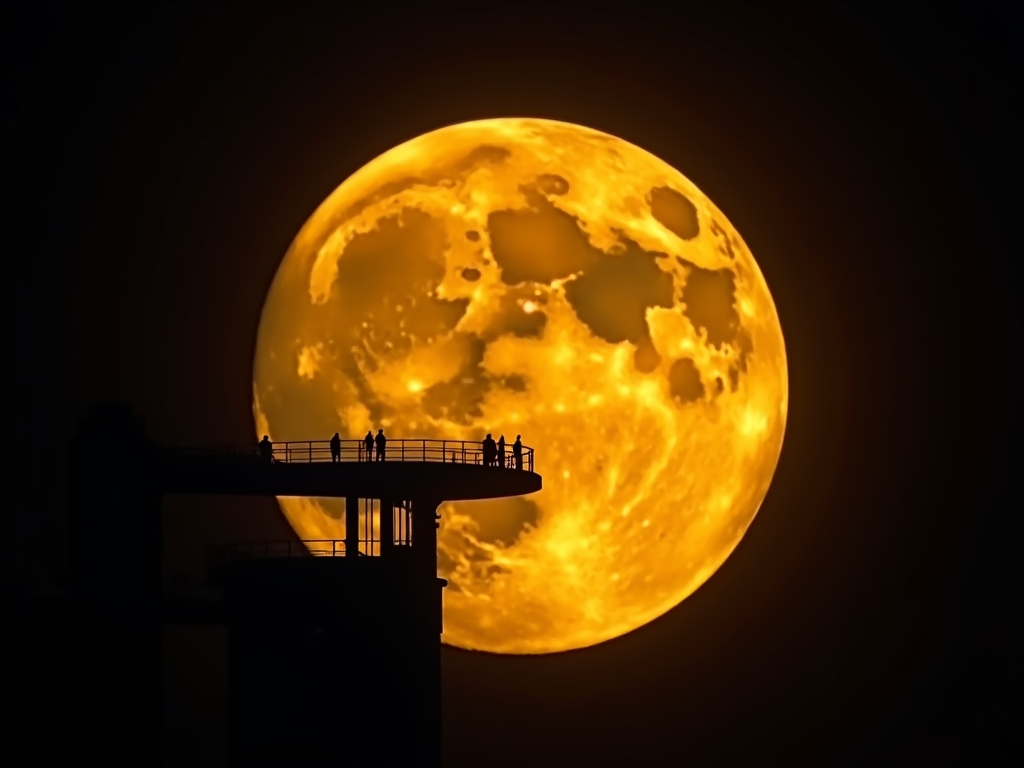
October’s full moon will light up the night sky this weekend, and observant stargazers may also be able to spot Saturn nearby.
Coming about a month after the autumn equinox, the full moon will rise unusually early, appearing around sunset before reaching its fullest point at 12:12 a.m. ET on Monday, October 26. On Sunday evening, Saturn will shine with a golden tint a few degrees south of the moon.
The moon’s low position near the horizon can make it seem warmer in color, with shades of orange becoming more noticeable. As its light travels through a thicker portion of Earth’s atmosphere, shorter blue and violet wavelengths are scattered away, leaving red and orange hues more visible, much like a sunset.
Known as the hunter’s moon, October’s full moon was traditionally associated with a time when Native American communities used its strong light to hunt wildlife and gather supplies ahead of winter. It follows September’s harvest moon, which was linked to the season when crops were commonly brought in from the fields.
“These names were given to the moon because it carries meaning,” said Noah Petro, chief of NASA’s Planetary Geology, Geophysics and Geochemistry Lab at Goddard Space Flight Center in Maryland. “I’d encourage people, while they look at the moon, to consider what this season means to them. Everyone can form a personal connection with it.”
Many other names for the hunter’s moon also reflect seasonal events and local customs. Indigenous communities have called it the drying rice moon, the falling leaves moon and the migrating moon. Some also used the term blood moon, referring to the reddish-orange appearance it can take on near the horizon.
Although the full moon will generally look silver-white in the coming months, careful observers can notice subtle changes across its surface as its orientation shifts, Petro said. These differences are connected to the moon’s varying terrain, surface materials and geological age — features scientists hope to investigate further during the Artemis mission planned for June 2027.
“When you notice different colors on the moon, it shows that something has happened in that location — either the rocks have a different composition, or the surface is younger or older,” Petro said. “Those details reveal its geological past.”
Getting the clearest view
For the best viewing conditions, Petro recommended choosing an open area without trees, rooftops or tall buildings blocking the horizon, such as a broad field. Crisp winter evenings can also offer clearer views because warm air creates atmospheric turbulence that can blur the sky.
“The wonderful thing about the moon is that you don’t need an extraordinary telescope,” Petro said. “You only need two things: clear eyes and clear skies. With those, you can really come to appreciate the moon.”
If clouds interfere on Sunday night, the moon should still look nearly full on Saturday and Monday.
The hunter’s moon arrives after several days in which the moon moves toward and then beyond Saturn. The ringed planet could be challenging to see because the moon’s bright glow may wash out fainter objects nearby.
There will be more celestial events to watch after the weekend. From Monday through Wednesday, the moon will move near, pass in front of and then continue beyond the Pleiades star cluster, often called the Seven Sisters. To the unaided eye, the cluster resembles a soft grouping of six or seven stars and is one of the most recognizable stellar formations in the sky.
Upcoming supermoons to watch
The hunter’s moon is the 11th of 13 full moons in 2026. The year’s final two full moons will also be supermoons, appearing somewhat larger and brighter because the moon will be closer to Earth in its orbit.
• November 24: beaver moon
• December 23: cold moon