The Disappearing Apothecary of the Sundarbans
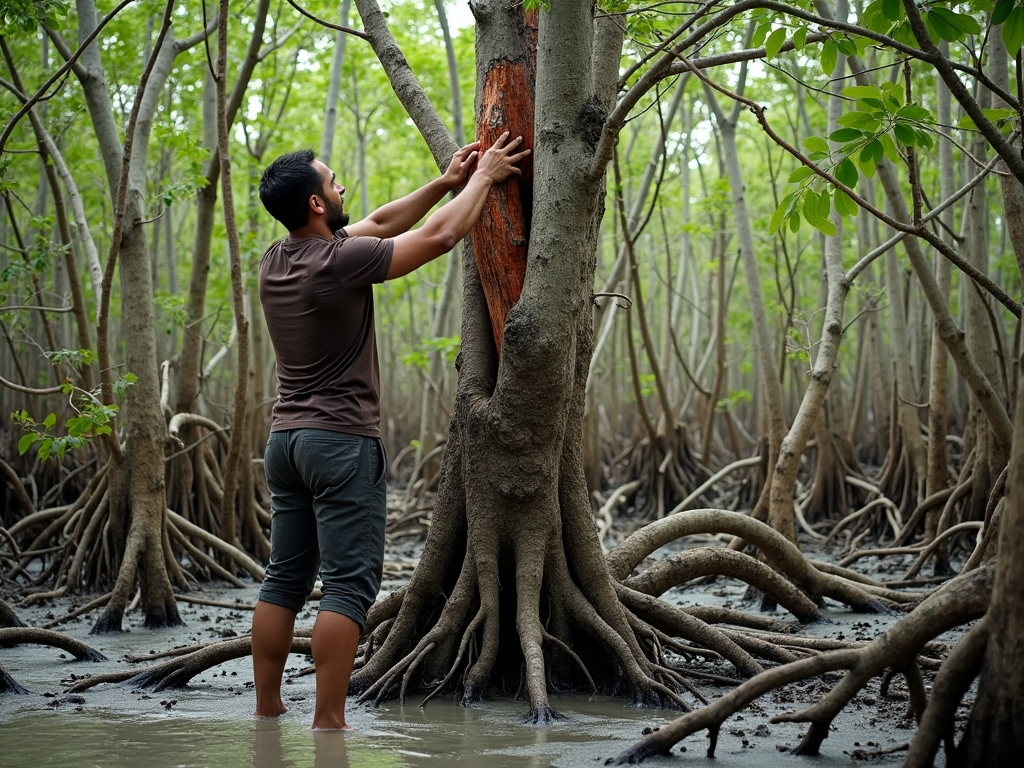
Koyra Upazila, Bangladesh – At low tide, the Shakbaria River retreats and reveals a broad, slick stretch of mud between Suranjan Raptan’s village and the Sundarbans, the largest tidal mangrove forest on Earth.
For nearly all of his life, Suranjan has regarded the forest as a living dispensary. Before sunrise, he boards a small boat, crosses into the mangroves and walks barefoot for hours through thick clay, carrying a knife to gather leaves, roots and bark for herbal remedies.
On this morning, the 40-year-old traditional healer, known locally as a kabiraj, is going to borrow his uncle’s boat.
“Uncle, are you at home?” he calls from outside.
Chapal Raptan, Suranjan’s uncle and a honey collector, is of average build, with a narrow face and keen eyes.
“Suranjan? Come inside and sit,” Chapal replies in a rough voice. “I worked in the rain yesterday and caught a cold, so I’m lying down.”
“That is unfortunate,” Suranjan says. “Have warm tea with tulsi leaves and honey. It should help. I can’t stay now; I’m going to the forest to collect plants. I need to use your boat.”
His uncle tells him where it is kept.
“All right, uncle. Rest. If you feel worse, I’ll send you some medicine,” Suranjan says before leaving.
Past the courtyard is a narrow road, then the Shakbaria River, and beyond that, the Sundarbans.
Suranjan finds the boat turned upside down and eases it into the river. Forest leaves and fallen fruit lie scattered across the muddy shore. His feet disappear into the soft mud as he pushes off. Once inside, he lets his legs hang over the side to rinse them, while the breeze carries the boat over small ripples toward the trees.
Inside the Sundarbans, the air smells of wet earth and salt. Mangrove roots break through the water like hooked fingers. Kingfishers call through the dim light, insects buzz, and branches shift in the wind. Suranjan goes barefoot because, he says, it helps him sense the ground and move silently; shoes slide too much in the mud.
“A deer came through here recently,” he says, pointing at a small mark in the mud.
“These leaves,” he says, stopping at a shrub, “can be boiled for stomach pain.”
Nearby, he places his hand on the trunk of a tall tree. “Scrape this bark and mix it with water. It can help with a stubborn cough.”
Then he comes across a tall Sundari tree with oval, deep-green leaves.
“This is the tree that gave the Sundarbans its name. It has become rare now. We are fortunate to still find one here.”
He recalls the forest as it once was.
“Before Cyclone Aila in 2009, the forest was so thick that sunlight barely reached the ground. After that, it became thinner. It feels vacant now.”
He says the difference became especially clear around 2015 or 2016, when sunlight began entering areas that had always been shaded, and medicinal plants he once knew well started becoming scarce.
That day, he is searching for a certain tree. He looked for it on his previous visit but failed to locate it. He fears it may be gone.
Suranjan has worked as a kabiraj for 21 years. He learned from his father, who had learned from Suranjan’s grandfather. None of it was recorded in books. He was taught to recognise plants, remember their locations, understand which parts to take and know how to prepare them – lessons carried through observation, practice and memory.
Suranjan lives in Koyra, in the Khulna district along Bangladesh’s southwestern coast. From his yard, he can see the green mass of the Sundarbans beyond a canal.
Two decades ago, he says, his courtyard was crowded with patients. Men, women and children came with coughs, fever, cuts and stomach ailments. Some arrived carrying roots or leaves for him to identify. The number of visitors started falling around 10 years ago. Today, he sees only a small number of people from the surrounding community.
Part of that shift began in the forest. Repeated cyclones and increasing salinity made many of the plants he relied on more difficult to gather. At the same time, villagers had more medical options than before.
Bangladesh began strengthening its community clinic programme in 2009, bringing primary healthcare closer to rural and remote populations. By 2015, roughly 14,000 community clinics were functioning nationwide, offering basic treatment near people’s homes. There were also countless retail drug shops, where medicines could often be purchased without prescriptions.
Suranjan says younger residents increasingly choose clinics, physicians and pharmacies. Those who still visit kabiraj are often older people or those with limited means to seek other care.
Today, Suranjan carries the happiness of becoming a father. Two days earlier, his first child, a daughter, was born at her maternal grandparents’ house. Both mother and child are well, and everyone in the village has heard the news.
People stop him while he walks.
“How are the mother and baby?”
To younger neighbours, he smiles, presses a hand to his chest and answers, “By your blessings, both mother and daughter are well.” Before elders, he folds his hands in respect. Every conversation ends with blessings for the child.
At home, Suranjan sits on the polished earthen floor. When someone offers him a rug, he politely declines.
“One day, I will return to this earth,” he says. “It has a special feeling.”
When payment is mentioned, he shakes his head.
“I never set a fee. People gave whatever they could, and that was enough. I never did this to earn money.”
A small electric fan moves the thick air. Suranjan steps into another room and returns with a second one. Although rain has fallen through the night and morning, the heat still hangs heavily indoors.
“It did not used to be like this,” he says. “A few years ago, rain would make the air cool. I would wear long sleeves, and sometimes a light scarf at night.”
The Sundarbans covers about 10,000 square kilometres across Bangladesh and India. Its dense green cover supports Royal Bengal tigers, saltwater crocodiles and more than 300 plant species. On the Bangladesh side, almost 2.7 million people live in coastal districts surrounding the forest.
For generations, nearby communities have depended on the forest for food, fuelwood and remedies. Kabiraj have long served rural families in places where formal healthcare can be costly, distant or hard to reach.
Their treatments use leaves, roots and bark, while knowledge is generally handed down through families and apprenticeships. A 2011 survey of medicinal plants in Barisal Division found that nearly one-third of coastal rural households sought care from kabiraj or comparable traditional healers.
Higher seas and recurring cyclones are forcing saltwater deeper into coastal environments. From 2017 to 2021, pre-monsoon salinity in tidal water increased from 21 to 33 parts per thousand, while soil salinity rose by 31 percent.
Mangroves can survive saltwater, but each species has its limits. Sundari trees, known scientifically as Heritiera fomes, are declining. Bain, or Avicennia officinalis, an important nectar source for bees, has failed to flower in some areas. Plants used by kabiraj are also becoming less common.
For Suranjan, the proof lies in the plants that have vanished.
As the tide moves farther into the forest, fiddler crabs scuttle over the mud. He pauses beside a tree and uses his knife to remove a narrow strip of bark.
“There is a layer between the wood and bark,” he explains. “If that layer is not damaged, the bark grows back quickly. If it is hurt, the bark takes much longer to return, and sometimes it never returns at all. The scar remains.”
When he harvests vines, he does not uproot them. He only cuts the amount he requires, allowing the plant to regenerate.
Yet careful harvesting cannot prevent damage caused by changing water conditions.
“Before, the forest did not completely disappear beneath the tide. Higher ground stayed above water,” he says. “Now the forest is fully submerged, and saltwater is killing many trees.”
He lists plants that are increasingly hard to locate: hogla, or Typha, whose fibres are traditionally used on burns and wounds and whose roots appear in local medicines; and bain, whose leaves and bark are used in remedies while its flowers provide nectar for honeybees.
“My father collected more than 100 medicinal plants from different regions and planted them in our garden,” he says. “Then Cyclone Aila came in 2009. Saltwater flooded the area and destroyed every one of them.”
Professor Md Abdur Rahim, who chairs the Department of Genetics and Plant Breeding at Sher-e-Bangla Agricultural University, says the plant balance of the forest is being transformed.
“Salt is gradually remaking the forest,” he says. “Hardier trees may remain, but the healing plants relied on by kabiraj are vanishing. As salinity rises, salt-tolerant species expand while sensitive medicinal species disappear.”
A season without blossoms
Not far away, a modest tea stall with wooden benches stands beside the Shakbaria River. A television remains quiet during the day, but residents gather around it in the evening. Rainwater has collected along the roadside, and low clouds cover the river.
Customers sip sweet, strong black tea, often eating biscuits beside it.
Suranjan’s uncle Chapal Raptan, the honey collector, sits on one of the benches.
When asked about this season’s honey harvest, Chapal, now recovered from his cold, slowly shakes his head.
“This should be the season for bain flowers,” he says. “But this year not one bain tree has flowered. There is no bain honey.”
Several men speak over one another.
“We have never seen anything like it,” one says, while others nod. “Not a single flower on any bain tree.”
For people who have spent their lives working in the forest, the missing flowers represent more than a poor harvest. It is a strange change in a place they believed they understood.
Suranjan also names neem, ashwagandha and haritaki as medicinal plants that are becoming difficult to find near Koyra.
Then he looks down at his hands.
“Collecting medicinal plants is becoming harder. Because I cannot keep every necessary medicine in my collection, I cannot always give patients what they need when they come.”
Three houses from Suranjan’s home, 32-year-old Deepa Mandol sits on her veranda with her husband as he takes medicine. Their six-year-old son has just bathed and is waiting for food.
“Suranjan-da is the first person I visit when someone in my family is ill – fever, cold, cough, or women’s health problems. If we go to him, he prepares medicine,” she says.
Her husband has hepatitis B. While some people use herbs to relieve symptoms such as jaundice or discomfort, such remedies cannot eliminate the virus from the body.
The family sits on a wooden khat in the courtyard. Deepa, barefoot and dressed in a pink sari, feeds her son rice, fish and potatoes with her hand.
“I do not have enough money to visit a doctor in town. The clinic is far, and medicine costs too much. Suranjan-da does not charge us.”
There are clinics and private doctors’ chambers in Koyra, but people living near the forest may have to travel by boat or rickshaw to get there. Private consultations usually cost between 500 and 800 taka, before the cost of transport and medicine. Public facilities are cheaper, residents say, but queues are often long and medicines may not always be available.
Farther down the road, 80-year-old Suvodra Mondal tends to her goats in the late afternoon. Wind from the Shakbaria River lifts her white hair.
She lives with joint pain and digestive trouble.
“I often get headaches, and arthritis gives me pain in my knees,” she says. “I take medicine from my nephew, Suranjan Kabiraj. He prepares it with plants and honey. After I take it, I feel some relief.”
She has visited doctors in town as well.
“I went to a town doctor, but they said treatment would cost a lot. My son catches fish in the forest just so we can eat – how could he pay that amount? So I take Suranjan’s medicine. It makes me feel a little better and eases the pain. Sometimes I pay if I have money, sometimes I cannot. He never complains.”
The shortage of freshwater creates another hardship. Families collect and store rainwater during the monsoon. In dry months, Deepa says, many people walk nearly two kilometres to a freshwater pond, making a four-kilometre trip to bring back drinking water. Desalination systems have been set up by aid groups in some places, but they can be far away and often involve waiting in line.
“There is no freshwater here,” Deepa says. “Our daily lives depend on saltwater – for cooking, bathing and everything else.”
Then she returns to the concern behind so many choices in the village: money.
“We are poor. We cannot pay for treatment in the city. We cannot buy expensive medicine. Kabiraj is our hope.”
Several kilometres away, rain has turned the paths in Koyra’s Mothbari area into thick sludge.
Shrimp ponds mirror the dull grey sky. A thin path leads toward another kabiraj’s home, where bricks have been placed in the mud as rough stepping stones.
Provat Sarder lives in a small house made of aged red brick and wood, with two rooms, a kitchen and a veranda. The floors inside are bare earth.
Provat is 65, with sparse white hair and deep creases across his face. Dressed in a T-shirt and lungi, he speaks quietly and without hurry.
“I have been a kabiraj for 35 years,” he says. “My grandfather was one too. But I will be the last. Young people do not want to learn this work now.”
His grandfather, Basanta, first introduced him to healing when Provat was a teenager. At around 15, he watched Basanta treat a neighbour who had been bitten by a snake. From then on, Provat began learning at his side.
Snakebite is a medical emergency. Specialists emphasize that anyone believed to have been bitten by a venomous snake should be taken urgently to a suitable medical facility, rather than depending on traditional remedies.
The kabiraj interviewed said families often come to them first. Some healers now advise patients to go to hospital immediately, though referrals are still not common.
Inside his house, Provat brings out a bag holding dried medicinal plants.
His hands are rough, dark and worn from years of labour. Still, his fingers move carefully as he opens each parcel. The white paper crackles softly. He pauses often, making sure the packages do not tear and that no leaf is lost.
“This is all I have now,” he says. “I once had three times this amount. But I must collect plants from different districts, or sometimes buy them from nurseries. They are rare now. So I save what I have and use them carefully. I am afraid to waste even one leaf.”
He takes a dried green leaf from a small box.
“This is Sundari,” he says. “Not the tree, only its leaf. It is used for stomach pain. I once found it everywhere, only a short walk from home. Now I must travel deep into the forest, and even then I may not find it.”
Provat says he once grew many of the plants he needed around his own home. Now he must journey farther or purchase plants from nurseries.
He returns the leaf to its wrapping as carefully as if placing it back in a chest of valuables.
About a kilometre away, 59-year-old Mamata Bachar sits on a bench beside the road. She remembers being bitten on the hand by a snake while sleeping on her veranda.
“My whole body began burning,” she says. “My head hurt so badly that I felt like tearing out my hair.”
Her eldest son ran to call Provat.
“My hand became swollen,” Mamata says. “Provat kabiraj first applied mustard oil to the bite. Then he made medicine in front of me, crushing leaves and mixing them with honey before giving it to me. Slowly, the pain became less. Later he gave me more medicine, and gradually I recovered.”
Her story reflects her personal experience and does not demonstrate that traditional remedies can safely treat venomous snakebite.
For Provat, the fear is not only about the loss of individual species, but about the dwindling stock of plants needed for his entire practice.
“I am afraid,” he says softly. “Not for myself, but for those who come to me. They come with pain, fever and wounds, hoping I can help. What will they do if I have nothing left to give? If the forest stops answering and the medicine disappears, where will they go?”
Changes affecting medicinal plants are also altering everyday life around the Sundarbans.
Studies from coastal Bangladesh have connected high sodium intake through drinking water with higher blood pressure. Other research has explored possible effects of saline-water exposure on skin conditions and reproductive health.
Provat remembers when ponds nearby were different.
“The water was once sweet,” he says. “We drank from ponds, washed there and felt refreshed. Now the water is salty. It burns our skin. And the plants that grew around those ponds, the plants we used as medicine, have disappeared.”
He lowers his eyes.
“Everything is tied together,” he says.
The losses go beyond the plants alone. The United Nations climate body describes cultural heritage, local knowledge, identity and biodiversity as forms of “non-economic loss” caused by climate change – damage that cannot easily be measured in money.
A 2025 study of the Sundarbans found widespread reports of declining wildlife and disappearing traditional medicinal plants.
Even identifying the number of healers who remain is difficult.
When asked separately how many kabiraj once worked in and around Koyra, both Provat and Suranjan start counting people from memory.
Provat lists healers he knew: his teacher Basanta Kabiraj; Sukumar Mandal from a nearby area; Nalen Biswas in Madhyapara; and others from neighbouring villages.
“None of them are alive now,” he says. “Their students did not stay in this work. They chose other jobs.”
About 10 kilometres away, Suranjan makes his own count.
“In my father’s time, perhaps eight or 10 kabiraj worked here,” he says. “Now? Maybe three. The older ones are gone. I do not know any young kabiraj. Only my nephew is learning a little from me.”
No local records document the decline. Traditionally, the knowledge was hardly ever written down. Elders instructed children, and healers taught apprentices through spoken lessons and hands-on learning.
Now younger generations are entering other occupations, while the plants connected to this knowledge are becoming unfamiliar and increasingly unavailable.
“We are the last generation,” Suranjan says.
A 2026 study in Barguna district found that 18.5 percent of surveyed kabiraj were older than 60, while 81.5 percent had inherited their knowledge through family lines.
Dr Sarder Nasir Uddin, a principal scientific officer at the Bangladesh National Herbarium, has witnessed the break in his own family.
“My grandfather was a kabiraj in Barguna,” he says. “As a child, I saw many people come to him for treatment. Dada listened to them carefully and gave them medicine. But my father stopped practising and took another profession. My grandfather had several disciples, but I do not know where they are today.”
Uddin remembers medicinal plants growing around ordinary homes when he was young.
“In my childhood village, tulsi and basak plants grew in nearly every household garden, either in front of the home or beside the kitchen,” he says.
“People used them for simple fevers, colds and coughs. But they are not seen much now. Because modern medicine is easy to obtain, people have lost interest in forest-based remedies.”
Uddin has spent years recording traditional uses of mangrove plants and studying their biological properties.
“The Sundarbans is a storehouse of medicinal plants,” he says. “But we are losing species before we fully understand what they may offer.”
He says further pharmacological research could reveal useful medical compounds in disappearing species.
“Some researchers are working on it, but time is running out. The healers are ageing. The plants are going. There is no organised system to protect the knowledge and resources being lost.”
Professor Rahim says the decline of plants such as Sundari and golpata is both ecological and cultural.
“That tree is not just timber and foliage; it represents the identity of the forest. But Sundari is dying. The disease affecting it is not only an ecological problem – it is a wound to culture,” he says.
“And the issue is not limited to Sundari. Golpata, the Nipa palm, is deeply connected to coastal households. Its leaves roof homes, its fibres support domestic life, and it is woven into local culture.”
Uddin says the risk is not simply that modern treatment will take the place of traditional remedies. Generations of knowledge may vanish before anyone can determine its scientific, historical or cultural meaning.
“Whenever a kabiraj dies, a library burns.”
Rain falls steadily on the tin roof of Provat’s home. Puddles glimmer beneath the grey sky. Drops gather on leaves outside the doorway before falling one by one. Wind drives fine rain onto the veranda, where Provat sits on a mat.
When asked about the future, he remains quiet for a long time.
“I will be dead,” he says at last. “Or too old to walk. And the plants that remain today may be dead too. Or they may have changed – changed by salt until they no longer work as medicine.”
He looks out into the rain.
“Then what will happen? People will go to clinics. They will pay for medicine. They will wait in lines. They will do what they can. And they will forget there was ever another way.”
He pauses again.
“That is the deepest pain,” he says. “Not that I will lose my work. It is that people will lose their memory. One day, no one may remember a plant called thankuni or basak. No one will remember that it was used to heal wounds. It will be as though it never existed.”
At Suranjan’s house, the medicinal garden that once held more than 100 plants planted by his father has almost disappeared. Suranjan is trying to create a new one.
Beside the house, young plants grow in plastic pots filled with soil carried in from other places. A 2,000-litre tank holds rainwater for the family to drink and, when enough is available, for the plants. During the dry season, he uses it sparingly.
He points to a tulsi plant. Several stems are dead, while the remaining leaves are small and crumpled.
Suranjan picks a leaf, rubs it between his fingers and smells it.
“See how faint the smell is compared with tulsi from other areas,” he says. “Its medicinal strength is weaker too.”
Several plants died in his garden last summer. He believes salinity was responsible.
“I got seeds from a neighbour and planted them. Now it is the rainy season, so salt levels are lower here. These plants may survive until the summer. Otherwise, I will have to care for them with freshwater collected from far away.”
He bends beside a pot and gently presses wet soil around a small seedling. For a moment, he stands watching it.
Then the rain starts once more.