
How Kraftwerk’s groundbreaking 1976 song Radioactivity evolved into an anti-nuclear anthem
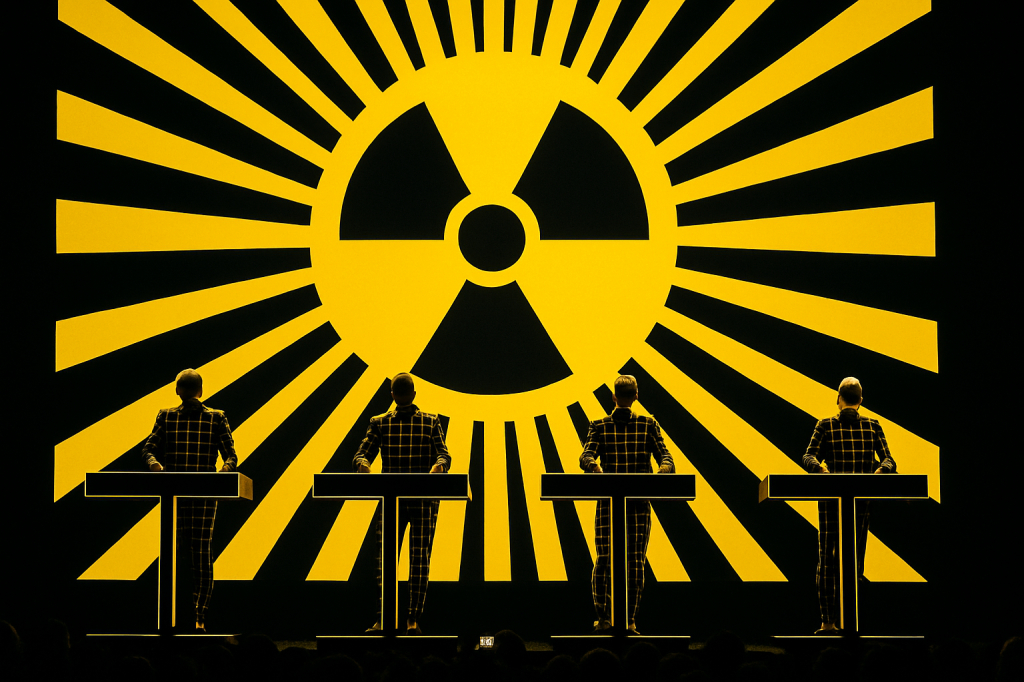
Turning 50 this month, Kraftwerk's single Radioactivity stands as a landmark recording that gradually evolved into the German electronic innovators’ most overtly political statement.
From the quivering opening moments of Radioactivity – the crackle of a Geiger counter, swelling synthesizers, and sharp Morse code tapping out the title – it is clear that something transformative is unfolding.
The centrepiece of Kraftwerk’s fifth studio album, Radio-Activity (1975), feels at once like a futuristic hymn and a subtle warning. Beneath its hypnotic rhythms and spectral Sprechgesang refrain – “Radioactivity / Is in the air for you and me” – lies an undercurrent of unease.
Across five decades, the song has continually reinvented itself, shifting from melancholic meditation to dancefloor anthem to urgent anti-nuclear protest, all while retaining its unmistakable identity. Now reissued to mark its half-century milestone, the album still hums with the band’s visionary energy.
Kraftwerk recorded Radio-Activity between stretches of international touring. The album expanded on the experimental pop minimalism and dry humour that had propelled Autobahn (1974) to global recognition, blending lyrics in English and German.
It was a record steeped in paradox: capturing both optimism about a dawning “information age” and anxiety shaped by Cold War tensions. It also introduced the group’s definitive four-piece formation – founders Ralf Hütter and Florian Schneider, alongside Karl Bartos and Wolfgang Flür – working from their Kling Klang studio in Düsseldorf.
Musically, they stepped fully into electronic terrain, leaving behind the folk and jazz elements of their early years. Schneider’s former flute and violin gave way to precise synthesizer textures, including the crisp Minimoog and the ghostly tones of the Vako Orchestron. Though concise – 12 tracks in under 38 minutes – the album creates a richly immersive world, balancing clinical precision with moments of awe.
Reflecting on the record years later, Hütter described it as a kind of science-fiction vision: a blend of beauty and menace. Built from tape edits and electronic experimentation, it incorporated more spoken and sung passages, forming what he once called “speech symphonies”.
Kraftwerk’s body of work resembles an intricate circuit board, connecting countless genres: hip-hop, electro, ambient, new wave, synth-pop, industrial, techno, and contemporary classical music. Radio-Activity exemplified their fusion of sound and visual identity. The artwork, created with long-time collaborator Emil Schult, reinforced the concept, while live performances grew increasingly elaborate. Flür later recalled using a light-sensitive percussion cage onstage that unpredictably malfunctioned. The album’s influence spread widely, sampled and reinterpreted by numerous artists across decades.
Major musicians have consistently acknowledged Kraftwerk’s impact, from David Bowie to Ryuichi Sakamoto and composer Max Richter. For many, encountering their music was a revelation that redefined what electronic sound could be and inspired new creative paths.
As technology gradually became more accessible, Kraftwerk’s innovations proved prophetic. For younger listeners discovering them through subsequent generations of artists, their music felt like stepping into the future by revisiting the past.
“Kraftwerk are one of the foundations of my creativity,” says musician and producer Martyn Ware, who co-founded The Human League and Heaven 17. “Many artists from my era simply wouldn’t exist in the same way without them.”
Ware recalls discovering the band as a teenager, before their sound had fully turned electronic. “What truly changed everything for me was Radio-Activity. It felt like conceptual art. It didn’t resemble anything else. There was bravery in it, but also gentleness – an intelligence that seemed to guide every detail.”
Growing up in Sheffield’s industrial landscape, Ware found that Kraftwerk’s sonic imagery resonated deeply. Their use of found sounds alongside electronics suggested a roadmap to the future.
By the early 1990s, Kraftwerk’s influence on club culture was undeniable. Their album The Mix (1991) revisited earlier tracks with updated production, including a dramatically transformed version of Radioactivity.
Where the original had referenced scientific discovery, the new rendition became a forceful anti-nuclear statement. Opening with a vocoder list of nuclear disasters and atomic tragedies, it replaced detached observation with urgent protest, adding lines that described contamination and chain reactions.
The song had become both a protest anthem and a dancefloor rallying cry. Kraftwerk performed this version at environmental benefit concerts and major festivals, where younger audiences encountered its charged new meaning.
In recent years, the revised Radioactivity has remained a highlight of Kraftwerk’s live shows. Though the group often maintains an enigmatic distance from overt politics, this track stands out as a direct and uncompromising statement against nuclear power.
For Ware, this evolution felt natural. “Artists reflect their times,” he says. “By the early ’90s they were different people, responding to a changed world. It made complete sense.”
The song’s message continues to resonate in an era marked by environmental crises and geopolitical instability. Following the Fukushima disaster in 2011, Kraftwerk once again updated the lyrics for performances in Japan, underscoring the work’s ongoing relevance.
Decades after its debut, Radioactivity persists in popular culture, appearing in film soundtracks and reinterpreted in diverse styles. From electronic remixes to unexpected acoustic adaptations, it continues to inspire artists across genres.
Musician and writer Nabihah Iqbal describes the album as a set of sonic experiments that pushed synthesizers into new territory. “Even now, you can trace how those ideas filtered into so many forms of music,” she says. “They created a blueprint.”
Kees Berkers of Dutch band Yin Yin agrees, noting how contemporary the track still sounds. With its piercing Morse code motif, restrained electro rhythms and resonant synth bass, it could easily pass for a modern production. “They completely changed the game,” he says.
Although today’s world feels vastly different from that of 1975, Radioactivity remains strikingly current. Ware observes that younger listeners no longer tie songs so closely to specific eras. Instead, they hear in Kraftwerk the origins of a digital language that now defines music created on laptops worldwide.
Radio-Activity is reissued on 15 May, as Kraftwerk continue their global tour.



