Inside Ukraine's phantom museums: war debris and traces of occupation take center stage
The local history museum in Izium, a town in eastern Ukraine, has endured severe hardship alongside its people since Russia’s large-scale invasion began.
Fierce battles over Izium in early 2022 left the 19th-century museum building damaged by two direct missile hits, destroying its roof and causing flooding. During the Russian occupation from March to September 2022, a Russian soldier stood guard at the entrance. However, the invading forces never removed the museum’s collection or located its rare 18th-century gospel book—one of only three in existence—which staff had carefully hidden away.
Now back under Ukrainian control, the museum still stands in a precarious position, dangerously close to the front lines and at constant risk. Although the roof has been mended, the windows remain without glass due to ongoing nightly missile strikes, according to director Halyna Ivanova.
Most of the collection has been securely relocated. The precious gospel volume, which once survived Nazi occupation during World War II, is being preserved after another period in hiding.
Presently, the museum functions more as a silent witness. Its exhibits are stored away, its doors shut to the public for safety reasons, and much of the town’s population—once 40,000—has dwindled by half.
Still, the museum team remains active, Ivanova explains. Employees now give guided walks of the city's damaged historical sites and organize small exhibitions in the building's surviving rooms. She jokes about their improvised appearance, calling it a “loft style,” open only to soldiers and invited guests.
“Our goal is to capture and preserve memories,” she says. “To remind people of how the city looked before the war, what it went through, and what remains today.”
The museum has begun showcasing art by local artists and photographs taken by soldiers. These works form the beginnings of a collection documenting the war through images, film, and audio.
One room is dedicated to notable local figures. Among them is children’s writer Volodymyr Vakulenko, who was murdered after burying his occupation-time diary under a cherry tree. Another tribute honors a firefighter who died delivering aid and was killed by a cluster bomb.
“That firefighter was my neighbor. I watched his life from beginning to end,” Ivanova recalls.
She is also curating a “museum of occupation,” collecting artifacts left by the occupying forces as evidence of their crimes and presence.
Some of those items are already on display: pieces of a cluster munition, uniforms and helmets from Russian troops and their allies from the Donetsk People’s Republic, as well as ration packs and cigarette boxes from the Soviet era.
Other displays include outdated crutches, old tourniquets, aid packages from a Russian tank manufacturer, schoolbooks presenting Russia as home and Moscow as the national capital, and fragments of a carved memorial to a Russian colonel—an indicator, Ivanova says, that they intended to stay permanently.
There are also examples of propaganda materials, along with a photo of a well-known Russian media figure flanked by local collaborators. “One fled to Russia, one’s on the police watchlist, and two women are now imprisoned,” Ivanova adds.
Among the display is a crude, wooden homemade medal given “for all this mess,” showing a touch of grim humor from the war's chaos.
Izium's museum isn’t alone in its struggles. Further south is the Sviatohirsk Lavra monastery, situated atop cliffs beside the Siverskyi Donets River in the Donetsk region.
Dating back to medieval times, this religious site hosts both Ukrainian Orthodox monks and nuns and a government-run museum. Despite the church formally breaking from Moscow in 2022, some believe the divide is not yet fully realized.
Parts of the monastery now house displaced individuals, some of whom have lived there since the earlier conflict started in 2014.
Yaroslava Diedova, deputy museum director, lost her boss and the director’s family to a missile strike as they attempted to flee. Four monks were also killed in a March 2022 attack, followed by the deaths of three construction workers in a later strike, according to monastery representative Fr Trofim.
The town of Sviatohirsk, located across the river, was seized by Russian troops in June 2022. They destroyed the bridge linking the town and monastery. When Ukrainian forces retook the area in September, Diedova had to walk 11 km daily across another bridge until a new one was constructed and a boat system set up.
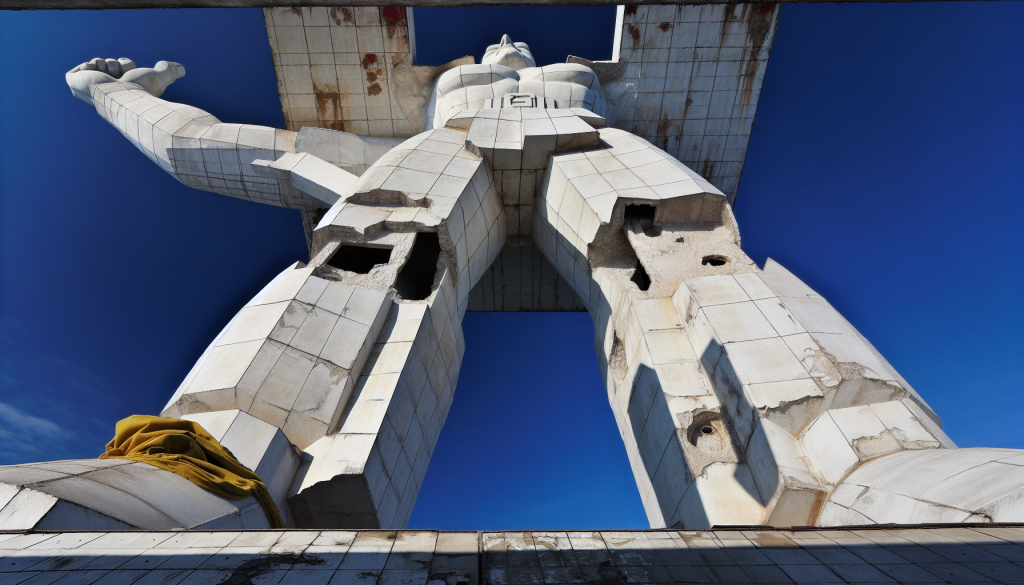
Nearby, a 22-meter statue known as Artyom, representing early Bolshevik leader Fyodor Sergeyev, stands on a hill. Heavily mined and used strategically during the conflict, the sculpture—damaged by shells—avoids removal due to its artistic status, being a work by Ukrainian sculptor Ivan Kavaleridze.
The museum's current mission includes running art workshops for displaced children and hosting military visitors. “It's important for the troops to see what they're defending,” says Diedova. Many used to visit as children, but now soldiers come from across Ukraine.
These visits often include spiritual reflection. “Some pray in the churches, others come to the museum afterward for tea and conversation. It's a way to ease the emotional load,” explains the new director, Ihor Saletskiy.
Unlike museums with portable collections, he says, theirs depends on permanent sites like the caves and churches. “That's why we're staying, working closely with the monastery.”
Back in Izium, signs of normal life persist despite the devastated surroundings. Public fountains flow, and high school graduates take pictures in formal wear near their damaged school.
“Life goes on as it did, except now we run to shelters when the missiles come,” Ivanova says. Compared to the hunger and fear during occupation, it's bearable.
“We know the Russians could return,” she admits. “If they do, it might be like Bakhmut—completely wiped out.”
The role of the museum, she believes, is to help preserve the essence of the city—if not physically, then in memory.