‘Lenin stood against humanity’: Why Kyiv plans to replace Soviet leader with a Cossack chief statue
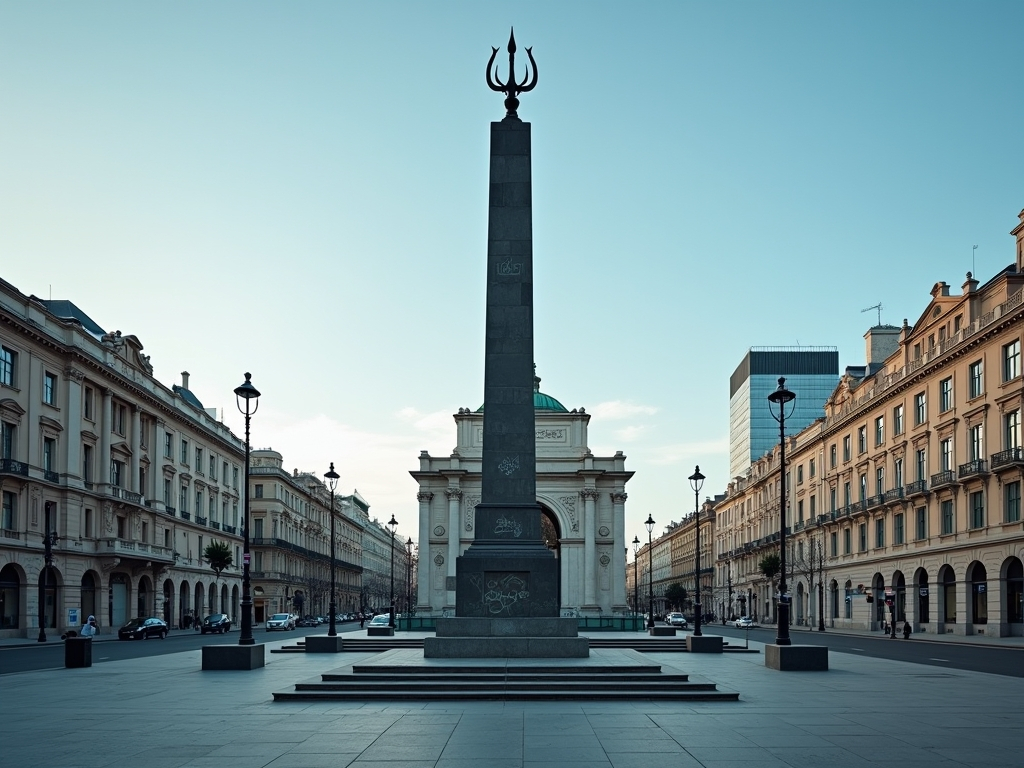
Since 2013, the pedestal at the foot of Taras Shevchenko Boulevard in Kyiv has stood conspicuously bare. The worn structure is streaked with white paint and graffiti. A Ukrainian trident has been fixed in the spot where Lenin once towered, looking out over the city during the decades of Soviet rule. During the Maidan revolution, protesters brought the statue down and shattered it with sledgehammers, marking a decisive break with the pro-Russian leadership of the time.
In June, President Volodymyr Zelenskyy suggested replacing Lenin with a new figure: Ivan Mazepa, the Cossack military and political leader who ultimately severed ties with Moscow in pursuit of Ukrainian autonomy. “Where Lenin fell, Mazepa will stand firm,” Zelenskyy declared beside a newly installed bust of Mazepa at the Pechersk Lavra, a historic Kyiv monastery recently damaged by Russian strikes.
The idea of exchanging Lenin for Mazepa has reignited discussion about public monuments and their role in shaping national identity. After independence in 1991, Ukraine dismantled many Soviet statues and renamed streets as part of a broader decommunisation effort. This process intensified following Russia’s annexation of Crimea in 2014 and the outbreak of war in the Donbas, accelerating further after the full-scale invasion in 2022.
Nataliia Kryvda, a cultural historian at Taras Shevchenko National University, believes Ukraine is still navigating an incomplete decolonisation. “The Soviet Union absorbed distinct national cultures in an attempt to create a single Soviet people,” she explained. “Today Russia claims Ukrainians and Russians are one nation. That is not the case. We have our own worldview, history, values and aspirations. Identity is constantly evolving.”
Standing beside the empty pedestal, Kryvda expressed support for honoring Mazepa there. “Why not? He is part of our story. Every culture marks its space through monuments. They make memory visible,” she said, while acknowledging that Mazepa was a complex and imperfect historical figure.
“For many years he cooperated politically with Russia, until the moment he made a dramatic turn that changed both his life and Ukraine’s history,” she added.
As hetman of the Cossack state, Mazepa tried to balance the competing pressures of Moscow and Warsaw. In 1708, when Tsar Peter the Great declined to defend Ukrainian lands from a Swedish invasion, Mazepa shifted allegiance and allied with King Charles XII of Sweden. The gamble ended in defeat, and later Soviet narratives branded Ukrainian patriots as “Mazepists,” equating them with betrayal.
“Mazepa envisioned a European future for Ukraine,” Kryvda said.
At the Lavra, Zelenskyy argued that Russia had long portrayed Mazepa as a traitor in order to distort Ukraine’s historical memory. According to him, this narrative sought to make Ukrainians see their past through a foreign lens rather than their own.
Writer and Crimean Tatar advocate Alim Aliev said the country is finally reclaiming its narrative. “We are restoring our own voices and names,” he said, pointing to the decision to feature poet and dissident Vasyl Stus on a new 2,000-hryvnia banknote. Stus, who championed Ukrainian cultural revival, died in a Soviet labor camp in 1985.
Aliev argued that Ukraine is now reassessing its past without outside intermediaries. In his view, it was appropriate that statues of the Russian poet Alexander Pushkin had been dismantled across the country. He criticized Pushkin’s portrayal of Crimea as reflecting an imperial gaze that exoticised Crimean Tatars. As for a monument to Mazepa, Aliev said he did not see it as divisive.
Recently, workers also removed a statue of the Russian-born writer Mikhail Bulgakov that had stood since 2007 on St Andrew’s Descent, near the house where he once lived. Kyiv’s city council approved the decision, and several commemorative plaques have already been taken down. The Bulgakov museum, located in his former home, continues to operate.
Liudmyla Habianuri, the museum’s director, said she did not oppose removing the statue and dismissed efforts to preserve it as unconvincing. She acknowledged that Bulgakov’s novel The White Guard, set amid the turmoil of 1918–19, depicted Ukrainian nationalist forces unfavorably. “He was a witness to a chaotic era and a satirist who spared no one,” she said, noting that his criticism extended to many groups.
According to Habianuri, Russia’s invasion has forced Ukrainians to confront fundamental questions about identity. “People are asking themselves who they are,” she said. “If I speak Russian and consume Russian culture while Russia wages war against us, can I continue as before? Many feel they must redefine themselves as Ukrainian as quickly as possible.”
She observed that this search for clarity has fueled activism, whether online or through direct action against monuments.
Bulgakov, she noted, has become a symbol in these debates. “Right now, everything is judged in simple terms—positive or negative. As a Russian writer who did not side with Ukrainian independence, he cannot easily be seen in a positive light.”
Although she described this moment as one of simplification, Habianuri supported the earlier toppling of Lenin’s statue, calling him “an enemy of humanity.” She characterized Mazepa as an exceptional figure who inspired works of European literature, but questioned whether the former Lenin pedestal was the right place to honor him, given the site’s troubled history during the second world war.
Unlike Lenin’s monument, the Bulgakov statue was carefully dismantled and returned to the family of sculptor Mykola Rapay. His daughter, Kateryna, stated that she had formally guaranteed it would remain outside public view. “This is not a personal decision,” she said. “I am responsible for ensuring its preservation.”
Meanwhile, visitors at the Pechersk Lavra stroll past the new bust of Mazepa, set before a fountain and shaded garden near the 11th-century Dormition Cathedral, once a burial place for prominent figures. Recently, a young boy photographed his father beside the monument.
A patron of the arts, Mazepa contributed funds to the cathedral’s baroque restoration centuries ago. In June, a Russian drone struck the building, igniting a fire that scorched religious images on its exterior, though many icons were saved.
One visitor, Olena Polishchuk, who has been living in the UK since the 2022 invasion, said she was pleased to see Mazepa commemorated. “He is well known and an important part of our past,” she said. “I’m glad he is being honored.”