
Americans crave connection. So why are European-style plazas so rare here?
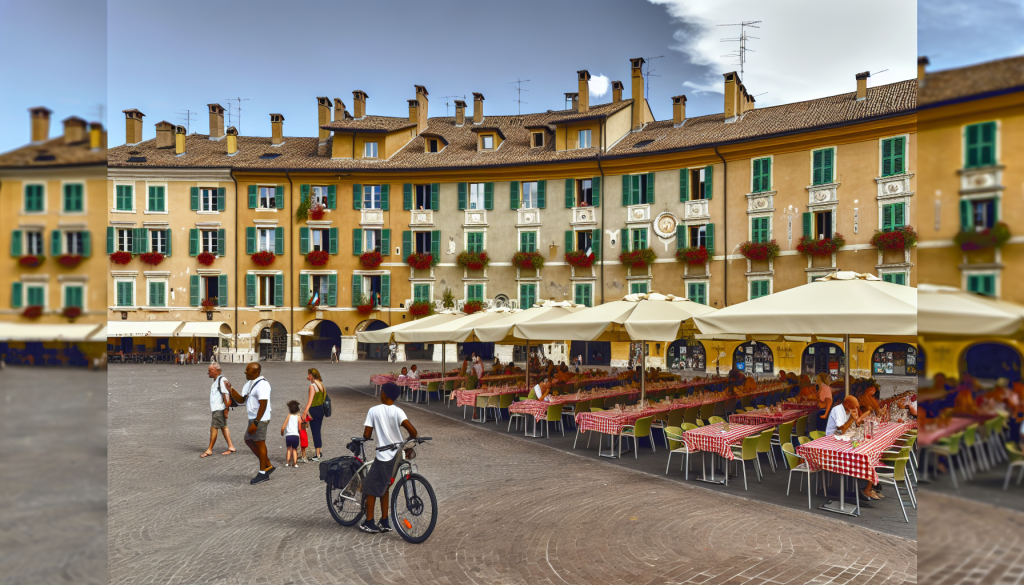
When Elizabeth Ruane and her family lived for a semester in Lüneburg, Germany, much of their daily life centered around the town’s main square, Marktplatz.
“There was this enormous community market in Marktplatz where everything you needed was available,” she recalled. “It served as a central spot where everyone gathered. You’d simply say, ‘Let’s meet at the market.’ It created a sense of unity that’s often hard to find in the U.S.”
It was a far cry from ordering groceries online for home delivery, said Ruane, a mother of two from Olympia, Washington.
Jessica Ketcham found a similar charm in Place Bellecour when she spent time teaching in Lyon, France.
“There was this beautiful cathedral on a hill above the city,” said Ketcham, a writing professor. “It offered a stunning view despite being right in the heart of the urban center.”
She noted that the square always featured some kind of activity, from fire performances to public book readings.
Europe is full of such vibrant public spaces, and alongside their fondness for European cuisine, many Americans are increasingly drawn to the allure of piazzas and plazas across the globe.
But upon returning home, some travelers feel a sense of disappointment in the lack of similar communal spaces in American cities.
Lily Bennett, a student who studied with Ketcham in Lyon in 2024, experienced the city’s main square deeply and found reentry to American life unsettling.
“The reverse culture shock was stronger than my initial shock in arriving in Lyon,” said Bennett, 18. “After being reunited with my family and dog, the isolation of American city life quickly hit me.”
In Lyon, her mornings included a casual stop for breakfast and often exchanged greetings with numerous people.
That spontaneous, lively start to her day now feels distant.
“Now, I just get in my car, drive, and barely interact with anyone,” said the University of Washington student. “It felt lonely when I came back.”
Bringing vacation lifestyles home
With international travel now common among more Americans, many have witnessed the benefits of having a prominent, walkable gathering space at the heart of a city or town.
Yet, despite some cities having European influences, most lack central areas where people can easily walk, shop, and socialize.
As a 2024 report from The Economist pointed out, North America is not known for pedestrian-friendly cities. While over half of Americans desire this lifestyle, car dependency remains dominant and only a small fraction of workers commute on foot.
The most walkable cities in the study, all found in Europe, Africa, and Asia, included Quelimane in Mozambique, Peja in Kosovo, and Utrecht in the Netherlands.
While high-speed rail has made limited progress in the U.S., many American cities remain driven by freeway systems, and public transportation often lacks investment.
European plazas, by contrast, are built for people to walk to and through freely.
“These places were intentionally designed for people first, not cars,” said architect Daniel Parolek of Opticos Design, a firm focused on walkable communities.
He explained that many European cities also feature linked streets that connect one public square to another.
“Any older European city—whether in Italy, Germany, or Spain—includes a network of narrow, human-scaled streets,” he said.
Even with limited built environments supporting it, Parolek noted that there's growing appeal among Americans for walkable neighborhoods. However, less than 8 percent of U.S. infrastructure supports this, according to Smart Growth America.
Squares and lost opportunities
Some older American cities do feature public squares. Savannah, Georgia, for example, has preserved nearly two dozen walkable squares since its founding in 1733.
Charleston, South Carolina, Santa Fe, New Mexico, and St. Augustine, Florida, are other notable cities with walkable central areas.
These town squares reflect a mix of early American planning and Spanish colonial urban design practices, said Ellen Dunham-Jones, director of the Urban Design Program at Georgia Tech.
Cities like New York and Philadelphia also contain prominent squares such as Union Square and Rittenhouse Square, often tied to their founders’ visions for orderly, communal city planning.
Still, in most American cities and towns, outdoor communal spaces are either minimal or underutilized. In some areas, they are primarily used by homeless individuals, which can hinder broader community gatherings.
Even well-known spaces like Times Square, while more pedestrian-accessible than before, remain crowded with cars during most of the year.
Dunham-Jones noted that during the 1960s, developers in cities like Atlanta and New York were required to add small plazas to their skyscrapers. These rarely became true community spaces, often serving only lunchtime crowds.
Urban designers refer to these lackluster civic zones as “blah-zas.”
While such voids may be less noticeable in dense cities with active street life, they represent a missed opportunity elsewhere.
In cities that still feature active main streets, people do gather, albeit briefly or primarily for shopping.
“It tends to be a straight-line experience versus a space where people linger,” said Parolek.
This contrasts with vibrant European or Asian plazas where simply spending time doesn't cost anything.
Ketcham, recalling her time in Lyon, viewed the central square as a welcoming environment where no purchase was needed to belong or feel at home.
Public parks in American cities provide some alternatives. New York's Bryant Park is an example of a space with lively communal events, though these parks lack the street integration and open layout found in piazzas abroad.
How cars shaped America
Throughout much of the 20th century, American cities prioritized freeway construction, slicing through urban centers and deepening car dependence.
In contrast, European cities, founded long before automobiles, preserved their pedestrian-friendly layouts and resisted redesigns that would accommodate wide roads and highways.
Fuel prices also help explain the European reliance on transit. In Europe, gas costs more due to lower subsidies, and cities often integrate rail and tram systems directly into urban squares and commercial zones.
The importance of having a central public meeting place isn't new. It dates back to ancient Greek forums like the agora, and Roman towns were required to center around public squares, said Dunham-Jones.
“Italian and Spanish cities show this Roman heritage clearly,” she noted.
Cities like Santa Fe and St. Augustine still preserve their town squares because of their origins under Spanish rule, not American planning.
However, it wasn’t just historical legacy that created this divide. After World War II, the U.S. made deliberate choices to move away from European models in favor of suburban development and the promise of the “American Dream.”
“During postwar prosperity, having a yard and a car came to represent success,” said Dunham-Jones.
Billions were funneled into building highways, while countries abroad invested in fast rail systems. Even with new American high-speed trains being introduced, outdated infrastructure hampers their true potential.
Further suburban spread followed, often requiring new developments to provide on-site parking, embedding car culture even deeper.
Atlanta's Darin Givens witnessed the beauty of communal life firsthand during a visit to Brussels. He described the Grand Place as “magical,” illuminated by soft lights and filled with people.
Back home in Atlanta, he’s reminded of what’s missing: fast-moving cars and a lack of large communal squares.
“There’s nothing like that within walking distance here,” he said. “The street in front of my home is busy and not pedestrian-friendly.”
Making room for shared spaces
As people yearn for connection in today’s digitally-fragmented world, many are seeking a greater sense of belonging found in communal city spaces abroad.
“I met so many friendly people willing to talk in open squares,” Ketcham said of her time in France.
But forming such ties is harder in America today, where a growing share of households are made up of just one or two people. The U.S. Census reports that nearly a third of all households now consist of a single person.
Some developers are taking note, creating walkable residential spaces designed around community squares.
One example is Culdesac Tempe in Arizona, a unique development by Parolek’s firm, designed with no car traffic and located next to a light rail station.
The development, completed in 2023, includes more than 20 local businesses set around 50 small community courtyards. These spaces offer social and commercial engagement, from ping pong tables to open-air markets.
Parolek drew inspiration from charming towns in Italy like Pienza and Lucca when designing the 16-acre development.
However, replicating Culdesac nationally is challenging. Few places offer transit access like light rail, and the car-free setup depends on services like Waymo’s driverless vehicles to fill transportation gaps.
“Living without a car in most places is still unusual outside of areas like Manhattan,” said Dunham-Jones.
Still, Culdesac CEO Ryan Johnson believes the demand will grow.
“Every generation now values walkability more,” he said. “It’s a powerful trend.”
Other developments have already responded to similar desires. Efforts like the Beltline in Atlanta and the High Line in Manhattan offer new uses for old rail routes, bringing people out to walk and socialize.
These projects are celebrated for revitalizing nearby neighborhoods and attracting residential developments—but they don’t quite offer the wide-open spaces of European piazzas.
Givens pointed out that spots like the Beltline are often too narrow and crowded to invite people to stop and relax.
“You're always on the move,” he said. “If you slow down and linger, people look at you strangely.”
What lies ahead?
Can America one day become a land filled with piazzas and vibrant public squares? It won’t happen quickly.
While interest in walkable communities is growing, creating such spaces requires extensive resources—including land purchases and land-use changes—that make it a complicated endeavor.
Even more challenging is the need to develop connected spaces and transit options that mirror networks in Europe or Asia.
For those who’ve experienced squares abroad, their view of ideal city life has changed. Many now seek to hold onto pieces of the social, walkable culture they encountered.
Ketcham, inspired by her time in Lyon, decided to walk to and from work—seven miles each way—near Seattle. A year later, she’s still doing it.
“It’s changed how I experience my day-to-day life,” she said.
For others like Bennett, who are still planning their futures, the appeal of a car-focused life has greatly diminished.
“In every European city I visited, I found a square where I could sit and write in my journal,” she said. “To feel truly fulfilled, I need spaces like that to exist.”
Could the growing desire for connectedness and ease of travel shift American city planning?
Parolek thinks so. “Travel teaches people what’s possible,” he said.
America may lack a cultural tradition like Italy’s nightly passeggiata—the daily evening stroll—but Parolek believes people respond when the chance exists.
“When given the opportunity,” he said, “Americans tend to embrace it.”



