Margot Robbie dons scarlet latex, Kate Bush lookalikes, and a glass of Emily brew: my whirlwind dive into Brontë fever
On a crisp afternoon in Haworth, West Yorkshire, I find myself sipping an Emily Brontë amber ale at The Kings Arms pub. This isn't just any beer – it's a homage to the legendary writer and part of a themed selection featuring other Brontë siblings, including Anne (a classic ale), Charlotte (an IPA), and Branwell (a porter). The bartender tells me Emily's version, with its malty biscuit notes, is the favorite – fitting, as Emerald Fennell, the Oscar-winning director, is speaking later today at a nearby literary festival about her upcoming film based on Emily's “Wuthering Heights.”
The movie, set for a pre-Valentine’s Day release, has already raised eyebrows. That started with the bold casting choices – Jacob Elordi and Margot Robbie – followed by a provocative trailer full of sensual imagery and dramatic flair. But the most controversial element? A scene involving a public execution and a nun with disturbingly graphic detail. It’s clear that this adaptation won’t shy away from exploring the story’s raw intensity.
The newly released full trailer showcases Fennell’s unique style: a blend of historical and avant-garde elements, bold set designs, and tantalizing glimpses of the characters’ passionate entanglements. Elordi, wielding a surprisingly authentic Yorkshire accent, declares: “So kiss me – and let us both be damned!” The reaction to all this drama is hardly surprising – the spirit of “Wuthering Heights” still pulses through the landscape of Haworth.
As I finish my drink and walk through the village's cobbled paths, the presence of the Brontës feels almost tangible. “Some mornings, I imagine they’re just around the corner, chatting away,” says Diane Park, owner of Wave of Nostalgia, a feminist bookshop steeped in Brontë heritage. Her shop, located on a charming hill lined with stone cottages, sits moments from where the Brontë family lived, behind the church where their father was reverend, and next to the graveyard that inspired so many of their stories.
Park tells me that she only read “Jane Eyre” before moving to Haworth years ago. Today, she reads aloud one of Emily’s poems from behind the counter with reverence: “‘Hope, whose whisper would have given / Balm to all my frenzied pain …’” What first struck her about “Wuthering Heights”? “Emily could see into the soul. It was astonishing.”
When Emily secretly published the novel in 1847 under a male pseudonym, it startled readers with its unflinching themes. The story of the tempestuous Catherine and the mysterious Heathcliff unfolds across the wild moors: “He’s more myself than I am,” Catherine famously proclaims. Their broken love, followed by vengeance and haunting consequences, was seen by many as disturbing, even grotesque.
Despite its initial shock factor, the novel became a timeless classic. As early as 1920, it was turned into a silent film shot locally in Haworth. Later, Hollywood took over, with Laurence Olivier and Merle Oberon starring in a romanticized version. Over time, at least 15 screen adaptations have been created, from Japanese reimaginings to a 2011 version featuring the first Black Heathcliff, James Howson. Jacob Elordi’s recent casting, while controversial, follows this long tradition of reinterpreting Heathcliff’s identity.
Kate Bush’s ethereal hit song, inspired by a 1967 BBC adaptation, even introduced “Wuthering Heights” to a broader culture. She saw only moments of the show – a ghostly hand at a window – but the image was enough to inspire a haunting anthem that would captivate generations.
So what is it about this bleak love story on desolate moors that continues to resonate? Author Juno Dawson, who contributed to a “Wuthering Heights”–themed anthology, believes that its complex characters defy conventional labels. “Their relationships don’t fit tidy categories,” she says. “Each personality is maddening and mysterious. That kind of emotional ambiguity can be more satisfying than closure.”
I make my way toward the parsonage where the Brontës lived, sharing the route with other visitors – mostly women, many of whom I later see at Fennell’s talk. “Haworth has always drawn pilgrims,” says Rebecca Yorke, director of the Brontë Society and Parsonage Museum, founded in 1928. “Many visitors come from all over the world – from the US, Japan, Australia, and beyond.” Famous fans throughout history have left their signatures here – Sylvia Plath and Patti Smith among them.
This visit marks the third time I’ve come to the parsonage with my mother – something about it keeps us returning. Today we learn that back in the Brontës’ time, the house overlooked a graveyard directly, with no shielding trees. The family home was caught between views of death and the open moors. Downstairs is where their creativity flourished – the table where they wrote still bears an engraved “E.” In one corner sits the couch where Emily died, likely of tuberculosis at just 30 years old. In those days, life expectancy in Haworth was only about 24 – a chilling fact linked to wastewater from the graveyard mixing into the town’s water supply.
“Emily remains an enigma,” says Yorke. “We don’t know as much about her as we do Charlotte. And yet, she crafted one of literature’s most enduring novels.” Charlotte even rewrote parts of her sister’s biography after her death, further intensifying the mystery that surrounds Emily’s life and spirit.
The Brontë siblings themselves have become the focus of countless dramatizations – from TV miniseries to imaginative biopics. In 2022, “Emily,” a creative retelling starring Emma Mackey, added to the lore with a romantic subplot involving a local curate. Such portrayals continue to draw curious tourists to Haworth year after year.
Signs of Brontë mania pepper the village, with cafes and record shops nodding to the family in clever ways. Park notes that artists and authors regularly settle or visit for inspiration. “There’s creativity in the air,” she says. Even installations in nearby Penistone Hill Country Park reflect Emily’s influence, merging nature and art as part of the city’s cultural celebration. “It’s like Emily is in the wind and the moorland. Her essence is still here.”
The Brontë legacy isn’t only preserved through tourism. Initiatives like the “Wandering Imaginations” project bring the siblings’ stories to life in new ways. This collaboration between writers in Bradford and Ghana explores the imaginary African kingdom of Angria, created by the Brontës in childhood. “We’re here for local people too,” says Yorke, citing a new building the Brontë Society acquired to create more community-based programming that connects residents to their heritage.
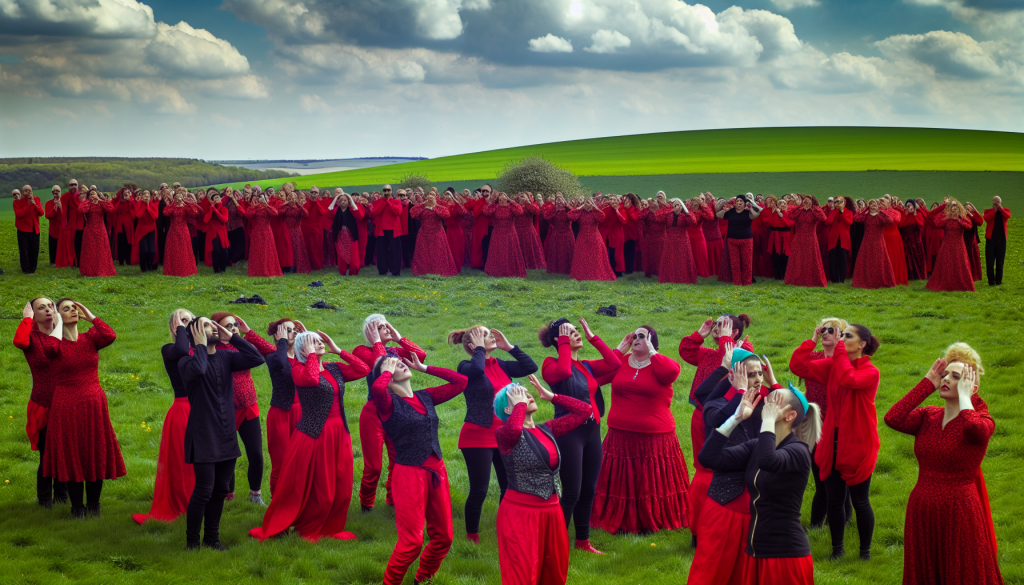
The ultimate celebration might be the annual Most Wuthering Heights Day Ever on 27 July, where people in red dresses gather across the UK to sing and dance to Kate Bush’s song. In Haworth, the event also serves as a platform for activism, like protesting developments near Top Withens – a site long linked to the novel’s iconic setting.
Still, this dramatic countryside attracts more than readers. Hikers and athletes love the rugged trails; cycling events like the Tour de Yorkshire have become part of local lore. A forest path behind the parsonage leads to a waterfall said to be a favorite spot for the sisters. It’s easy to see why – being out here imparts the same untamed freedom Emily once felt. “These moors pull at you,” says Park, “like they pulled at Cathy.”
That evening, I join a full crowd at the local church for Fennell’s talk. A visitor from New York tells me she’s staying the entire weekend for the festival, which includes creative sessions on the moors. Fennell steps out wearing a T-shirt emblazoned with “The Brontë Sisters” in a gothic font – like a rock band logo.
She recalls reading “Wuthering Heights” at 14 and feeling deeply affected. That raw, emotional reaction is what she sought to capture in her film. What stands out most is her admission that the book’s meaning changed for her over time. After rereading it recently, she questioned why she once thought it romantic at all.
“As a teen, you think: ‘This is passion!’” says Yorke. “But later, you realize the relationship is actually toxic.” Fennell puts it more bluntly: “It’s absolutely mad.”
To reflect her own response, Fennell focused on the first part of the book, the love story, omitting its darker second half. While some might see this as a missed chance to delve into Heathcliff’s complexity, it highlights the novel’s contentious themes – including its connection to slavery and race, as Heathcliff arrives in the story from Liverpool without origin. Still, this version is Fennell’s vision, shaped by personal interpretation. “I can’t please everyone,” she says simply. “No one agrees on what this story should be.”
As I return to my car and night cloaks the village, I remember something Park told me earlier: “Emily’s poetry pierces the soul. It makes me feel truly alive.” That lingering emotion is what continues to draw people to Haworth and will no doubt bring them back when Fennell’s film hits screens.
“Wuthering Heights” is scheduled for release on 13 February.