Scientists sequence DNA from 3,600-year-old cheese
Subscribe to CNN’s Wonder Theory science newsletter to dive into the cosmos and stay updated with remarkable breakthroughs, scientific progress and much more.
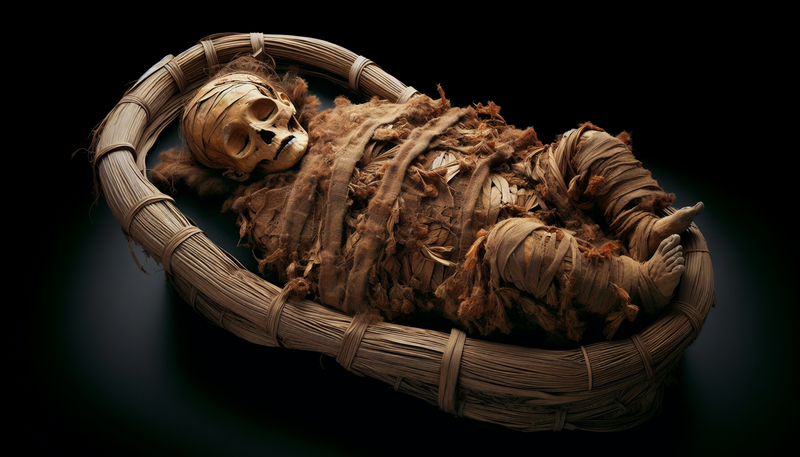
In northwest China, mummified remains from the Bronze Age have revealed a curious burial practice: desert dwellers were interred with cheese carefully placed on their heads and necks—perhaps as sustenance for the afterlife.
Over a decade after this dairy discovery emerged from the Taklamakan Desert's dry grasp, researchers have successfully extracted and sequenced DNA from the 3,600-year-old cheese, claiming it to be the oldest specimen of its kind in the archaeological record.
This detailed analysis sheds light on how the Xiaohe people made cheese, illustrating how humans utilized microbes to enhance their food. It also demonstrates how microbial signatures can trace cultural exchanges over time.
The research, published on Wednesday in the journal Cell, marks a “new chapter in ancient DNA studies,” revealing techniques that were unimaginable a mere ten years ago, said Christina Warinner, a Harvard anthropologist who wasn't directly involved in the study.
“Today’s fermented foods are mainly produced with a few laboratory-cultivated strains of bacteria and yeast,” Warinner explained.
“We know very little about the diverse heirloom microbes that ancient people relied on to create iconic foods—whether it’s bread, cheese, beer, or wine.”
A study led by Chinese paleogeneticist Qiaomei Fu uncovered DNA from goats and cattle in these ancient cheese samples. The team also sequenced microbial DNA, confirming the cheese was of the kefir variety, a type still enjoyed today. Fu directs the ancient DNA lab at Beijing’s Institute of Vertebrate Paleontology and Paleoanthropology.
Unraveling how the desert people made kefir
Hundreds of mummified remains unearthed in the 1990s from the Xiaohe cemetery in China’s unforgiving Tarim Basin have captivated archaeologists. Remarkably preserved by the desert’s arid climate, these individuals—dating back nearly 4,000 years—still have distinctly visible facial features and hair color.
Clad in felt and woven textiles, they were buried in boat-shaped graves, and their blended cultural traits have long intrigued researchers. Despite being a genetically isolated group, recent studies from October 2021 show how the Xiaohe people adopted outside technologies and customs.
The latest research suggests that the Xiaohe population made kefir without mixing different milk sources—a practice common in the Middle East and Greece—though the reasons for this remain unclear.
Related article: Ancient DNA reveals secrets of an empire that spurred the construction of China’s Great Wall.
“The Xiaohe people likely made cheese much like modern-day kefir producers, by using kefir grains passed down among family, friends, and communities—akin to kombucha starters or bread yeast cultures,” said Taylor Hermes, an anthropology professor at the University of Arkansas, who didn’t participate in the research.
“This study is significant because it showcases how these microbial cultures spread throughout Asia,” Hermes noted.
Traces of probiotic bacteria's evolution
Fu’s team uncovered bacterial and fungal species in the cheese samples, including Lactobacillus kefiranofaciens and Pichia kudriavzevii, both of which remain essential ingredients in present-day kefir grains. These grains combine beneficial bacteria and yeast that ferment milk into cheese.
The researchers also sequenced bacterial genes from the ancient kefir to reveal just how these probiotics evolved over the last 3,600 years.
Modern kefir-making employs two major strains of Lactobacillus: one originating from Russian territories, the other from Tibet. The latter strain, which is less common globally, showed a close relation to the bacterial strain in the ancient cheese.
Related article: Ancient DNA decodes mysteries surrounding a 6th-century Chinese emperor.
This discovery casts doubt on the theory that kefir production was limited to the Caucasus Mountains, Fu explained.
“This is a remarkable study, offering a glimpse into 3,000 years of bacterial evolution. Through dairy products, we’re gaining unparalleled insights into ancient human habits and environmental interactions,” Fu mentioned in a statement. “This is just the beginning.”
The mere fact that the cheese had not only survived but still contained DNA to be sequenced was extraordinary, said Hermes. “Ancient DNA studies, particularly with microbes, are fraught with difficulties due to contamination from modern-day bacteria,” he added.
When did humans first start making cheese?
The discovery that the Xiaohe people fermented cheese didn’t surprise Warinner. Fermentation breaks down milk, making it easier to digest as bacteria produce lactic acid, causing milk to thicken and form cheese.
“Without refrigeration, storing fresh milk longer than a few hours is next to impossible. Naturally occurring fermentation likely began soon after dairying itself, with souring taking over quickly,” she said.
“Over time, humans progressively mastered the fermentation process, selecting microbes that best fit their needs for dairy production,” she added.
While the cheese found in these desert graves represents the oldest intact cheese ever discovered, protein traces in human dental remains and pottery residues hint that cheesemaking could go back over 9,000 years, with origins likely rooted in Anatolia or the Levant, Warinner emphasized.
Genomic research like the one in this study is a major leap forward, said William Taylor, an anthropologist at the University of Colorado Boulder and curator at the university’s Museum of Natural History.
“It’s fascinating to see how sophisticated these ancient products were, especially since they don’t usually survive in the archaeological record,” remarked Taylor, who wasn’t part of the study.
“Such revelations highlight how foundational cheese and other dairy products were to ancient cultures—a legacy that continues strongly today and will likely persist for many more millennia.”