AP PHOTOS: ‘We have no place left.’ In Ghana, surging tides and strong waves wash away homes
AGAVEDZI, Ghana (AP) — The shoreline of this seaside town in Ghana is being steadily consumed by the ocean. Violent tides gnaw away at Agavedzi, toppling homes, claiming land, and even threatening gravesites where families have buried their loved ones for generations.
Residents say climate change is fueling these harsher tidal patterns and sea level rise, drastically shifting the coastline inward. They’ve repeatedly appealed to the government for protective sea walls — so far without success.
• Facebook
• Copy Link
• Print
• Email
• X
• LinkedIn
• Bluesky
• Flipboard
• Pinterest
• Reddit
Just weeks ago, another devastating tide surge wiped out 51 additional homes, displacing around 300 people in Agavedzi and neighboring areas, according to local authorities.
Below are some personal accounts from those affected.
Afeli Bernice Adzo, 23

Afeli Bernice Adzo stands at the ruins of her family’s 10-unit house in Avegadzi, Ghana, on March 5, 2025. (AP Photo/Misper Apawu)
For Afeli Bernice Adzo, the crashing waves were once a haunting background to her evenings. Some days, the sea would lash against their walls. Sometimes it went quiet — for days or years — only to return with fury.
The last time it came, it didn’t stop. It crushed the very walls her family had lived within for years. The house where her grandparents raised generations is now rubble, bits of concrete scattered on the beach. Her family now rests uneasily at a local fuel station, knowing they could be asked to leave with no notice.

The tide now creeps to where Adzo’s family home once stood, eroded away piece by piece. (AP Photo/Misper Apawu)
“It’s heartbreaking,” said Adzo, who works during the day but struggles to cope. “I’m constantly worried something terrible will happen to my parents.” Her younger sister, just nine years old, often refuses to attend school. More than 100 buried bodies had to be retrieved from the nearby cemetery and moved to new graves.
“As a child, none of us thought the sea would make it this far,” she said in disbelief.

Adzo plays with her dog, Nuworza, by what’s left of her home. (AP Photo/Misper Apawu)
Dennis Dostey Dorve, 28

Dennis Dostey Dorve, a driver and part-time fisherman, stands by fallen sections of his father’s house. (AP Photo/Misper Apawu)
According to Dennis Dostey Dorve, erosion began its quiet takeover of Agavedzi over a decade ago. His father's home — built from years of fishing — couldn’t withstand the force. It crumbled in 2016 while Dorve was inside.
“The room I had, the one my late father used — the sea has taken it all,” he recalled. “Growing up, this area was far from the shore.”

Dorve stands near a sculpted piece of wall that once was part of his father’s room. (AP Photo/Misper Apawu)
He added that while sea defense structures have gone up in surrounding towns, Agavedzi remains exposed. “We’ve cried out to the government repeatedly. Nothing has changed,” he said.
“I still can’t accept it — that the sea has reached this point,” Dorve said, staring out over the water now lapping at his doorstep.
Makafui Atayi, 43

Makafui Atayi stands near the entryway of the once-sprawling family compound now reduced to rubble. (AP Photo/Misper Apawu)
Sometimes, the waves pound so violently that walls tremble and families, like Makafui Atayi's, are forced to sleep outdoors. Late into the night, it's common to see people walking, unable to return to their trembling homes.
The home her father first built succumbed in 2019. The family gathered in the older, inherited house — over 80 years old — which is now barely standing.

Adzo (left) and her aunt Atayi continue working in a hair salon set to be claimed by the sea. (AP Photo/Misper Apawu)
“It housed 25 people at one time. Now, two rooms remain and 11 of us are wedged in,” Atayi said. She also runs a hair salon on the premises, but the business is nearing its end. “If the sea takes this, we lose everything,” she said.
Atsu Godslove Afeli, 52

Atsu Godslove Afeli poses inside the collapsed family home where he once lived with his children. (AP Photo/Misper Apawu)
It started slowly — cracks creeping across walls, water surging closer. Then, just a month ago, the final blow came. What remained of Afeli’s home flattened before his eyes.
Today, he sleeps with his kids and his brother behind a nearby fuel station, the remnants of his former home a short walk away.
“We thought we were far enough,” he said. “The sea was a distant force — not a threat.” But recent months brought waves he couldn’t ignore. With their home gone, he can only hope someone listens.

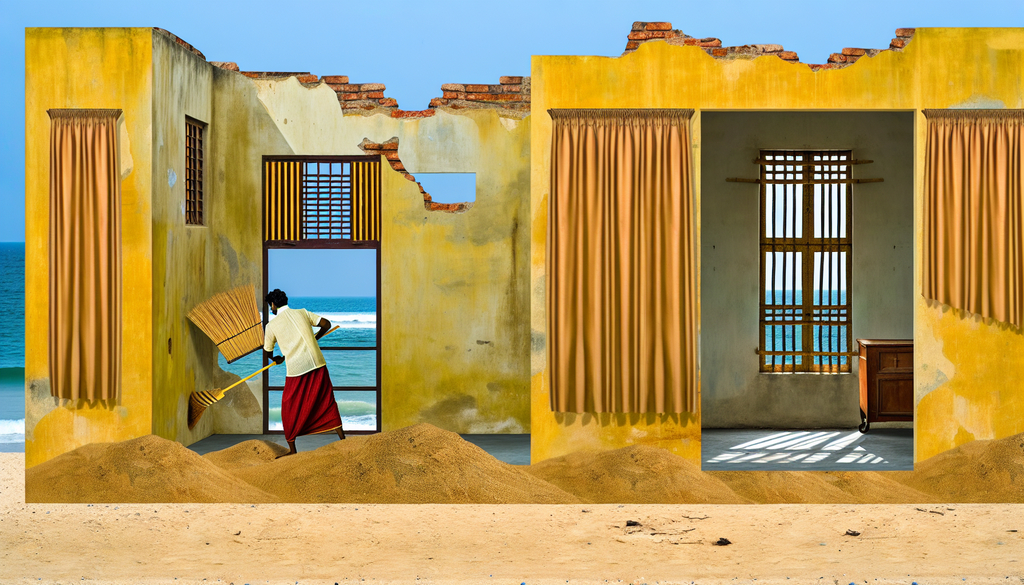
Through an empty window frame, the sea that swallowed Afeli’s home is still visible. (AP Photo/Misper Apawu)
“We need protective barriers to stop this. If not, we’ll never rebuild. We can’t do this alone.”
___
This story includes reporting by Tammy Webber of the Associated Press.
___
The Associated Press receives financial support for climate and environmental coverage from independent foundations. AP maintains full editorial independence. More information and a list of funders can be found at AP.org.