Two galaxies caught in a 'duel' before a colossal cosmic collision
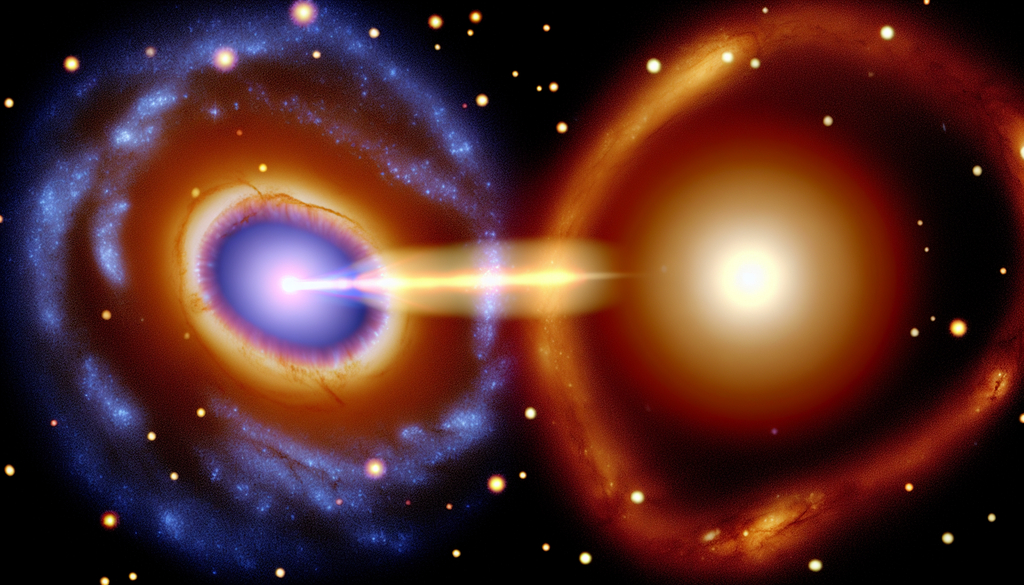
WASHINGTON, May 21 (Reuters) – Scientists have captured an extraordinary cosmic encounter between two ancient galaxies on a collision course, each boasting a star population comparable to the Milky Way. This stellar clash, which occurred when the universe was just 20% of its current age, evoked imagery of two knights meeting head-on in a medieval joust.
The galaxies were observed as they appeared approximately 11.4 billion years ago—around 2.4 billion years after the Big Bang—using two powerful telescopes positioned in Chile.
One of the galaxies contains a quasar at its core—a brilliantly bright phenomenon generated by gas and cosmic material spiraling into a supermassive black hole. Radiation emitted across the electromagnetic spectrum from this quasar was seen affecting its partner galaxy, particularly by disturbing massive clouds of gas and dust known as molecular clouds.
Molecular clouds serve as the prime material for star birth. But in this instance, the quasar’s intense energy transformed the clouds into “small, dense pockets that can no longer generate stars,” said Sergei Balashev, astrophysicist at the Ioffe Institute in Saint Petersburg, Russia, and co-lead author of the study released Wednesday in the journal Nature.
This is the first documented observation of this kind, according to Balashev.
Normally, stars form as gravity causes molecular clouds to gradually contract, with small dense areas heating up into blazing new stars. However, in the galaxy exposed to the quasar’s radiation, such star-forming regions became far rarer, significantly lowering the rate of new star formation.
The vivid interaction sparked by this galactic duo reminded researchers of an old-world joust.
“Just as knights charge toward each other, these galaxies are hurtling at full speed. The galaxy hosting the quasar unleashes a beam of energy that cuts through the opposing galaxy like a lance. This radiation ‘injures’ the other by disturbing its gaseous content,” explained Pasquier Noterdaeme, an astronomer at the Paris Institute of Astrophysics and co-lead author of the study.
Supermassive black holes, like the one powering this quasar, are commonly found at the center of galaxies, including our own. The team calculated its mass to be about 200 million times greater than that of our sun.
Such black holes exert enormous gravitational force, dragging in gas and cosmic debris. This material spirals inward, creating friction and heat that form a glowing disk. The energy is released as twin beams of powerful radiation extending in opposite directions—biconical in shape.
One of these ultraviolet beams is responsible for the dramatic effects observed in the companion galaxy.
For comparison, the black hole at the Milky Way’s center—called Sagittarius A*, or Sgr A*—is about 4 million solar masses and situated 26,000 light-years from Earth. A light-year equals 5.9 trillion miles (9.5 trillion kilometers).
To examine this distant pair, scientists employed the Atacama Large Millimeter/submillimeter Array (ALMA) to study the galaxies themselves, and the European Southern Observatory’s Very Large Telescope (VLT) to analyze the quasar and its impact on its galactic companion.
From Earth’s vantage point, researchers were uniquely positioned to observe the quasar’s radiation coursing directly through the neighboring galaxy.
Most known galaxy collisions have taken place later in the universe’s history, making this an exceptional discovery.
“Galaxies usually reside in clusters, and over time, gravitational interactions lead to mergers,” Noterdaeme noted. “Based on our understanding, these two galaxies will eventually fuse into a single, larger entity. As the quasar runs out of material to consume, its brightness will diminish.”