
Researchers Reveal the Reason Behind Mars’ Red Color
Subscribe to CNN’s Wonder Theory science newsletter to journey through the cosmos with updates on discoveries, breakthroughs, and more from the scientific world.
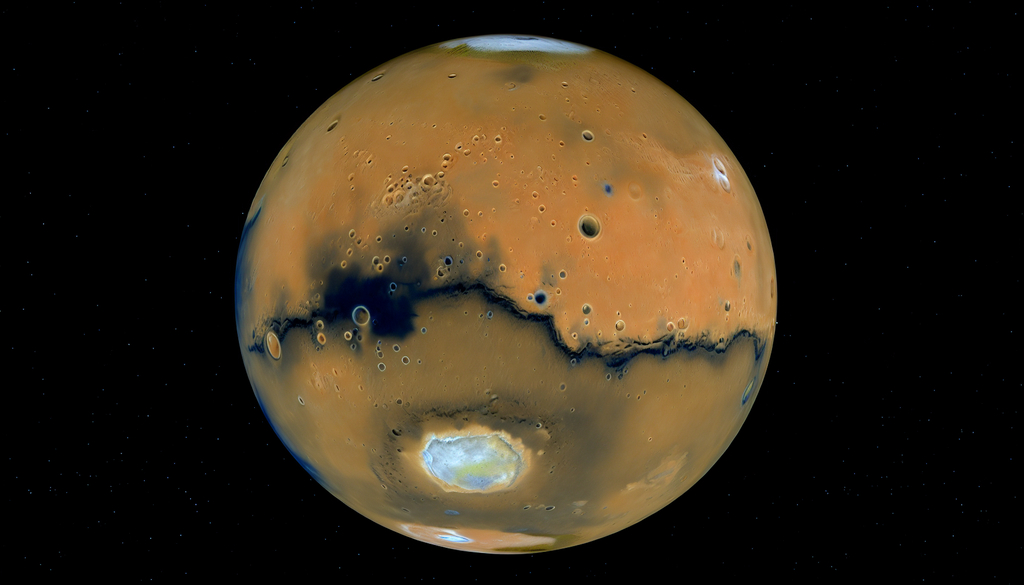
Often recognized by its reddish appearance, Mars has long been known as the Red Planet. Now, new research may have identified the true cause behind that signature shade—challenging a long-held scientific assumption.
Mars has been one of the most thoroughly observed planets thanks to its relative proximity and decades of robotic missions. Data gathered from orbiters and landers has previously pointed to rust-colored iron minerals found in the Martian dust as the source of its red tint.
The theory suggests that iron in Martian rocks reacted with water or possibly atmospheric oxygen, forming iron oxide, akin to rust on Earth. Over millions of years, this substance degraded into fine particles that spread across the planet’s surface—partly due to high winds that continue to stir up dust devils and massive storms today.
Earlier evaluations of Mars’ iron oxide—based solely on remote spacecraft data—couldn’t confirm the presence of water, leading scientists to believe that the mineral was likely hematite, a dry and stable form of iron oxide commonly found in iron ore. This supported the notion that hematite was created through slow atmospheric processes occurring after water had mostly disappeared from the Martian surface.
Related article: Strange mounds on Mars may unlock clues to enduring planetary questions
However, fresh research that integrates findings from different Mars missions with simulated Martian dust suggests that ferrihydrite, a water-containing mineral forming in cooler conditions, might be responsible for the planet’s red color instead. These findings, detailed in the journal Nature Communications, potentially transform our understanding of early Mars and its capacity to support life.
“Mars remains the Red Planet,” said lead researcher Adomas Valantinas, a postdoctoral scholar at Brown University’s department of Earth, environmental and planetary sciences. “What’s changed is our explanation for why Mars is red.”
Analyzing the Martian dust
Understanding the specific makeup of iron oxide in Martian dust can provide insight into Mars’ ancient environmental and atmospheric conditions, allowing researchers to reconstruct its evolutionary timeline.
Yet despite its abundance, Martian dust has been challenging to analyze, explained Briony Horgan, a planetary science professor at Purdue University and member of the Perseverance rover team—not directly involved with the study.
“These oxidized iron particles are incredibly small—just nanometers across—and lack a clear crystalline structure, so we can’t even classify them properly as minerals,” Horgan noted. “Iron can oxidize without water through mechanisms like erosion or exposure to air, as observed in Antarctic rock surfaces. But oxidation can also occur with water, such as in moist soils or lake sediments.”
This latest investigation highlights ferrihydrite, a hydrous iron oxide that forms rapidly in cool aqueous environments, as the best explanation for the reddish dust on Mars. Unlike hematite, ferrihydrite requires the presence of water and likely formed when Mars still had liquid water on the surface. Though suspected in previous theories, this new study offers supporting evidence through lab simulations and observational data combined.
“The research focuses on identifying which poorly crystalline iron oxide causes the red coloring in Martian dust—a discovery that could reveal how and when the dust formed,” Horgan added.
Valantinas and his colleagues utilized data from multiple spacecraft: ESA’s Mars Express and ExoMars Trace Gas Orbiter, alongside NASA’s Mars Reconnaissance Orbiter and the Curiosity, Opportunity, and Pathfinder rovers.
Using the Trace Gas Orbiter’s CaSSIS (Colour and Stereo Surface Imaging System) camera, the team was able to determine the size and makeup of Martian dust particles and then replicate them in a lab on Earth.
They produced Earth-based analogs of the dust using various iron oxides and ground them to match the ultra-fine size of Mars dust—roughly 1/100 the width of a human hair.
The samples underwent testing using X-ray technology and light-reflecting instruments—methods also used by orbiting spacecraft around Mars. The scientists then cross-referenced the lab results with Martian observational data.
Related article: NASA recovers possible life-bearing samples from Mars, explores strategies to return them
Data from the Mars Express spacecraft’s OMEGA spectrometer revealed hydrated minerals within even the most dust-rich Martian regions, while CaSSIS imaging confirmed ferrihydrite as the closest match to the red material, surpassing hematite, according to Valantinas.
CaSSIS, which has been observing Mars since April 2018, provides precise color imaging of the planet’s terrain, said team leader Nicolas Thomas from the University of Bern’s Physics Institute.
“We determined that ferrihydrite mixed with basalt—a common lava rock—best corresponds with spectral readings from Martian surface scans,” said Valantinas, who began this research at the University of Bern. “This implies that Mars began rusting earlier, during a period when liquid water still existed on the surface. Ferrihydrite has remained stable ever since.”
Revisiting Mars’ aqueous history
The enigma of Mars’ red color has intrigued people for millennia, Valantinas observed.
The Romans named it after the god of war due to its blood-like hue, and the ancient Egyptians called it “Her Desher,” which translates to “the red one,” according to ESA.
The revelation that ferrihydrite—rust formed in the presence of water—might be responsible came as a surprise, Valantinas said. But it unlocks crucial insights into the environmental and climatic history of Mars.
“Since most of Mars is blanketed in this water-rich rust, it suggests that liquid water may have been more widespread in Mars’ earlier eras than we thought,” he explained. “And the presence of both water and oxygen—key to forming ferrihydrite—implies a potentially habitable environment in the distant past.”
While the study didn’t pinpoint exact formation dates, ferrihydrite is believed to develop in cool conditions, indicating that it may have formed around 3 billion years ago—after Mars’ warmer, wetter phase had ended.
“That period was marked by volcanic activity on Mars, probably causing ice to melt and enabling reactions between water and rock—an ideal setup for ferrihydrite to form,” Valantinas stated. “It fits with Mars’ shift from a water-rich world to its current arid state.”
The mineral might also be embedded in the Martian rock layers, not just the dust. To confirm this, scientists will need direct samples. NASA’s Perseverance rover has already begun collecting such specimens, and a collaborative Mars Sample Return mission by NASA and ESA aims to bring them back to Earth in the early 2030s.
“When we finally retrieve these valuable samples, we’ll be able to accurately measure the amount of ferrihydrite and deepen our interpretation of Mars' water history—and its potential for hosting life,” said Colin Wilson, project scientist for ESA’s Trace Gas Orbiter and Mars Express missions.
Related article: Martian rover spots quirky ‘googly eye’ formation high above the planet
In the meantime, Valantinas and his research team are focused on broader questions—such as the original sources of ferrihydrite and the planetary conditions that allowed for its distribution across the Martian surface.
Identifying these factors could help contextualize the evolutionary pathways of atmospheres on Earth-like planets, Horgan explained.
“We often find ferrihydrite in moist soils here on Earth—places with heavy water flow from snowmelt or short bursts of intense rain,” Horgan noted. “In fact, similar signs have surfaced in sediments at Gale Crater, where Curiosity continues its exploration. To truly crack this mystery, we’ll need to examine Martian dust in detail within Earth labs.”



