From a once-quiet Florida pad, a rocket aiming to rival SpaceX's supremacy stands ready for liftoff
Subscribe to CNN’s Wonder Theory science newsletter to dive into the cosmos and stay updated on groundbreaking discoveries, scientific advancements, and more.
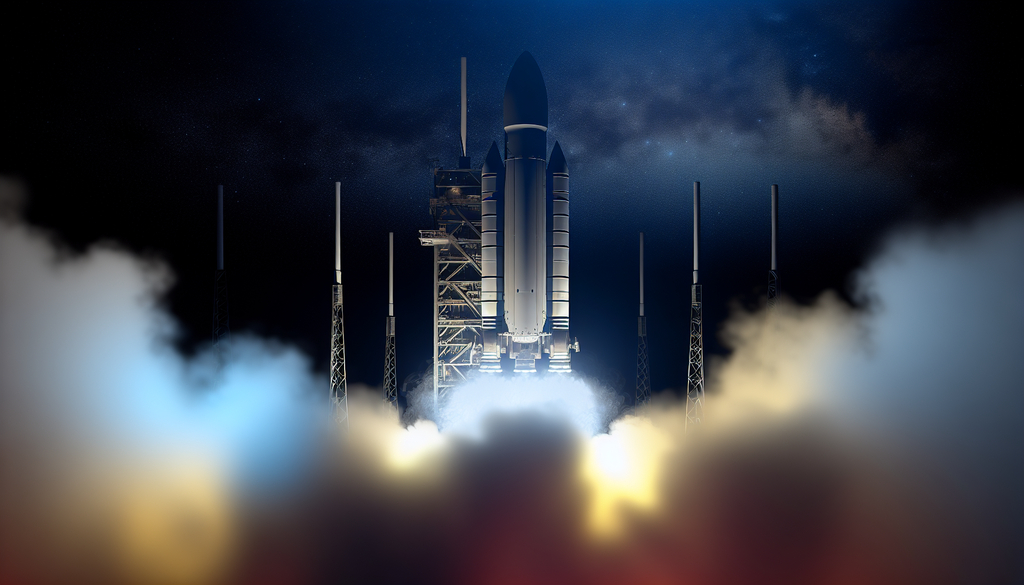
On a once-quiet launchpad in Florida that hasn’t seen action in nearly two decades, a towering new rocket measuring around 320 feet (98 meters) is ready for its debut flight. Developed by Jeff Bezos’ company, Blue Origin, this rocket represents a major milestone for the aerospace firm.
The uncrewed vehicle, named New Glenn, will serve as Blue Origin’s first attempt to launch a rocket into orbit—a crucial step if the company hopes to challenge SpaceX’s dominance in the field.
New Glenn’s maiden flight is slated to take off from Cape Canaveral Space Force Station as early as next week.
Standing at the height of a 30-story building, the rocket is designed with multiple components. Its first stage, a booster, drives the thrust needed for liftoff, while an upper stage—topped with a protective nose cone—houses experimental payloads for this mission.
In a move mirroring the success of SpaceX’s reusable rocket technology, Blue Origin plans to recover the New Glenn booster for reuse. After liftoff, the booster is expected to land on a seafaring platform named Jacklyn (in honor of Bezos’ mother), marking a pivotal attempt at lowering costs by recycling key components.
Blue Origin’s strategy echoes that of SpaceX—recover, refurbish, and reuse first-stage boosters to make spaceflight more economical.
However, the success of this inaugural flight is uncertain, as first launches are rarely flawless.
Long-term, New Glenn—named after renowned NASA astronaut John Glenn—is central to some of Blue Origin’s most ambitious goals.
This heavy-lift rocket could eventually support national security launches, deploy Amazon’s internet satellites, and aid in constructing a commercial space station that Blue Origin is developing with other partners.
The First Launch of New Glenn
New Glenn was first announced in 2016 as Blue Origin’s answer to surpassing SpaceX’s Falcon 9. The design allows it to carry up to 45 metric tons (99,200 pounds) into orbit—twice the payload capacity of Falcon 9.
The rocket’s debut, originally planned for 2020, is significantly delayed—a common occurrence in the aerospace industry. New vehicles often take years longer than expected to prepare for their first flights.
As is standard, Blue Origin’s maiden mission will carry a "dummy payload" to space. Rocket manufacturers often adopt a cautious approach for such flights, with early missions featuring inert payloads like blocks of metal, or in the case of SpaceX’s Falcon Heavy, an old red sports car.
Blue Origin emphasizes its commitment to meticulous development, avoiding shortcuts—a philosophy Bezos has repeatedly championed since founding the company. The mascot, a tortoise, symbolizes the ethos of slow, steady progress, inspired by the classic fable of "The Tortoise and the Hare."
“Slow is smooth, and smooth is fast,” Bezos declared in 2016, positioning his company as a measured counterbalance to SpaceX’s fast-paced, trial-and-error development style.
While Blue Origin has taken its time, SpaceX achieved its first orbital success in 2008 with the Falcon 1 rocket. SpaceX has since executed hundreds of successful launches while refining its approach through iterative launches, even if that occasionally included dramatic in-flight failures.
Blue Origin, by contrast, is primarily known for its suborbital space tourism rocket, New Shepard, which has flown customers and celebrities alike. Out of more than 20 New Shepard missions, only one has encountered a failure—and that was during an uncrewed science mission.
Despite their frequent rivalry, SpaceX founder Elon Musk offered positive words for New Glenn ahead of its debut, posting "Godspeed!" on his platform X (formerly Twitter) on December 27.
The Mission of New Glenn
Even before its first flight, New Glenn has already made waves in the aerospace sector. For years, Blue Origin has pitched the rocket as a competitor to both SpaceX and United Launch Alliance (ULA), the latter being a joint venture of Boeing and Lockheed Martin that depends on Blue Origin for engines.
In June, the US Space Force awarded contracts to Blue Origin, ULA, and SpaceX, allowing them to compete for $5.6 billion in Pentagon launch contracts over the next four years.
Additionally, Blue Origin has secured contracts with private companies, including plans to deploy Amazon’s Kuiper satellite network and launch AST SpaceMobile’s space-based cellular broadband technology.
New Glenn could also play a key role in constructing Orbital Reef, a commercial space station in development by Blue Origin in partnership with companies like Sierra Space and Boeing. This station is envisioned as a future destination for astronauts post-International Space Station.
New Glenn vs. Other Powerful Rockets
New Glenn’s capabilities position it between SpaceX’s Falcon 9 and the more robust Falcon Heavy. It can lift twice as much payload as Falcon 9 while potentially maintaining a similar price point, estimated between $60 million and $70 million per launch.
However, maintaining competitive pricing will be critical for Blue Origin to rival SpaceX, according to Caleb Henry, a space industry analyst with Quilty Space.
One area where New Glenn truly stands out is its massive payload fairing. Measuring 23 feet (7 meters) in width, it’s nearly 6 feet (2 meters) wider than anything SpaceX currently offers, enabling it to carry bulkier components vital to Bezos’ long-term goals.
Bezos has often described a future where heavy industry moves off Earth, reducing environmental damage on our home planet while using powerful rockets to support space-based manufacturing.
Despite New Glenn’s impressive specifications, SpaceX is advancing its own next-gen flagship rocket: Starship. Starship, which towers at nearly 400 feet (121 meters), will boast the highest payload capacity ever, targeting up to 300 tons per launch—far surpassing other rockets.
Musk envisions Starship as a key enabler of interplanetary living, particularly on Mars. While its initial impact on launch costs remains uncertain, Starship could reshape space accessibility if it hits its ambitious targets, experts say.
The Payload for This Flight
The original plan for New Glenn’s debut flight included delivering NASA’s Mars-bound satellites. However, due to rocket development delays, NASA reassigned that mission to a later date, leaving Blue Origin to pursue an alternate demonstration mission.
For this inaugural flight, the rocket will carry the Blue Ring Pathfinder demonstrator—a piece of technology aimed at advancing the company’s Blue Ring spacecraft concept, which would act as a rideshare booster to reposition satellites in orbit.
The demonstrator will remain attached to New Glenn throughout the six-hour flight, enabling tests on communication systems, tracking hardware, and telemetry capabilities between space and Earth. This mission is part of Blue Origin’s partnership with the US Department of Defense.
The Push for Reusability
Much like SpaceX, Blue Origin is pursuing the reuse of first-stage boosters to slash the cost of launch operations.
“Reusability is crucial to dramatically cutting costs per launch,” the company noted in a statement, reiterating a principle SpaceX has championed since it successfully landed its first booster in 2015.
Bezos has emphasized reusability since founding Blue Origin in 2000. His company’s efforts in creating reusable technology predated SpaceX but took longer to achieve orbital flight capability.
Successfully returning New Glenn’s booster would be a key triumph. This involves the booster separating from the rocket, maneuvering with precision, and reigniting its engines to land smoothly on the Jacklyn recovery vessel—a high-stakes operation requiring flawless execution.