"Unknown mollusk discovered in the ocean's midnight zone baffles researchers with its uniqueness"
Subscribe to CNN’s Wonder Theory newsletter to stay up-to-date with awe-inspiring news about scientific breakthroughs and the wonders of the universe.
Scientists have unveiled a surprising addition to the ocean’s mystifying midnight zone: a glowing creature they've dubbed the “mystery mollusk.”
This new species—an apple-sized sea slug named Bathydevius caudactylus—is unlike any other the Monterey Bay Aquarium Research Institute (MBARI) has encountered. Its unique characteristics set it apart from any previous sea slugs studied.
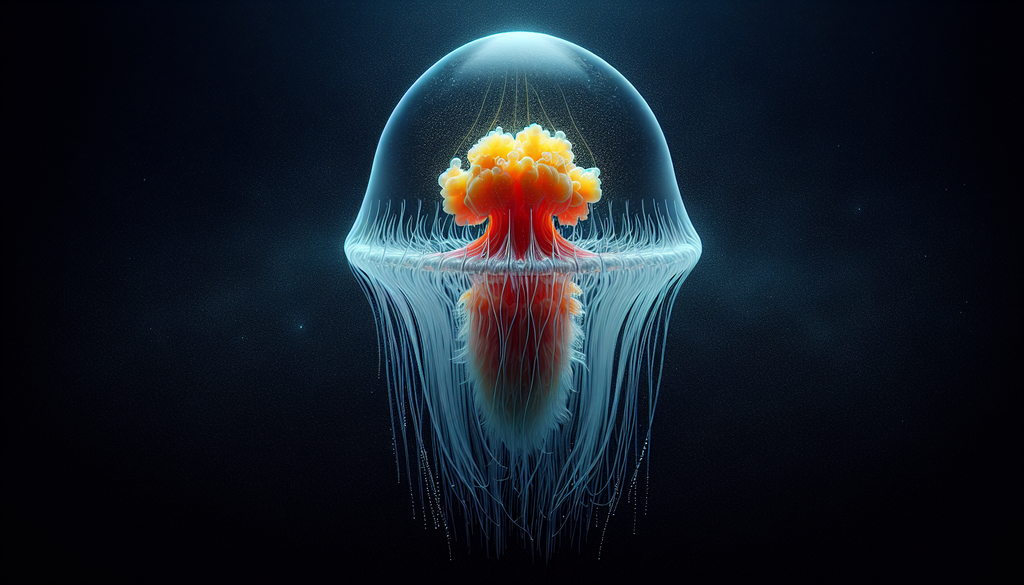
Bathydevius is a bioluminescent, free-swimming sea slug unlike its seafloor-bound relatives. With paddle-like fins and a gelatinous, canopy-like protrusion, it stands out as the first sea slug known to inhabit the deep ocean. Traditional sea slugs live in much shallower environments, often settled in tide pools or close to the shore, while only a few venture into near-surface waters.
This unusual animal lives in the midnight zone—waters ranging from 3,300 to 13,100 feet (1,000 to 4,000 meters). What makes Bathydevius truly distinct is that every aspect of its development—adapted to this eerie deep—is unlike other nudibranchs, a term used to describe soft-bodied sea slugs such as this new species.
In February 2000, senior scientists Bruce Robison and Steven Haddock from MBARI first encountered this enigmatic creature during an expedition in the deep waters off Monterey Bay, using their remotely operated vehicle, Tiburon. Since then, researchers have spotted the "mystery mollusk" more than 150 times.
Exploring such extreme ocean depths has proved difficult for scientists, but research on Bathydevius caudactylus may shed light on the adaptations that allow animals to survive in the intimidating midnight zone. As the world’s largest habitat, it contains 70% of the Earth’s seawater.
In a study published Tuesday in Deep Sea Research Part I, the findings have been described in detail. “We’ve committed over 20 years to understanding this captivating nudibranch species,” Robison said, adding that each discovery adds to our understanding of the Earth’s most immense habitat.
A Deceptive Discovery
At first glance, Bathydevius appeared more like a megaphone with a feathered tail than a typical sea slug, according to Haddock, co-lead of the study.
This creature boasts an oversized, hooded structure at one end and a flat, tail-like fin fringed with finger-shaped projections. Its internal organs, vibrant and translucent, are clearly visible, and it walks with a snail-like foot—raising some initial uncertainty regarding its true identity.
Found along the Pacific coastline, from Oregon to Southern California, similar creatures have even been spotted by the National Oceanic and Atmospheric Administration (NOAA) in the Mariana Trench, hinting that this species inhabits a vast range.
Upon capturing a specimen, further analysis revealed it to indeed be a nudibranch—albeit one that exhibits unique adaptations for thriving and hunting in the midnight zone. Its peculiar anatomy and behavior hint at how it hunts its elusive prey.
“Finding a nudibranch in the deep midwater zone is like discovering hummingbirds on Mount Everest,” noted Robison. “This is a dark, cold, and perilous world, yet it’s teeming with life, albeit forms that are significantly different from terrestrial organisms. Everything about Bathydevius—from its physiology to its behavior—has been optimized for survival in this particular environment.”
The name Bathydevius was inspired by the creature’s trickery, while "caudactylus" refers to the finger-like "dactyls" on its tail.
Unlike typical sea slugs that graze with their raspy tongues at the ocean’s floor, Bathydevius sports a hood used to trap its fast-moving prey, such as mysid shrimp.
Haddock explained that deep-sea creatures moving up from the seabed frequently grow larger, more delicate, and more transparent. To capture crustaceans, which can dart with incredible speed, Bathydevius relies on a different strategy—reminiscent of the way jellyfish stun prey. Its secret? Flexibility becomes an asset as it engulfs and smothers its quarry, enveloping them like a wet blanket.
Strategies for Survival
In terms of movement, Bathydevius navigates the water column with ease, either by flexing its body or riding ocean currents.
These creatures are hermaphroditic, equipped with both male and female reproductive organs. When ready to lay eggs, the mysterious mollusk returns to the seafloor, using its foot to anchor temporarily.
For escaping predators, its nearly-transparent body provides natural camouflage. In dire situations, it can even close its massive hood, launching itself backward for a quick getaway.
But if fast movement isn’t enough, Bathydevius has another defense—bioluminescence. Luminous granules scattered across its tissue create a starry glow that can confuse threats. In one remarkable instance, the mollusk detached one of its glowing dactyls to deceive a predator, much like a lizard shedding its tail—a part that it can later regenerate.
"When we first documented its bioluminescence with our ROV, the whole control room gasped in awe," Haddock recalled. "We are fortunate to have cutting-edge cameras capable of recording high-resolution, full-color footage of deep-sea bioluminescence, allowing us unprecedented insight into these bizarre creatures in their own world.”
Although rare among sea slugs, bioluminescence is present in about 75% of marine life in the water column. This nudibranch marks only the third instance of such an ability in its kind, raising more questions about the evolutionary origins behind its glow. “We still don’t know the exact chemicals that create the light or the specific genes that make it possible,” Haddock said. “It’s as though this trait emerged out of nowhere. With few close relatives, Bathydevius represents an isolated event in evolutionary history.”
Robison also highlighted concerns regarding deep-sea mining, which stirs up obscuring sediment and jeopardizes the habitat by disturbing the seabed. The extraction process can harm deep-sea organisms that both spawn on the seabed and hunt in the water column, such as Bathydevius.
As such, the scientists emphasized the importance of continued research in the midnight zone, home to some of the most fascinating and lesser-known creatures of the planet. “Deep-sea creatures captivate our imaginations, and we share this blue planet with them,” Robison concluded. “Every discovery serves as a reminder to protect these spectacular environments and the extraordinary life teeming beneath the surface.”