A T. rex unearthed in South Dakota may shatter auction records — and potentially vanish from public view forever
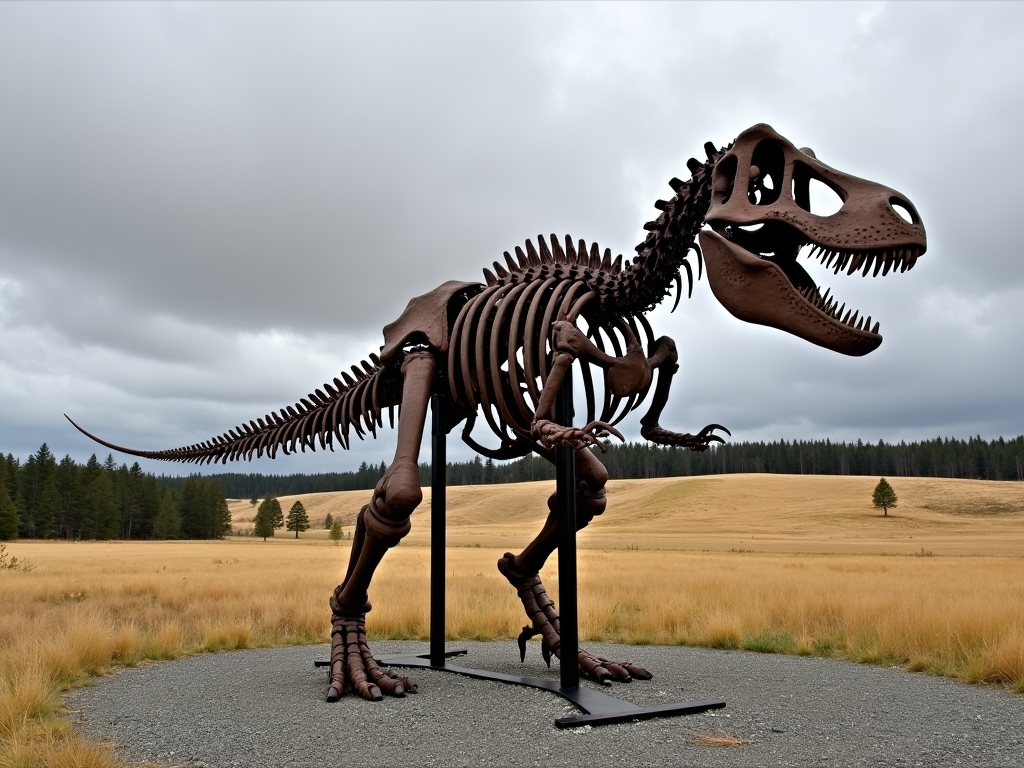
Long before his name was attached to one of the most formidable predators ever to walk the Earth — or appeared in the pages of an auction catalog — the late Gary “Gus” Licking, a cattle rancher in South Dakota, had a strong feeling that something extraordinary lay beneath his land.
The Licking ranch sits within the Hell Creek Formation, a renowned fossil-rich region spanning Montana, Wyoming and the Dakotas. It is considered the most significant site in the world for Tyrannosaurus rex. One of the earliest T. rex skeletons was uncovered there in 1902, and fossils from this formation helped define and name the species.
Stan, a remarkably complete T. rex discovered not far from Licking’s ranch, sold at auction in 2020 for $31.8 million, setting a record at the time.
Today, Licking’s 6,500-acre property in Harding County has carved out its own place in Hell Creek history. The ranch produced a skeleton comparable in scale to Stan. Named Gus in honor of Licking, the fossil is scheduled to be auctioned Tuesday at Sotheby’s in New York, where it could become the most expensive fossil ever sold.
Yet the impending sale — likely to a private buyer — is expected to fuel debate. Many paleontologists argue that fossil ownership and scientific responsibility are increasingly in conflict, and that research often suffers as a result.
In this case, the story began with chance. Licking had collected dinosaur teeth and fragments over the years and hoped for a major discovery. That possibility grew real when he met Thomas Heitkamp, a commercial paleontologist and founder of Theropoda Expeditions, a Texas company that excavates fossils on private property.
“I happened to drive past the ranch one day and saw Gary near a watering trough by the road,” Heitkamp recalled. “I stopped to introduce myself.”
Heitkamp explained that the ranch had long interested him because of its position within Hell Creek. Licking, he said, understood how fossil-rich his land was and believed a thorough search might uncover something significant. “I’m glad we were able to make that happen,” he said.
Gus was discovered on the property in 2021. Licking had identified the general area where the skeleton lay, but he died before the excavation was complete and never saw the fossil fully prepared.
Measuring 38 feet long and 12.5 feet tall, with a skull 54 inches in length, Gus ranks among the largest T. rexes ever found, according to Sotheby’s. The skeleton includes 183 fossilized bones, making it about 61% complete by bone count, or roughly 75% to 80% complete by mass.
Sotheby’s describes Gus as one of the most complete T. rex specimens ever discovered. However, it is less complete than Stan, which is about 70% complete by bone count, and Sue — the landmark T. rex sold at auction in 1997 — which is about 90% complete. Gus also shows bite marks and healed fractures, signs of injuries the animal survived, which may increase its scientific interest.
Despite this, no formal scientific research has been published on Gus. Many researchers decline to study privately owned fossils. Heitkamp said several independent scientists have viewed the skeleton informally. Still, because the fossil was found on private land, its sale is legal — and certain to revive debate over fossil auctions and the growing number of T. rex skeletons in private hands.
“If this specimen goes to a private individual, it may never be publicly accessible again,” said Stuart Sumida, a biology professor at California State University, San Bernardino, and president of the Society of Vertebrate Paleontology (SVP), which opposes fossil sales. Some privately owned fossils are loaned to museums, but others disappear into personal collections.
“And without public access, it cannot be properly studied,” Sumida added. “No reputable scientific journal will publish work based on material that isn’t held in the public trust.”
The SVP requires its members to research only fossils housed in publicly accessible institutions, ensuring that other scientists can examine them. Private ownership does not guarantee such access.
“Once something is sold, it is often effectively lost to science,” Sumida said.
A record sale in the making
Heitkamp said his team spent a year surveying the ranch before locating Gus in a shallow valley with little exposed rock, which had allowed it to go unnoticed. “We quickly recognized the bones as T. rex,” he said.
After beginning his career cataloging fossils at an auction house in Los Angeles, Heitkamp founded Theropoda Expeditions in 2012. His team excavated the site over three field seasons from 2021 to 2023, working about five months each year when the ground was not frozen.
“We excavated roughly 7,000 square feet by hand,” he said. Natural faults complicated the work, and the wide distribution of bones added technical challenges.
Once excavation ended, extensive laboratory preparation followed. Technicians cleaned and stabilized the bones, filled missing sections with sculpted epoxy, and mounted the skeleton in a dramatic predatory stance on a custom steel frame, according to Sotheby’s.
Beyond its size, Gus has features that make it especially attractive to collectors. About 82% of the skull is represented by original bone. The skeleton also includes rarely preserved elements such as the wishbone, a complete pelvis and both feet. Only one other T. rex is known to preserve two well-represented feet.
Sotheby’s estimates Gus could fetch up to $30 million, though recent fossil sales have exceeded expectations. In 2024, Apex the Stegosaurus sold for $44.6 million after a much lower presale estimate.
Gus is being sold with full rights, meaning it contains no replicated elements derived from other copyrighted specimens. Often, missing bones are replaced with casts taken from other skeletons — commonly Stan. Many museum displays of T. rex are based partly on Stan casts.
“Most T. rex skeletons on the market have included some Stan material,” said Cassandra Hatton, Sotheby’s vice chairman and head of science and natural history. “Gus does not.”
The excavation team created its own molds and scans from other T. rexes they had uncovered, allowing Gus to stand independently. A buyer could potentially produce casts for museums or collectors.
Hatton acknowledged that formal scientific study is unlikely but noted that many major museums originated from private collections. She argued that without the financial incentive of a high-value sale, costly excavations like Gus would rarely occur.
“If fossils remain buried, they eventually erode and disappear,” she said. “Commercial paleontologists invest their own time and resources to recover them.”
Asked where she hopes Gus will end up, Hatton replied, “Somewhere my son and I can see it.”
‘You can look at it, but you can’t study it’
Heitkamp agrees that recovering fossils before erosion destroys them is essential. “I don’t know where Gus will ultimately go,” he said, “but I know it would have been lost if left in the ground.”
David Hone, a paleontologist at Queen Mary University of London, acknowledged that limited resources mean some fossils might never be recovered without private efforts.
However, he argued that museums could conduct such excavations if landowners partnered with public institutions instead of commercial companies.
“With a few million dollars, a museum could likely find and excavate a T. rex,” Hone said. “It might not be identical to this one, but it would cost far less than auction prices.”
Sumida added that private landowners can collaborate with museums and still receive compensation. “It’s not accurate to suggest only commercial sales can save these fossils,” he said.
Hone believes many wealthy buyers want both ownership and public benefit — but the two do not always align.
“Owning a T. rex is like owning a rare sports car,” he said. “It may be impressive, but it doesn’t advance science unless it’s accessible.”
Even museum loans can be problematic. Apex the Stegosaurus is currently on temporary display at the American Museum of Natural History, but Sumida argues that mounted skeletons are difficult to study.
“To conduct detailed research, scientists need access to individual bones and their original context,” he said. “Once reconstructed and mounted, much of that context is lost. Gus has been assembled for display, which limits its research potential.”
The SVP has objected to temporary loans, noting that permanent accessibility is necessary for rigorous study.
Some museums have provided digital 3D scans to researchers, but experts say scans cannot fully replace examination of original fossils.
“Scientific results must be repeatable,” said Steve Brusatte, a paleontology professor at the University of Edinburgh. “If access depends on the discretion of a private owner, that standard cannot be met.”
With price tags reaching tens of millions of dollars, most public institutions cannot compete at auction, Brusatte added.
Susannah Maidment, a researcher at London’s Natural History Museum, noted that sums spent on single fossils could transform museum facilities and collections.
Kristi Curry Rogers, a professor at Macalester College and SVP vice president, emphasized that the debate centers on stewardship rather than simple ownership.
“Scientifically important fossils are irreplaceable records of Earth’s history,” she said. “If they are lost or made inaccessible, the information they hold is gone forever.”
She argued that significant specimens should be permanently housed in institutions that guarantee access for both researchers and the public. “That protects not just today’s science,” she said, “but the discoveries future generations have yet to imagine.”