As Indonesia reduces methane emissions, life on top of a towering garbage dump starts to shift
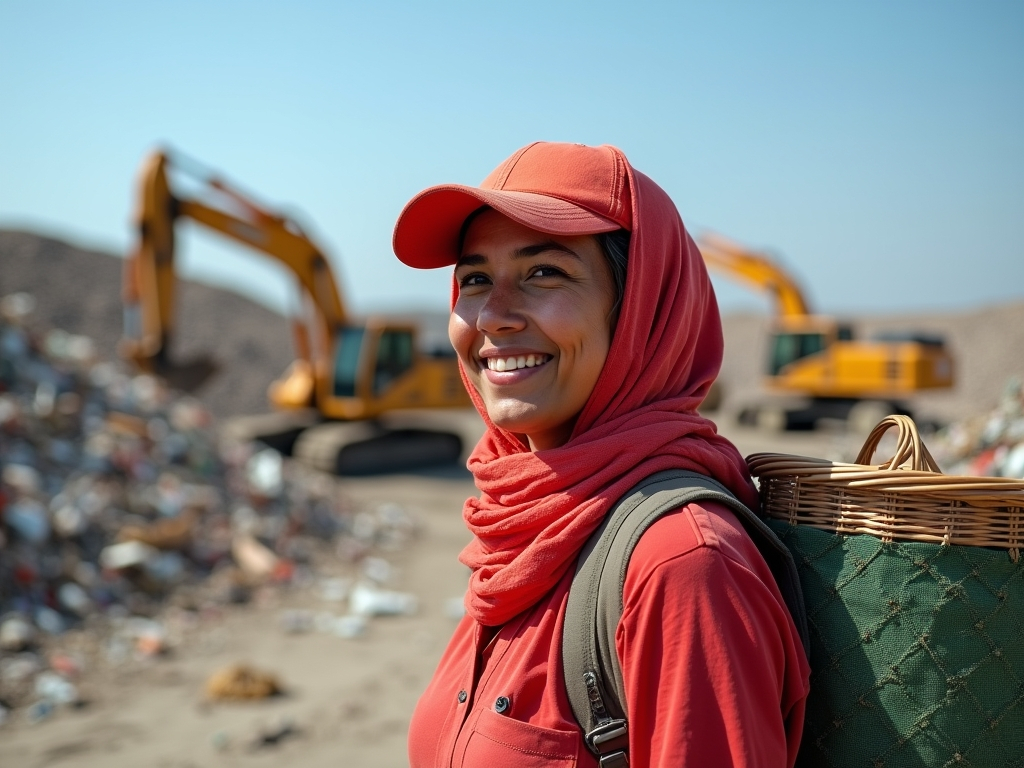
BANTARGEBANG, Indonesia (AP) — Well before sunrise touches Indonesia’s largest landfill, Nur Wencih is already scaling heaps of refuse with thousands of other waste pickers, searching for items that can be sold.
The 35-year-old widow has spent nearly 20 years working at the sprawling dump on Jakarta’s eastern fringe, following in the footsteps of her parents, who still depend on it for income. Earnings from Bantargebang have covered her rent and daily meals and helped support her two teenage daughters, who live with relatives in a rural village. She dreams that they will never have to work among the trash as she does.
Living alone in a modest rented room near the landfill, Wencih can make around 200,000 rupiah (about $12) on a good day by collecting discarded toys, cardboard and plastic bottles before bulldozers push fresh waste over them. Every so often, she uncovers something far more valuable — even gold jewelry.
“It feels like winning the lottery,” Wencih said, pausing in the intense July heat.
Yet such discoveries — and perhaps her job itself — may soon become increasingly rare.
Starting Aug. 1, Indonesia will begin converting Bantargebang from an open dumping ground into a more regulated landfill as part of a nationwide waste reform. Authorities recently announced plans to end open dumping at 343 of the country’s 550 disposal sites. These locations must shift to controlled or sanitary systems and gradually accept only non-recyclable and non-compostable waste, such as diapers, soiled tissues and stickers.
Nur Wencih, a waste picker, walks at the Bantargebang landfill on the outskirts of Jakarta, Indonesia, Monday, July 6, 2026. (AP Photo/Tatan Syuflana)
Waste pickers search for recyclable materials in piles of garbage at the Bantargebang landfill, Monday, July 6, 2026. (AP Photo/Tatan Syuflana)
At the same time, households are being instructed to separate food scraps and recyclable materials from other trash — a habit that many Indonesians have never consistently practiced.
Dudi Gardesi Asikin, head of Jakarta’s Environment Agency, said the initiative is designed to improve sanitation, reduce pollution and cut methane emissions produced by decomposing waste.
Methane accounts for about one-third of global warming and traps significantly more heat than carbon dioxide, making it a major focus of international climate strategies. Global leaders have increasingly called for sharp methane reductions as one of the fastest ways to slow rising temperatures.
A landfill at the center of the methane debate
Garbage trucks queue before unloading at the Bantargebang landfill, Monday, July 6, 2026. (AP Photo/Tatan Syuflana)
Scientists report that Bantargebang releases more methane than almost any other landfill worldwide, placing it at the heart of Indonesia’s reform efforts.
According to Asikin, the site opened in 1989 as a sanitary landfill equipped with methane capture systems and soil coverings for waste — unlike open dumps, which leave trash exposed.
However, after a private operator’s contract expired in 2016, the facility gradually reverted to open dumping.
“A site that was never meant to operate as open dumping eventually became exactly that,” Asikin said.
A waste picker searches through garbage at Bantargebang, Monday, July 6, 2026. (AP Photo/Tatan Syuflana)
Waste pickers walk near a tarped section of the landfill, Monday, July 6, 2026. (AP Photo/Tatan Syuflana)
Only two of the original 12 methane extraction wells are still functioning, he added.
Under the new plan, sections of the landfill are being covered with tarps, with more areas slated for closure. Asikin estimates that fully covering the remaining dumping grounds could cost up to 200 billion rupiah (around $12 million).
Uncertain future for waste pickers
Waste pickers rest at the Bantargebang landfill, Monday, July 6, 2026. (AP Photo/Tatan Syuflana)
Indonesia now faces a difficult balance: overhauling one of its most significant waste systems in decades while safeguarding the livelihoods of roughly 600,000 waste pickers nationwide.
More than 4,000 registered pickers work at Bantargebang alone, navigating trucks, excavators and towering garbage piles each day. The items they recover are sorted and sold through an informal network of traders and recycling businesses that depend on the landfill.
“My biggest fear is how I will provide for my family,” Wencih said, as heavy machinery deposited fresh loads of waste behind her.
Nur Wencih hangs laundry at her boarding house near Bantargebang, Monday, July 6, 2026. (AP Photo/Tatan Syuflana)
Nur Wencih sorts recyclable materials at her boarding house, Monday, July 6, 2026. (AP Photo/Tatan Syuflana)
Asikin said officials aim to improve conditions for pickers, who already receive limited protections and healthcare coverage through the national social security system.
He argued that the reforms could ultimately create safer, formal employment opportunities in recycling and composting.
“Right now, they are racing against excavators to retrieve recyclables. It’s extremely hazardous,” he said.
A waste picker drinks water while searching through garbage at Bantargebang, Monday, July 6, 2026. (AP Photo/Tatan Syuflana)
Bunin, a 53-year-old community leader living nearby, noted that although the landfill brings pollution, it also supports the local economy, from rental housing to food vendors serving workers.
“The landfill creates problems, but it also provides livelihoods,” Bunin said.
A landfill at its limits
A worker operates heavy equipment at Bantargebang, Monday, July 6, 2026. (AP Photo/Tatan Syuflana)
Spanning about 110 hectares (272 acres), Bantargebang has formed a massive artificial hill rising up to 60 meters (196 feet) — roughly the height of a 20-story building. Around 7,500 tons of waste from Jakarta arrive there every day.
“Trash doesn’t disappear. It accumulates in one place and becomes a mountain,” said Agung Pujo Winarko, who manages the facility.
In March, heavy rains triggered a collapse at the landfill that killed seven people, highlighting the dangers posed by its immense size.
“The situation is critical,” Winarko said. “Its capacity is at — or even beyond — its limit.”
A waste picker searches through trash at Bantargebang, Monday, July 6, 2026. (AP Photo/Tatan Syuflana)
Garbage trucks line up before unloading at the landfill, Monday, July 6, 2026. (AP Photo/Tatan Syuflana)
Satellite analysis ranked Bantargebang in 2025 as the world’s second-largest methane-emitting landfill, trailing only a site in Argentina.
Climate researchers say that while reducing organic waste sent to landfills can curb emissions, existing sites will require decades of monitoring and gas collection systems.
Changing Jakarta’s throwaway culture
A woman discards a bag of trash at an open dump in Jakarta, Friday, July 17, 2026. (AP Photo/Tatan Syuflana)
Under the reforms, Jakarta residents are expected to sort food waste, recyclables and residual trash before collection. Plans also include facilities that convert refuse into fuel.
“This is a major shift,” Asikin said. “For generations, people were never required to separate their waste.”
However, many residents say they are only beginning to understand the new system, raising concerns about whether public outreach has been sufficient.
“We’re used to throwing everything in one bin,” said Central Jakarta resident Rukasih Wanti. “Now we’re told to sort it, and it feels confusing and inconvenient.”
Asikin said several government agencies, including those responsible for education and health, are helping promote the changes.
Sanitation workers collect trash at a traditional market in Jakarta, Friday, July 17, 2026. (AP Photo/Tatan Syuflana)
Workers load garbage onto a truck at a temporary disposal site in Jakarta, Friday, July 17, 2026. (AP Photo/Tatan Syuflana)
Environmental groups stress that new recycling and composting infrastructure is essential. Government figures indicate that only about a quarter of Indonesia’s daily waste is managed through formal systems, with the remainder dumped, burned or left unmanaged.
David Sutasurya, executive director of the environmental group YPBB, said roughly half of Jakarta’s waste is compostable and another 30% recyclable — meaning up to 80% could potentially be diverted from landfills.
“We postponed reforming our waste system for too long and only reacted once landfills were nearly full,” Sutasurya said.
In West Jakarta, Monica T. Anggriani has spent more than a decade encouraging neighbors to sort their trash. She helped establish a community waste bank that now processes about one ton of organic material daily through composting, maggot cultivation and urban farming.
“Our generation was never trained to separate waste,” Anggriani said. “If we don’t begin now, nothing will improve.”
Workers spray water to cool garbage during hot weather at Bantargebang, Monday, July 6, 2026. (AP Photo/Tatan Syuflana)