The devil worm is the deepest-dwelling animal. It’s reshaping our understanding of life at its extremes
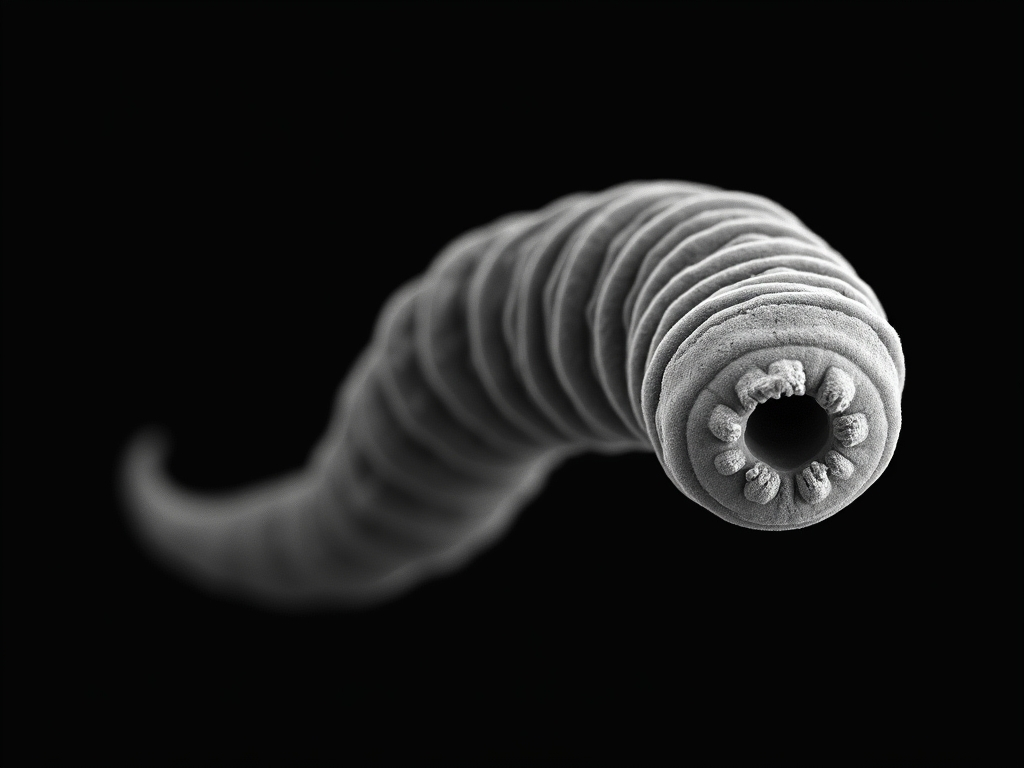
When a lone worm was discovered deep within Earth’s crust, it set off an extraordinary chain of events that reshaped our understanding of how far life can extend beneath our feet.
If you could bore through the soil below you and descend into the planet’s crust, discomfort would set in quickly. Sunlight would disappear, temperatures would rise, and pressure would steadily increase as you edged closer to the molten interior. Water trapped deep underground would seep through cracks in the rock. At depths of around 0.8 miles (1.3km), it would seem reasonable to assume that nothing could possibly survive.
Yet, with a bit of luck, you might encounter them: vast communities of bacteria, sometimes forming vivid orange or pale white films across rock surfaces. And with a microscope, you might even glimpse a tiny worm hauling itself along using structures around its mouth.
This creature is Halicephalobus mephisto, nicknamed the devil worm, hunting microbes in the darkness. Though only as long as a few human hairs laid side by side, it is a giant in its microscopic world. When it dies within the slimy microbial coating that lines the rocks, scientists believe its body becomes nourishment for bacteria and other organisms, sustaining a strange and ancient cycle of life far below ground.
Until the 1980s, many biologists believed life could not exist more than about 30cm (1ft) beneath the surface. The discovery of bacteria living kilometres underground—and, in 2011, the identification of the devil worm—dramatically overturned that assumption.
The worm’s existence proves that even animals can survive without sunlight or oxygen-rich air. It has forced scientists to rethink the limits of life and opened new discussions about how life began and where it might persist in the future.
“If there’s a worm down there, what else haven’t we found?” asks geomicrobiologist Karen Lloyd of the University of Southern California. “It suggests enormous potential.”
Through an extraordinary stroke of luck, researchers were able to produce offspring from that single worm and have spent years studying its descendants to uncover how it endures in such hot, lightless conditions.
The first solid evidence of deep subsurface life emerged in the 1990s. In 1997, for example, bacteria were identified nearly 2.8km (1.7 miles) below ground inside a gas borehole.
In the early 2000s, Belgian worm biologist Gaetan Borgonie, founder of the research institute Extreme Life Isyensya, began wondering whether nematodes—tiny roundworms known for their resilience—might also inhabit the deep underground.
Many senior scientists dismissed the idea that complex organisms could survive at such depths. But Borgonie knew how hardy nematodes were. In 2003, when the space shuttle Columbia disintegrated during re-entry, an onboard experiment containing nematodes plummeted about 64km (40 miles) to Earth. The worms survived and continued reproducing.
In 2008, Borgonie and colleagues visited the Beatrix gold mine in South Africa. At 0.8 miles (1.3km) down, they accessed boreholes drilled into the rock, where water at roughly 37C (99F) flowed. They filtered more than 6,000 litres (1,300 gallons) of this water in search of life. From all that volume, they recovered a single tiny worm.
At two other South African mines, they filtered even greater quantities—over 12 million litres at one site—and discovered several roundworm species, along with fungi, other invertebrates and numerous microorganisms.
“I never imagined we would find an entire underground zoo,” Borgonie says. Many of the species were already known from surface environments. But the worm from the Beatrix mine, whose tail had been damaged during filtering, was unfamiliar. In 2011, the team described it as a new species and named it Halicephalobus mephisto.
A broken tail is usually fatal for a nematode. Fortunately, this individual was female and parthenogenetic, meaning it could reproduce without mating. Before it died, it laid eight viable eggs. Borgonie has never found another devil worm.
“It was the worm that survived,” says genomics researcher John Bracht of American University in Washington, DC.
Some of its descendants are now maintained in Bracht’s laboratory, raised in petri dishes under conditions similar to those used for Caenorhabditis elegans, a well-studied nematode that thrives on rotting fruit. But there are key differences: mephisto does not swim freely. Instead, it clings to the sides of containers, a trait that likely helps it anchor itself to underground rock.
The devil worm also rejects the bacterium E. coli, a staple food for C. elegans. Instead, it gravitates toward other bacterial colonies that appear in the dish. Temperature is critical: at 20C (68F), its development slows, taking about eight days to complete a life cycle. At 37C (99F)—a temperature lethal to C. elegans—mephisto reproduces every two days.
Studying a species derived from a single ancestor presents challenges, especially after years in laboratory conditions. Still, Bracht’s team has uncovered important clues about how the worm survives underground.
When researchers sequenced its DNA in 2019, they found an unusually high number of genes coding for heat-shock proteins—molecules that protect cells from damage caused by extreme temperatures.
In 2024, the team examined another molecule, cytochrome oxidase c, which plays a central role in using oxygen to generate energy. They discovered that in mephisto, this molecule functions efficiently only at higher temperatures. At room temperature, it effectively switches off, reducing energy production and slowing the worm’s activity.
Bracht suggests this built-in slowdown may be adaptive. By conserving energy in cooler environments, the worms may ensure they reproduce most effectively in the warmer conditions that resemble their native habitat.
He is also investigating whether parthenogenesis itself is a survival strategy. In the vast underground environment, individuals may rarely encounter one another, making self-reproduction an essential means of persistence.
Asexual reproduction is often viewed as risky because it limits genetic diversity, which typically arises from mating between males and females. Many scientists argue that species relying solely on this strategy are vulnerable to extinction.
It remains possible that male devil worms exist but have yet to be found, allowing occasional sexual reproduction. Regardless, nematodes are renowned for their adaptability. Wherever food exists and access is possible, they tend to evolve to occupy that niche.
How these organisms reached such depths remains uncertain. Research by Borgonie and geobiologist Cara Magnabosco of ETH Zürich suggests that some nematodes may migrate downward through water pathways, potentially aided by seismic activity. Some species survive the journey; others do not.
“There must be some connection transporting them from the surface to deep environments,” Magnabosco explains.
Microbes in the deep biosphere are estimated to represent a substantial portion of Earth’s total biomass—between 12% and 20% of all microbial life. These bacteria have evolved sophisticated methods for extracting carbon and energy in darkness and likely sustain more complex organisms such as nematodes.
They provide food and may even generate small amounts of oxygen required by deep-dwelling worms. By altering acidity levels in underground water-filled cavities, microbes can create more hospitable conditions for larger life forms. In return, invertebrates supply nutrients—nitrogen through waste and carbon when their bodies decompose.
Such hidden ecosystems may have persisted for immense spans of time. Research led by Maggie Lau of China’s Institute of Deep-Sea Science and Engineering suggests that certain deep-dwelling bacteria may have inhabited Earth’s crust since the breakup of the supercontinent Pangea around 165 million years ago.
The devil worm and its subterranean companions may therefore represent some of the planet’s most enduring life forms. Studying the deep biosphere could illuminate the conditions that fostered life’s earliest emergence—and guide the search for life beyond Earth, where any organisms may exist beneath planetary surfaces.
If a catastrophic asteroid impact were to sterilise Earth’s surface, life might one day re-emerge from organisms sheltered below.
“We tend to think humans dominate this planet, but we don’t,” says biochemist Esta van Heerden, who participated in the worm’s discovery. “These life forms have persisted for millions—perhaps billions—of years, and they may remain long after we are gone.”