A family getaway on four legs: donkey trekking through the Spanish Pyrenees
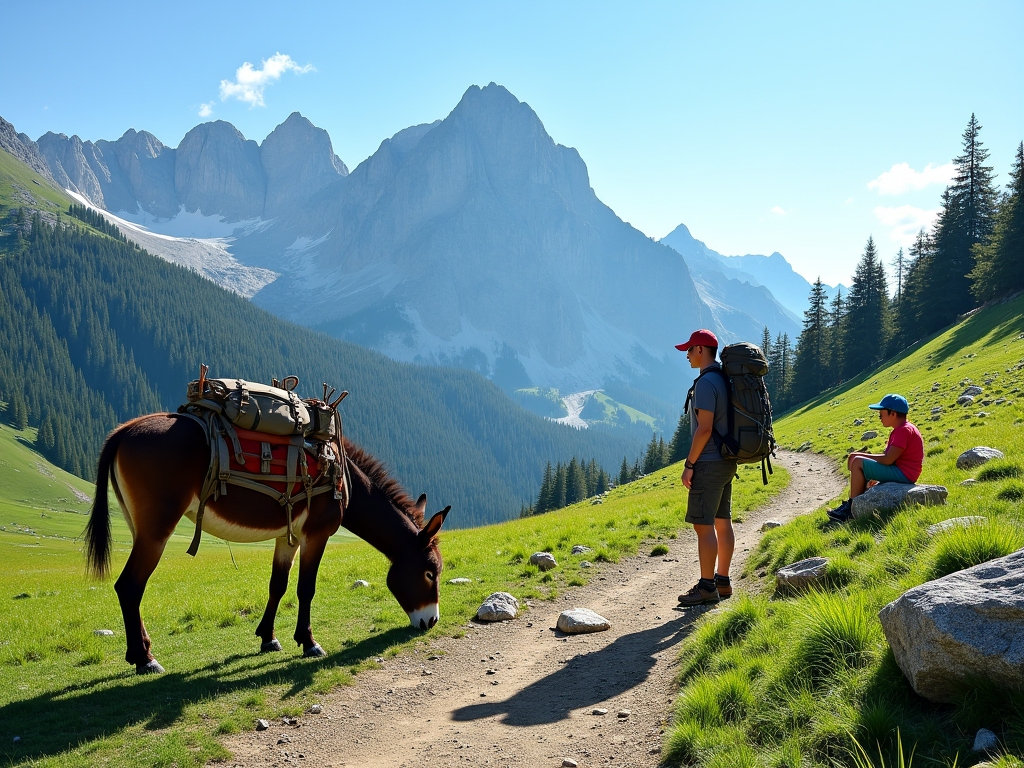
Legend has it that the 19th-century Parisian flâneur, determined not to hurry past the delights of the boulevard, would walk with a tortoise on a leash to slow his stride. That image came back to me as my donkey lowered his head for yet another thistle and I paused to take in the panorama while he chewed. In every direction, mountain ridges faded into layers of pale, misty blue. There was nothing to hear but the wind, the sharp whistles of marmots and the laughter of my two small children. I felt a deep, uncomplicated happiness.
Our donkeys came from Burrotrek, a small company run by Swiss-born Denise Wirth. Two decades ago, Denise spent four and a half months walking the Camino from Switzerland to Santiago de Compostela with two donkeys. She fell for Spain and never lost her affection for the animals, so she created a business leading donkey treks in the Pyrenees. For much of the year she is based near Cadaqués, offering self-guided routes through vineyard-covered foothills and along the Mediterranean, ranging from single-day outings to week-long journeys. In summer, when the coastal heat becomes intense, she moves with her donkeys to Cal Jan de la Llosa in Girona province, a beautiful ruined farmhouse reached by several miles of rough track. From there, she entrusts her animals to those drawn by the romantic idea of climbing a mountain with a donkey.
My family — myself, Ulli, and our two children, aged five and seven — travelled down from Paris on an overnight train using Interrail passes (under-12s travel free), crossed into Catalonia at Puigcerdà and, after a leisurely tapas lunch at the station bar, took a taxi up a long series of switchbacks to the farm. That first evening we pitched our tents in a meadow behind the barn. Darkness rose steadily from the valley below as house martins darted through the fading light. We drifted off to the sound of the river rushing nearby and the occasional bray from the donkeys.
In the morning we met our companions: Om and Rebot, whom we quickly nicknamed Robot — or, when tempers frayed, Roadblock. Denise described Om as “sporty,” ready for adventure, while Rebot was older and content to follow at a measured pace. She taught us the essentials: saddling, grooming, checking hooves. A donkey can carry about a fifth of its body weight — roughly 30kg in this case — which was fortunate, as we had packed a week’s provisions and what felt like an explosion of camping equipment that had multiplied since becoming parents.
We had never taken our children into the mountains before, and my last encounter with a donkey had been on a beach some 35 years earlier. We had much to learn. Donkeys possess a firm sense of their own preferences, which do not always match yours. Still, they were mostly cooperative, and we soon grew attached to them. Denise waved us off as our children held the lead ropes and Om and Rebot ambled behind. She had mapped out a week-long loop combining wild camping with nights in mountain refuges.
The early stages were gentle, winding through wooded valleys and charming stone villages. At lunch we tethered the donkeys beside a stream to graze while we splashed in the water, then stretched out on sun-warmed rocks with bread and cheese. Four hours in, I felt as though I had stepped into a pastoral memoir.
The second night brought the fiercest storm I have ever experienced. One moment the sky was an uninterrupted blue; the next, hail hammered down, whitening the meadow. The donkeys stood patiently beneath a tree, ears drooping. Rain and thunder continued until dawn, the claps echoing like artillery. The children slept through it all while Ulli and I stayed awake, watching lightning flicker across their faces and wondering if we had taken on too much. Our tents were never designed for such weather, and by morning the children were the only dry items left. Yet the sun returned, steam rose from the grass, and we saddled up and continued.
We recovered at Refugi dels Estanys de la Pera, a welcoming mountain hut filled with warmth and generous food. After that, the real ascent began, climbing steadily toward Andorra. At times it felt as though we were hauling two donkeys uphill. Spanish hikers suggested we shout “arré,” a word of Arabic origin brought by the Moors. Whether it helped was debatable, but it gave us a sense of purpose. The donkeys advanced carefully, placing each hoof with precision. We came to understand that they dictated the rhythm; our task was simply to trust them.
By the time we reached the Perafita Pass at 2,574 metres, we were enveloped in cloud and dizzy with accomplishment. We sheltered in a centuries-old stone corral and shared biscuits. As we descended, the mist lifted to reveal Andorra spread before us: an expansive plateau of long grasses and twisted spruce trees marked by lightning, dotted with lakes carved by ancient glaciers. It was breathtakingly beautiful and utterly still. A herd of chamois burst from cover and raced down the slopes.
The trail traced slender rivers — the Riu de Perafita and the Riu Madriu — tumbling urgently over stones. We drank from springs that bubbled straight from the rock and plunged into icy pools. One morning, a group of horses approached to inspect their smaller cousins. Om and Rebot stood calm and unmoving until the horses lost interest and thundered away.
I had feared the children might struggle with such a trip, but their talent for turning anything into play proved limitless. Each stop — and there were many — became an opportunity to paddle in streams, chase frogs or stalk marmots. Our daily distances were modest, six or seven miles, yet back home we often barely make it beyond the car park on a walk. Here, the presence of donkeys and mountains disguised the effort. In the evenings, the children groomed the animals, raced around camp, devoured whatever we cooked — noodles, lentils, pasta — and fell asleep instantly. It felt transformative.
Our final night was spent at Refugi de l’Illa, a large, metal-clad, solar-powered building perched on a stark plateau, as though it had landed from another planet. We enjoyed hot showers, wine with dinner and real mattresses. It was pleasant, but I realised I had not missed such comforts. We were eager to return to the trail. As we crossed back into Spain, the donkeys seemed to sense home ahead. The path descended gently through flower-filled pastures, and by evening on the eighth day we were back at the farm.
Some of my most treasured moments as a parent come when I revisit something I loved before children, now sharing it with these curious, remarkable people — cooking together after a long day outdoors, or staring up at a sky crowded with stars. We pitched our tent one last time and, the next morning, reluctantly returned Om and Rebot. They trotted into their field, greeting the others with nudges and soft nuzzles. We were genuinely sad to say goodbye.
The trip was provided by Burrotrek; donkey hire starts from €55 per day, including an introductory session and equipment. Half-board at Refugi de l’Illa costs €61 for adults and €48 for children. Half-board at Refugi dels Estanys de la Pera costs €46 for adults and from €33.50 for children.