Forget the Bayeux! Here’s some other stunning medieval art – and it won’t cost you a thing
Deep in the crypt of Canterbury Cathedral, a carved stone face twists in fury. The reason is clear enough: a man straddles the figure’s head, legs splayed, brandishing a fish and a bowl in his outstretched hands. Nearby, other sculptures cling to slender columns — a serpent-tailed beast grappling with a dog-like creature, a gryphon devouring a siren, and the remains of a horned devil now broken from its perch. Such unruly imagery lurking beneath one of England’s holiest spaces feels startling, yet it is entirely at home in the medieval imagination.
British medieval art overflows with strangeness, wit and marvels. It is so plentiful, in fact, that it often fades into the background of everyday life. Now, however, it is poised for renewed attention. Crowds are preparing to secure timed tickets for a brief encounter with one of the era’s most celebrated works: the Bayeux Tapestry. Stretching nearly 70 metres, this extraordinary embroidery narrates the Norman Conquest of 1066 and was most likely stitched in Kent in the 1070s, probably commissioned by Bishop Odo of Bayeux.
For centuries preserved in Normandy, the tapestry’s temporary display in London has generated excitement — though it carries a note of irony. Britain hardly lacks medieval masterpieces of its own. The current enthusiasm might prompt us to rediscover the Romanesque and gothic treasures already surrounding us. And for those daunted by queues, many of these wonders can be experienced with far less expense or effort.
Medieval art in Britain was transformed by the arrival of the Normans. Anglo-Saxon England had its own achievements, yet the scenes depicted in the Bayeux Tapestry — mounted warriors, castle-building, disciplined ranks — reflect a continental culture that had already embraced feudal structures and a unified Christian worldview. Across France and Europe, this was the age of imposing Romanesque abbeys and churches. After 1066, the style took firm root in England, encouraged by figures such as Lanfranc, the Italian monk appointed Archbishop of Canterbury by William I.
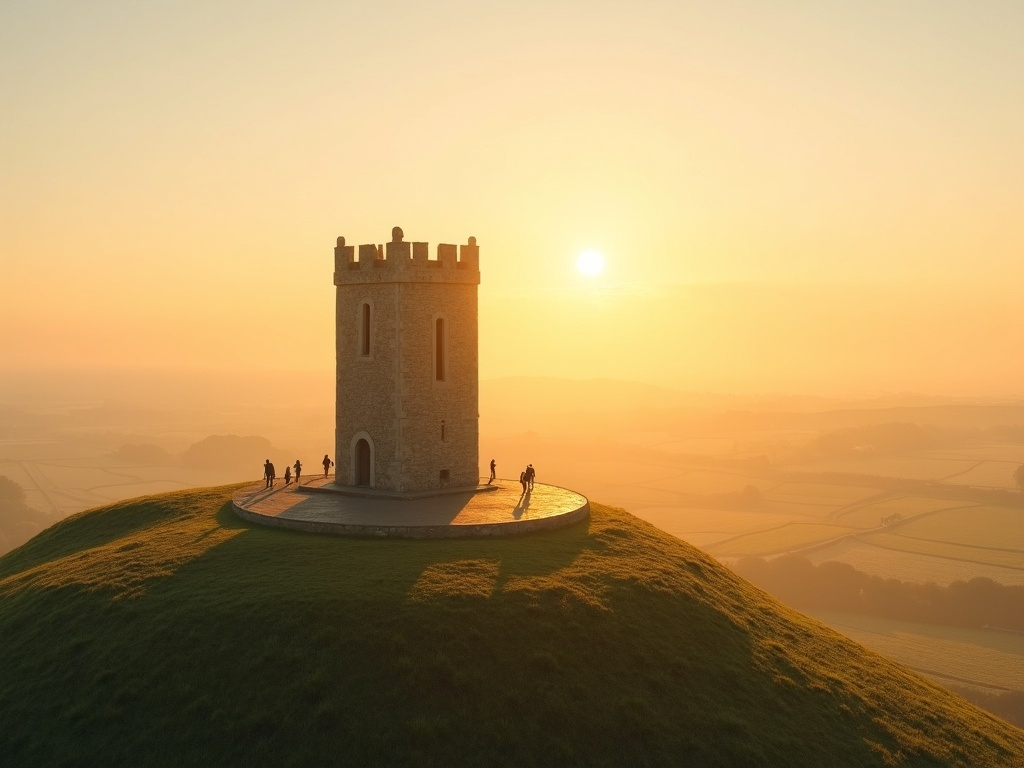
Some of the most powerful medieval creations cost nothing to behold. Glastonbury Tor rises abruptly from the Somerset landscape, crowned by the tower of a 14th-century church. Legends of King Arthur cling to its slopes. Whatever its myths, the Tor embodies the medieval sensitivity to dramatic setting — architecture and landscape fused into a single, haunting image.
Conwy Castle in north Wales commands the mouth of its river from a vast rocky ridge. Its position is strategic, yet its design is also strikingly beautiful. The 13th-century architect James of St George composed its towers and turrets in a rhythmic interplay against sea and mountains. Once adorned with roofs and banners, it must have seemed lifted from romance.
Childhood awe returns easily in such places. That feeling stirs again on the banks of the River Wear, where Durham Cathedral rises with its two massive towers balanced above wooded slopes and winding water. The cathedral occupies its promontory like a divine fortress. Artists across centuries have been drawn to these commanding views, capturing their drama and serenity.
Medieval Britain possessed a vivid awareness of nature. In the 14th-century Lady Chapel at Ely Cathedral, carved foliage spills across steep arches: clusters of grapes, seedpods and blossoms form a stone hedgerow in perpetual spring. The effect is poetic, echoing the freshness and vitality celebrated in medieval literature.
Yet medieval culture was as responsive to fashion as it was to faith. Architectural styles evolved rapidly. Romanesque buildings of the 11th and early 12th centuries favour rounded arches and heavy vaults. Gothic architecture, which soon prevailed, introduced pointed arches and soaring expanses of stained glass supported by flying buttresses. Within gothic itself emerged further variations — decorated, perpendicular — each refining structure and ornament.
Despite these differences, all aimed toward a common aspiration: to suggest heaven on earth. Cathedrals were immersive creations, blending architecture, sculpture, light and scale into overwhelming experiences. Faith in the middle ages was not optional; it shaped every aspect of existence. Cathedral vaults enfold worshippers just as the medieval vision of the cosmos imagined the heavens arching protectively over the world below.
Salisbury Cathedral makes this aspiration visible through its soaring spire, the tallest in Britain. The slender pinnacle seems to burst upward from the body of the church, simultaneously sculpture and structure. Rising from Salisbury Plain, it gathers the surrounding landscape into a single vertical surge.
Durham Cathedral’s interior achieves grandeur differently. Its immense circular columns anchor the nave like colossal tree trunks or the legs of some ancient beast. Their weight is softened by carved patterns — zigzags, spirals and fluting — incised into the stone. What begins as intimidation turns into admiration for the imagination of the masons.
James of St George played with geometry at Conwy, favouring harmonious circles, yet at Caernarfon Castle he rejected curves altogether. There, polygonal towers dominate the skyline. Stone eagles glare from the walls, proclaiming the authority of Edward I, who built these fortresses to secure his rule in Wales. Themes of conquest and kingship echo those woven into the Bayeux Tapestry. Medieval architecture often sought to project order and power — cathedrals to inspire reverence, castles to enforce obedience.
Still, alongside discipline flourished subversion. The grotesques in Canterbury’s crypt counterbalance the cathedral’s solemnity. Across manuscripts, marginal creatures cavort and misbehave; on the borders of the Bayeux Tapestry, naked figures tumble; elsewhere, mermaids and monsters appear in unexpected corners. Medieval art delights in this tension between authority and absurdity.
Over time, the playful margins began to influence the centre. Tales of chivalry and courtly devotion softened earlier austerity. Beaumaris Castle in Anglesey, encircled by water and low towers, resembles a fortress from a romance. Even religious art absorbed this spirit. Ely’s Lady Chapel, once filled with sculpted tributes to the Virgin Mary, celebrated her with a tenderness that later reformers found excessive.
In the later gothic period, English architecture developed fan vaulting — an intricate, radiating pattern unique to the country. At King’s College Chapel in Cambridge, the ceiling unfurls like a canopy of stone fans or fantastical fungi, dissolving solid masonry into delicate tracery.
Sensuous colour and elegance also define the Wilton Diptych, painted in the late 14th century for Richard II. The king kneels before the Virgin and a company of angels clothed in luminous blue and white. Gold gleams behind them. The intimacy and refinement of the scene feel far removed from the stern confidence of the early Normans. By the 15th century, renowned painters from the continent were contributing to British commissions. An elaborate altarpiece created for Edinburgh’s Holy Trinity Chapel by the Flemish master Hugo van der Goes — depicting musical angels and a radiant saint — survives today in Scotland, while the chapel itself endures only in fragmentary form.
If 1066 marked the arrival of feudal Christendom’s artistic culture in Britain, 1536 signalled its decisive rupture. Henry VIII’s dissolution of the monasteries dismantled institutions that had sustained medieval creativity for centuries. Yet an astonishing wealth of art and architecture escaped destruction. These buildings and objects remain, inviting us to step into their imaginative world and encounter its visions of power, beauty and belief.
Remarkable medieval art to see free of charge
Durham Cathedral Entry to one of Britain’s greatest cathedrals is free, though donations are welcomed. Its museum houses treasures associated with St Cuthbert.
The Lewis Chessmen These carved ivory figures from Scandinavia depict the ranks of medieval society, from kings to knights. They can be viewed in a national museum’s permanent collection.
Norham Castle The imposing keep of this Northumberland fortress once guarded the borderlands. Today the dramatic ruins can be explored without an admission fee.
The Trinity Altarpiece Painted by Hugo van der Goes for Edinburgh’s Holy Trinity Chapel, this gothic masterpiece with its musical angels is displayed free of charge in Scotland.
Flint Castle This coastal ruin in north Wales, open freely to visitors, is associated with the dramatic downfall of Richard II.
Tickets for the Bayeux Tapestry exhibition in London become available from 1 July.