Piglet, it’s a violet, mind-bending shapeshifter! The bizarre new being stalking the Hundred Acre Wood
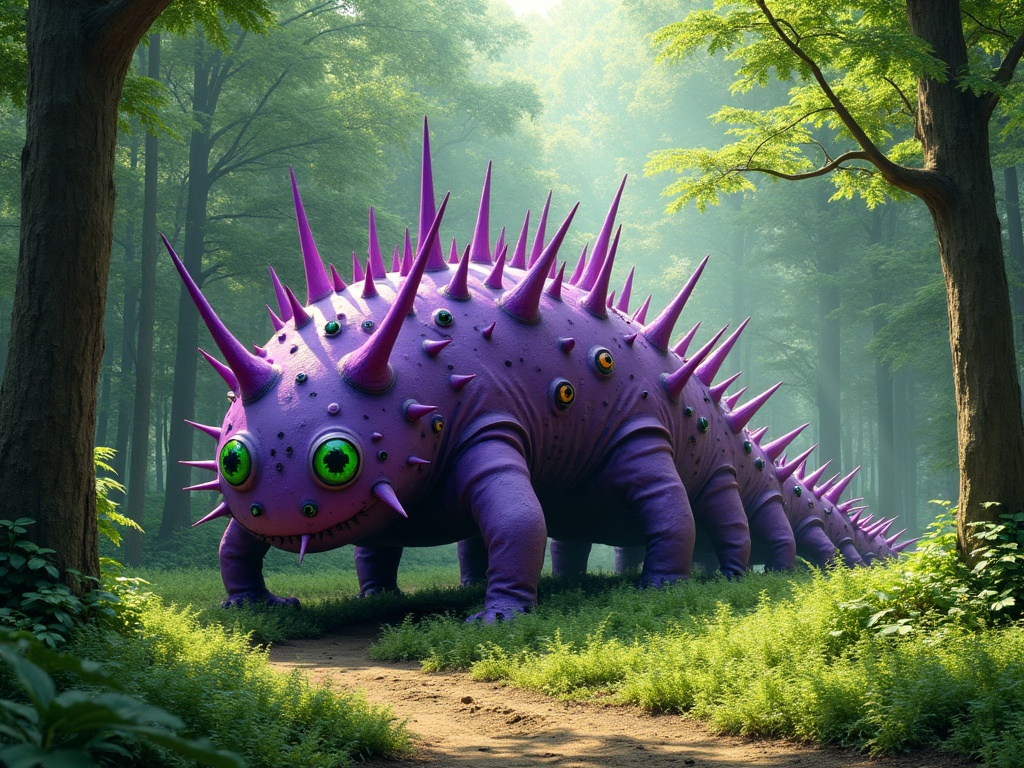
The sweeping landscape of heathland and woodland, thicket and stream that inspired the Heffalump, the Woozle and, most famously, Winnie-the-Pooh, has welcomed a new and curious inhabitant. Sliding through the bracken and releasing soft coos and purrs, this shapeshifting being sports a long tubular nose and eyes reminiscent of adders. Its body glimmers with iridescent flashes and the vivid purple of late-summer heather.
Poppet, a remarkable puppet designed by costume artist Jack Irving and animated by a team of 10 award-winning puppeteers, is performing for schoolchildren in Ashdown Forest, East Sussex. The visiting primary class squeals in delighted mock terror as the violet figure twists and transforms from caterpillar to bird to chomping monster in fluid, serpentine motions.
“What is it?” “It’s an alien!” “They’re dinosaurs.” “Dragons.” “We’re going to die!”
The shrieks are playful rather than fearful. Poppet seems far more intent on nibbling gorse and bracken than on troubling the young spectators—children who, in modern times, are rarely found roaming freely through forests.
This extraordinary creation stands at the heart of the forest’s Big One Hundred festival, a free celebration marking 100 years of Winnie-the-Pooh, the story that both immortalised—and arguably safeguarded—the largest stretch of open countryside in south-east England. The puppet and festivities were devised by Trigger, an outdoor arts charity known for ambitious large-scale creations, including The Hatchling, a dragon puppet as long as a double-decker bus that appeared during Queen Elizabeth II’s Platinum Jubilee in 2022. Beyond spectacle, the project carries a clear purpose: encouraging children and families, particularly those less familiar with rural spaces, to build a relationship with untamed nature.
“I’m drawn to those deep, mystical ideas that take root in childhood and never quite leave you—you feel compelled to return to those places,” says Angie Bual, Trigger’s creative director, who worked alongside local schoolchildren to imagine Poppet. Seeing the puppet move through Ashdown Forest for the first time, she reflects: “Theatre and outdoor arts can transform how we experience a place, reshape our memories of it and even alter how much we value it. The puppet looks extraordinary in this setting—far better than on a stage. But it also changes the landscape itself. Think of Christopher Robin placing his toys against a tree and letting the story unfold. Introducing something unexpected into nature brings out its magic.”
More than anyone, AA Milne infused the 2,500-hectare Ashdown Forest with enchantment. While celebrated for his wit and the enduring charm of Pooh, Piglet and their companions, Milne—together with illustrator EH Shepard—captured the quiet beauty of the countryside where he lived and explored with his son, Christopher Robin. Decades later, when the forest faced threats in the 1980s, Christopher Robin returned to help protect it. Today, the heathland is owned by the local council and managed as common land and a nature reserve.
That Ashdown’s hills and heaths would still feel familiar to Milne is striking, given that London lies only 35 miles away and the south-east has seen extensive development over the past century. The forest’s heathland remains home to rare species such as the silver-studded blue butterfly, adder, nightjar and Dartford warbler. On arrival, the first birdsong I hear is the call of a cuckoo—a sound increasingly scarce in southern England.
Equally rare is the sight of children freely playing among the trees. Independent adventures in nature are no longer typical of childhood. Rather than simply revisiting nostalgia for the 1920s world of Christopher Robin, the Big One Hundred aims to look ahead, inspiring new stories and fresh bonds with the natural environment. While Ashdown offers familiar attractions for Pooh enthusiasts, the organisers felt a strictly literary anniversary would be too limiting. “Young people are ready for a new kind of story,” Bual explains. “If you want to reach a broad and diverse audience, you need something that feels open and imaginative.”
During performances, Poppet cycles “through a carousel of natural forms,” shifting from caterpillar to crab to bird and eventually to plant. “It’s surprisingly difficult to invent a creature that doesn’t simply combine recognisable parts,” Bual says. “You want it to feel entirely new.” The creative process, she admits, has sparked some vividly unusual dreams.
Trigger intentionally designed Poppet as an open character, one that invites children to project their own interpretations. “The imagination can take over,” Bual says. For her, such artistic encounters heighten awareness of the subtleties around us. “Nature competes with bowling alleys, swimming pools and climbing walls. It’s quiet and understated. We know how restorative it is, but because it’s gentle, it’s easy to overlook. We’re simply giving it a little boost.”
Ashdown Forest itself has evolved since Christopher Robin’s era. Once 90% open heath, it is now closer to 60%, as traditional grazing has declined and trees have spread across the landscape.
Although trees are widely cherished, maintaining lowland heath—an increasingly rare habitat crucial for birds such as the nightjar and Dartford warbler—requires careful management. Beth Morgan, head of engagement and development at Ashdown Forest, explains that removing certain trees and controlling gorse can prompt questions from visitors. “When we explain the reasons, people usually understand. Ongoing conversation with visitors is essential so they appreciate why these actions matter.”
Poppet weaves this conservation message gently into its performance: the creature consumes gorse and bracken, and children can symbolically “feed” it. The aim is to animate what might otherwise be a routine environmental explanation. “When a playful monster embodies the need to manage the land, the message sticks,” Bual says.
Although Ashdown Forest welcomes around 1.5 million visitors annually, people from inner-city communities and diverse backgrounds are less likely to access such rural spaces. Alongside Poppet, the Big One Hundred includes nature-based activity badges, craft sessions, storytelling and yoga. Transport has been arranged to support participation from global majority communities and disabled-led groups.
As a British Asian, Bual recognises that time spent in nature is not equally embedded in every culture. She recalls country walks with her father, who would often ask, “Where are we going?” or “Is there a café?” Sometimes, she notes, an event provides the reason to set out. “Once you’re there, you discover joy along the way. That was Christopher Robin’s gift—finding delight in simple surroundings. If future generations are to protect these landscapes, they need to feel connected to them. Passion grows from a sense of belonging.”
Bual hopes that Poppet’s strange, enchanting presence will spark a profound sense of happiness in young visitors—an experience strong enough to inspire stewardship for decades to come. “When Poppet appeared, the children burst into laughter and excitement. You’re showing them that nature equals joy. Shared cultural moments create lasting memories. Those children will now feel something for Ashdown Forest. That emotional bond is what turns a place into a treasure—something that feels like it belongs to you.”
And how might Winnie-the-Pooh respond to this mysterious newcomer? Bual smiles. “I think he’d take it in his stride. He’d probably tell Piglet he’d known about it all along.”
The Big One Hundred features a programme of free cultural events at Ashdown Forest on 18–19 July, followed by appearances in Hailsham Town Centre on 26 July, Sheffield Park and Garden on 1 August, Uckfield’s Weald on the Field on 8 August, and Herstmonceux Castle on 22–23 August.