A 'haunting, crackling voice from the depths': When the world discovered whales could sing
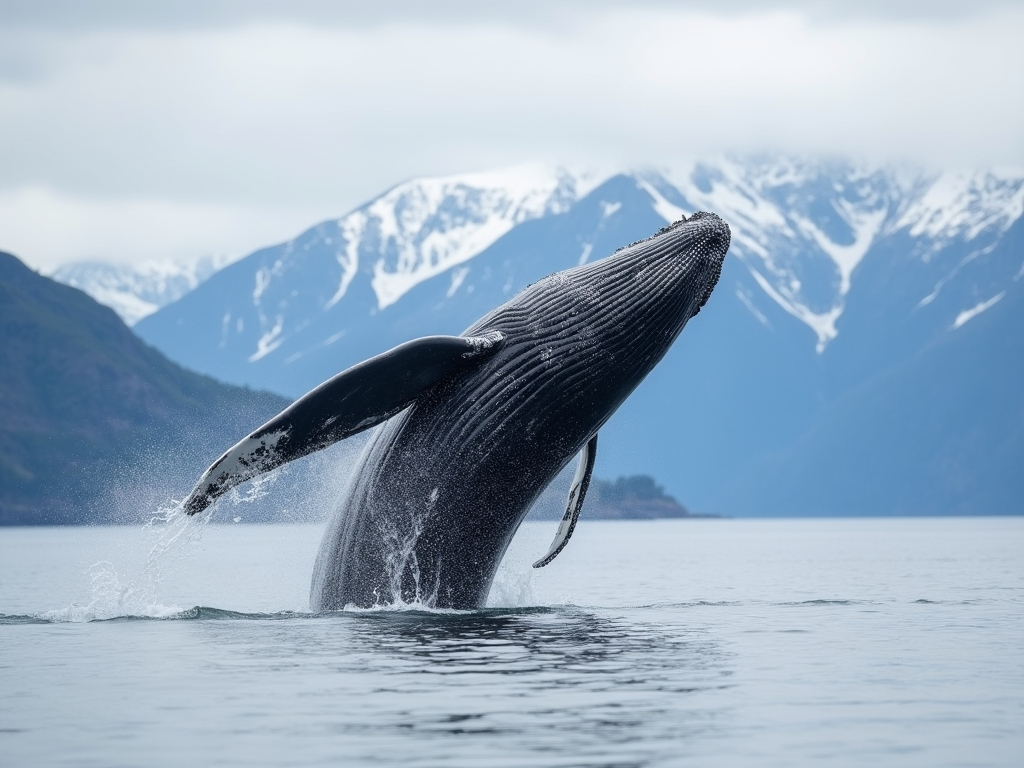
In 1970, the release of the most successful nature record ever made brought whale song to a huge audience and permanently changed the way people thought about whales.
It was 1952, at the peak of the Cold War. US sonar engineer Frank Watlington was working off Bermuda, listening beneath the waves for Soviet submarines and signs of seismic activity.
Watlington used an early hydrophone system: long cables fitted with microphones that could be lowered deep into the sea. Whatever military signals he may have encountered remains unknown, but he soon began hearing something entirely unexpected.
The strange, melancholy sounds could continue for hours at a time. Watlington was captivated. Although he could not initially prove it, he came to suspect that humpback whales were responsible.
He was correct. The remarkable early recordings made by Watlington and others would eventually alter human understanding of whales. When they appeared on the landmark 1970 album Songs of the Humpback Whale, they revealed the eerie and extraordinary world of whale song to people who had scarcely realised it existed.
Whale song quickly entered popular culture and became closely connected with the growing Save the Whales campaign, a movement that would help reverse the decline of humpback populations.
Watlington began playing his recordings for local residents and scientists. In 1967, he met acoustic biologists Katy and Roger Payne, who had come to Bermuda. He played the sounds for them in the engine room of his research boat, a wooden former Second World War minesweeper, with the generator thundering nearby.
"What I heard in unbelievably poor listening conditions was the most astonishing acoustic performance I had ever heard from an animal, or have heard from one since," Roger, who died in 2023, recalled in an interview in 2020.
The couple were struck by the beauty and enormous variety of the sounds. "As we later discovered, they were the sounds of a single animal," Katy said in 2015. "Just one animal."
Watlington loaned them a recording, and Katy, Roger and their collaborators – conservationist Scott McVay, mathematician Hella McVay and researcher Eleanora D'Arms – began trying to understand it.
They noticed that the sounds returned in lengthy, regular sequences. "You could not hear it a hundred times, as I did, without gradually recognising that," Roger said in 2020. "When an animal makes rhythmic sounds that repeat, that is what we call singing." A performance might last as long as 30 minutes before beginning again.
At the time, people broadly understood that whales made sounds, says whale researcher Nan Hauser, director of the Center for Cetacean Research and Conservation in the Cook Islands. But recognising those sounds as songs represented "a huge conceptual leap – from an animal producing noise to an animal creating an exceptionally elaborate, organised acoustic display".
Roger, an environmental campaigner devoted to protecting what he called the "wild world", rapidly understood that he was holding more than an important scientific finding.
He played the recordings wherever people would hear them: at anti-whaling demonstrations, scientific gatherings and dinner parties. "He was like a child with a new toy that everyone had to hear," says Iain Kerr, chief executive of Ocean Alliance, the US non-profit later founded by Roger Payne. "It was such a catalyst, making people think: these are singers, poets, composers."
Song is a relatively rare behaviour in nature, and connecting it with whales had a powerful effect on people, says Andy Rogan, a marine mammal biologist and Ocean Alliance's science and conservation director. Beyond humans, birds were generally the only animals widely believed to sing.
"In one sense it may not be so different from other animal behaviour. But why would an animal perform for half an hour? That requires a great deal of mental capacity."
In 1970, Roger, Katy and Watlington released Songs of the Humpback Whale, an album featuring five humpback recordings selected for their beauty and emotional impact on human listeners.
The record was an immediate triumph, carrying the haunting calls of humpbacks into millions of homes. It sold more than 125,000 copies, making it the best-selling nature album in history. An excerpt also went out to all 10.5 million subscribers of National Geographic, becoming the largest single pressing in recording history. "Nobody had truly heard anything like it before," Kerr says.
Roger used the album to build public support for whale conservation, mailing copies to musicians and influential figures. Artists including Judy Collins and Kate Bush incorporated whale sounds into their work. Recordings appeared in the 1986 film Star Trek IV, whose time-travel story centred on saving humpbacks from extinction. In 1977, an excerpt was also sent into space aboard the Voyager Golden Record.
Before 1970, encounters with recordings of large whales were unusual, says Max Bridge, an environmental historian at Harvard University who has researched the history of humpback song. "In popular films and cartoons of the 1960s, imagined large whales were generally silent, or they made animalistic grunts and growls."
The album arrived during a broader change in public attitudes towards whales, Rogan says. They had often been portrayed as dangerous creatures, as in tales such as Moby-Dick, or treated mainly as commercial resources. "Whales are now among the most charismatic animals that people grow up knowing about. I do not think that was true before these songs were released."
Whales had been hunted for centuries for products including oil for lamps and soap, as well as ambergris for perfume. By the early 1970s, several species stood close to extinction. Humpbacks were among them, with fewer than 5% of their pre-whaling population believed to remain.
Alongside mid-1970s images of whales being harpooned, captured by the newly established Greenpeace, Songs of the Humpback Whale helped energise the young anti-whaling movement. "It enabled ordinary people to hear whales at home," Hauser says. "You did not need to be a scientist to be emotionally affected by it."
As political pressure grew, the US Congress passed the Marine Mammal Protection Act in 1972. A binding global moratorium on commercial whaling followed in 1982, leading to a more complete ban in 1985-86.
Some whale populations began growing again, and humpbacks in particular have staged an extraordinary recovery. In certain areas, they are now observed in super-groups numbering hundreds of animals.
The discovery of whale song was also part of a larger transformation in environmental thought and in the study of animal intelligence.
Rachel Carson had published Silent Spring in 1962, investigating the environmental consequences of synthetic pesticides. The first Earth Day, held in 1970, mobilised around 20 million people. Meanwhile, researchers such as Jane Goodall and Dian Fossey were changing what the world understood about intelligent primates.
Whale song became a symbol of a wider ecological emergency, sometimes interpreted as a "mournful plea" from the natural world, Bridge says. By the end of the 1970s, however, US popular culture had become more sceptical of earnest environmental symbols such as whales and their songs. In the 1980s, the sound was embraced by New Age music. Even now, Bridge adds, whale recordings are often treated as a soothing escape from the pressures of office life.
At the same time, the discovery of whale song helped launch modern research into animals that had previously received little scientific attention, Rogan says.
Katy found that male humpbacks within the same area tend to sing versions of a shared song, and that the song changes over time. Scientists now know that these songs can travel between populations across vast stretches of ocean, at times rapidly replacing a previously established local song. "We are watching culture move through an ocean," Hauser says.
Humpbacks have the most complex whale songs known, with some features that resemble aspects of human language. Yet the sounds of other whales have also amazed scientists. Sperm whales communicate using Morse code-like click patterns known as codas and are now known to have regional dialects. Males also make separate, slower, deeper and extremely powerful clicks. Blue whales produce immense calls below the range of human hearing that can travel as far as 1,000 miles, or 1,600km.
Some scientists are now attempting to interpret whale communication and even explore whether meaningful exchanges with whales may be possible. Roger became involved in this work later in his life.
Today there are thousands of recordings of whale voices and other natural sounds valued by human listeners. Yet Kerr argues that few have the same "harmony or enchanting quality" as the recordings released in the 1970s. "They have a wonderful aesthetic: that crackling, haunting voice rising from the deep."
Perhaps that era simply included especially beautiful humpback songs, says Alyssa Wile, who digitises and preserves Ocean Alliance's large archive of marine mammal recordings from the 1950s through the 1990s, including many collected by Katy and Roger.
More to explore:
• Why humpback whales gather in super-groups
• The whale communication system that resembles an alphabet
• Sounds offering clues to the ocean's most elusive whales
Wile still remembers hearing Songs of the Humpback Whale as a child. "It is extraordinary, and every time I hear it, I still get chills."
Today, whales must communicate in a much noisier ocean shaped by human activity, making historic recordings particularly valuable, she says. "These recordings preserve a specific moment in time and place, as well as particular individuals. We can follow changes over time: how whales communicate differently and how the soundscape itself has changed."
Whales continue to face serious dangers, including collisions with vessels, entanglement in fishing gear, whaling in some countries, underwater noise and warming seas. One in four whale species is now threatened with extinction, compared with one in seven in 1991.
Even so, Songs of the Humpback Whale was "undeniably one of the great catalysts" for whale protection, Hauser says. "Most people would never see a live humpback whale, but suddenly they could put on a record and hear one. The question stopped being only, 'How many whales are left?' It became, 'What kind of beings are we killing?'"