‘Actual missiles and bombs were exploding’: How Saddam Hussein created a blockbuster-style Hollywood film in Iraq
In July 1983, Clash of Loyalties was shown publicly for the first time – and almost the last. Decades later, in 2020, its producer reflected on the extraordinary circumstances surrounding the production: military call-ups, tense interrogations, and an infamous incident involving a heavily intoxicated Oliver Reed.
The gravest danger to Saddam Hussein’s lavish, Hollywood-style epic was not the outbreak of the Iran-Iraq War in 1980, just weeks after filming had begun in the desert outside Baghdad. Nor was it the steady disappearance of cast and crew members summoned without warning to military service. It was not even the difficulty of transporting First World War prop weapons through Turkey, where suspicious customs officials halted the trucks, fearing they were carrying genuine arms destined for Iraqi forces.
Instead, the project nearly collapsed over a scandal in a hotel restaurant, when the film’s star, Oliver Reed, relieved himself into an empty wine bottle and instructed a waiter to deliver it to another table “with my compliments.” The film’s Iraqi-born British producer, Lateif Jorephani, later recalled that Iraqi authorities were outraged. Government ministers sent urgent messages demanding Reed’s removal. For Jorephani, dismissing the leading actor midway through a multimillion-pound production was unthinkable.
After intense negotiations, Jorephani convinced officials to allow Reed to remain, narrowly avoiding the need to reshoot the film. He described the struggle as relentless. The episode was just one of many crises during a production that lasted three years and cost $30 million — a sum comparable to major Hollywood blockbusters of the era. Yet despite its scale, Clash of Loyalties was screened only a handful of times. After premiering at the Moscow Film Festival in July 1983 and receiving an award, it faded from view, eventually stored away in film canisters in Jorephani’s Surrey garage.
This muted outcome stood in stark contrast to Saddam Hussein’s grand ambitions. After consolidating power in July 1979, the Iraqi leader envisioned building a domestic film industry capable of producing patriotic spectacles for global audiences. He imagined Baghdad becoming a cinematic hub of international stature.
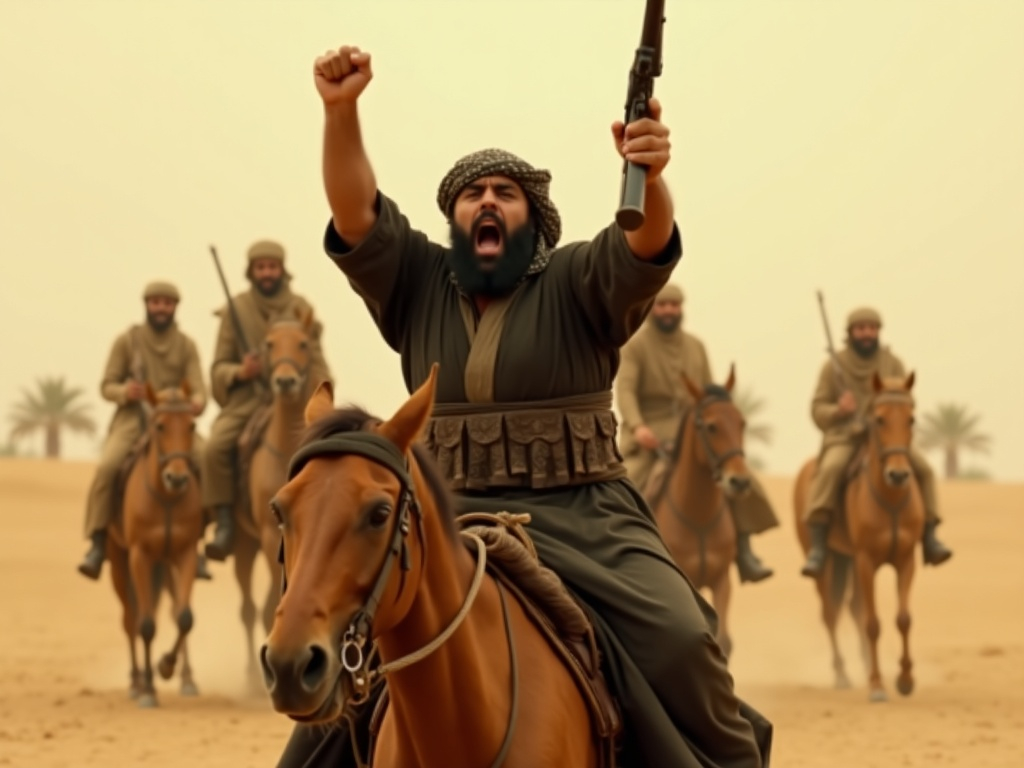
Hussein planned a series of large-scale productions to elevate Iraq’s global image. The first would link his Ba’ath party ideologically to the Iraqi revolutionaries who resisted British rule in 1920. Clash of Loyalties, also known as Al-mas’ala Al-Kubra (The Great Question), dramatized Iraq’s emergence from the remnants of Mesopotamia. One cast member described it as “Saddam’s answer to Lawrence of Arabia.”
The film drew on a real historical episode. During the 1920 uprising against British control, Lieutenant Colonel Gerald Leachman was killed near Fallujah. Hussein envisioned the story as a sweeping retelling of Iraq’s national birth.
Jorephani, who had worked in filmmaking since the 1950s and produced several low-budget features in the Middle East, was approached through contacts within the Iraqi government. With oil revenues surging during the 1970s, funding posed no obstacle. According to Jorephani, when officials asked Hussein about the budget required to break into international cinema, his response was simple: whatever was necessary.
The production spared no expense. Elaborate sets were constructed, special effects teams assembled, and hundreds of cast and crew members transported to Baghdad. Then Iraq invaded Iran. Jorephani later reflected on the surreal reality of having 140 film professionals — many accustomed to studios in Britain and the United States — suddenly working amid real missile strikes and bombings.
Although filming briefly paused, Iraqi authorities insisted that normal life should appear to continue. Leadership assured the production team that the conflict would be short-lived and encouraged them to proceed. After two weeks, cameras rolled again.
Yet signs of war were impossible to ignore. One actor recalled fighter jets escorting their plane into Iraqi airspace and landing without lights to avoid detection. Local performers were abruptly drafted, forcing scenes to be reshot. Meanwhile, prop weapons shipped from Britain were blocked at the Turkish border. Officials refused to allow military-looking equipment through a neutral country, despite explanations that the items were harmless film props.
To bypass the impasse, the production rerouted equipment through Greece, across the Mediterranean, through Lebanon and Syria, and finally overland to Baghdad — a costly and exhausting detour that tested everyone’s patience.
Another dramatic moment came during a scene involving the destruction of a train carrying troops and ammunition. The only suitable railway line lay near the Iranian border. Shortly after filming the explosion, Iranian media reported that their Revolutionary Guard had attacked and destroyed an Iraqi military train, claiming numerous casualties. The fictional sequence had been mistaken for real warfare.
Behind the scenes, tensions among the cast were equally intense. Reed’s behavior extended beyond the restaurant scandal to arm-wrestling contests, broken doors, and confrontations. Actor Marc Sinden later described seeing Reed dangled upside down from a fifth-floor hotel window after angering his minder, a former French special forces soldier. Reed, reportedly laughing throughout, seemed unfazed. Actress Virginia Denham later quipped that Reed himself was like a “weapon of mass destruction.”
Sinden encountered his own extraordinary situation. Before departing for Iraq, he was approached by two men claiming to represent a British government office. They encouraged him to photograph anything of potential military significance while abroad — communications towers, official buildings, palaces. Upon arrival in Baghdad, Iraqi secret police detained him for questioning after observing his photography.
During interrogation, Sinden defended himself by explaining that he was working on a film funded by Saddam Hussein and had recently dined with the leader. The claim secured his release, and he departed Iraq the following day still dressed in his 1920s military costume, complete with helmet and pistol.
After filming concluded, Jorephani completed post-production in London. Despite a few festival screenings, the film was shelved. Following Iraq’s invasion of Kuwait in 1990 and the imposition of long-term international sanctions, the project disappeared from public view. Hussein’s aspiration to establish a thriving Iraqi film industry capable of producing a succession of international epics never materialized. Instead, the grand experiment yielded a single, rarely seen film.
Looking back, Jorephani expressed regret that further collaborations never came to pass. Yet he also reflected on the broader context. After decades marked by conflict, destruction, and division, he suggested that filmmaking seemed insignificant by comparison.