Dolly Parton’s passion for the Great Smoky Mountains helped reshape her hometown
SEVIERVILLE, Tenn. (AP) — Dolly Parton did more than sing with affection about her Tennessee mountain home. Throughout her life, she lifted the profile of a frequently overlooked region, celebrating the place that shaped her music and helping create a tourism surge that permanently transformed communities near the Great Smoky Mountains.
That enduring loyalty made Parton’s death deeply personal across rural Sevier County. Around the globe, she was recognized as one of country music’s greatest stars. Among her neighbors, she remained Tennessee’s cherished daughter.
“It hit me hard. It hit me really hard,” said James Gambrell, a former Dollywood chef. Parton opened the signature theme park decades earlier after remembering that families like hers could not afford trips to Disneyland.
“If it doesn’t affect you, something is wrong,” Gambrell said of her death. He added that he became so close to Parton’s relatives that they came to regard him almost as a nephew.
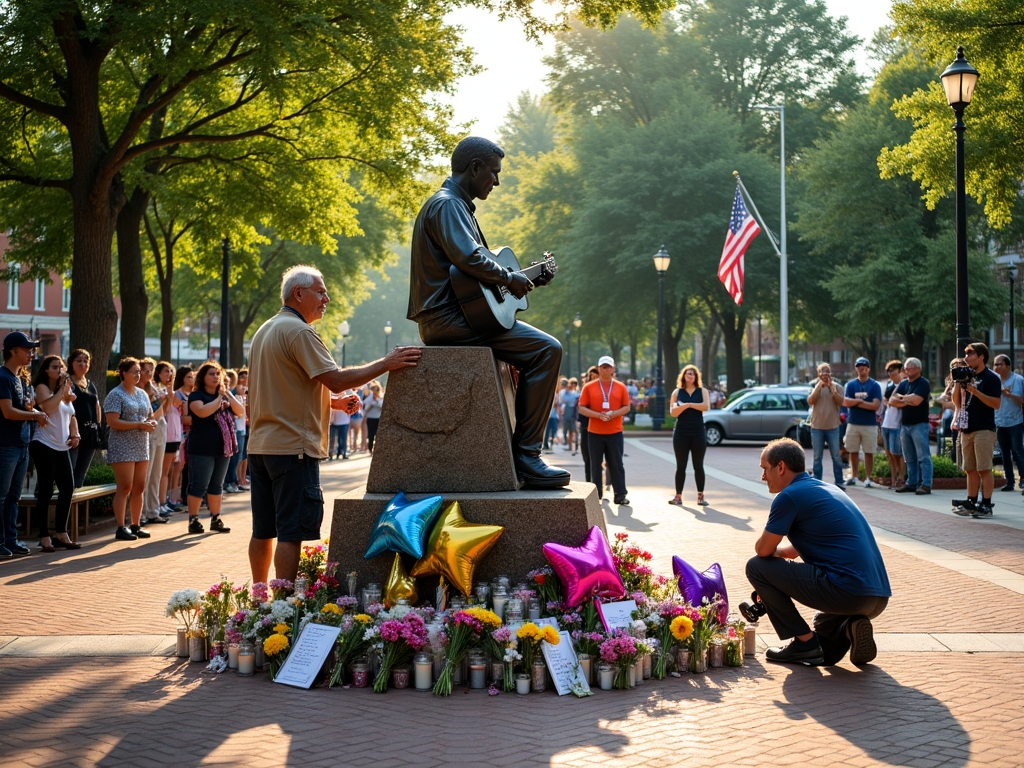
Mourners gathered Tuesday night around a bronze statue of Parton in downtown Sevierville, her hometown, sharing memories and wiping away tears. The community sits among the Smoky Mountain hills, only minutes from Dollywood. Visitors left flowers, artwork and other tributes honoring the singer.
At Dollywood on Wednesday morning, the aroma of cinnamon bread drifted through the park as long lines developed outside a theater presenting biographical accounts narrated by Parton. Because the park closes on Tuesdays, Wednesday offered many people their first opportunity to pay respects, including Carla Potts, who had flown from Seattle several days earlier.
“She constantly gave people joy, hope and light,” Potts said after arriving for her first visit to the park.
One of 12 siblings, Parton was raised in a two-room cabin without electricity or running water. Her songs portrayed East Tennessee as gentle and peaceful, with crickets singing in nearby fields. She left for Nashville soon after graduating from high school, but later joked that she might be the only person who departed the Smoky Mountains and carried them along with her.
The transformation began largely with Dollywood
The Smoky Mountains had attracted nature lovers for many years, but Parton broadened the region’s appeal when she became co-owner of a Pigeon Forge amusement park in 1986 and renamed it Dollywood. It soon developed into Tennessee’s most popular tourist attraction, with Parton frequently marking each new season through a performance and parade. State officials estimate that Dollywood contributes $1.8 billion annually and stands as Sevier County’s largest employer.
“Great Smoky Mountains National Park had been here since the 1930s, and Gatlinburg was already a major destination, but Dollywood helped move the county forward,” said Amanda Marr of the Sevierville Chamber of Commerce. “That business has had an enormous influence because it has attracted even more visitors to the region.”
Her commitment extended far beyond Dollywood
In the early 1990s, Parton established The Dollywood Foundation to reduce Sevier County’s high school dropout rate, which at the time was close to 30%.
David Wear, a former Pigeon Forge mayor, said he was in eighth grade when the Buddy Program began. It promised students and their assigned partners $500 toward college costs if they completed the initiative.
“If you and your buddy finished high school, The Dollywood Foundation provided money to those graduates,” he said. “I experienced her generosity personally.”
The foundation says Sevier County’s dropout rate ultimately fell to 6% after the program was introduced.
Parton’s Imagination Library, which later became an international success, also began as a community effort encouraging young children to read. Since its launch, more than 330 million books have been delivered to children in the United States, Canada, the United Kingdom, Ireland and Australia.
For many local residents, however, her response to a devastating 2016 wildfire remains the most emotional example of her compassion. The blaze started in Great Smoky Mountains National Park and spread into nearby Gatlinburg, killing 14 people and producing an estimated $2 billion in losses. Roughly 2,500 structures were damaged or destroyed.
Parton instructed her foundation to provide financial assistance to displaced households and established scholarships for students affected by the disaster.
“Through her generosity and ability to raise funds, she changed the course of our recovery almost single-handedly,” Wear said. “Her fame helped bring us back.”
Parton’s career and philanthropy also challenged long-standing stereotypes about Appalachian communities, said Ted Olson, a professor of Appalachian studies at East Tennessee State University.
“She recognized how outsiders perceived the region, but after meeting her or being encouraged by her to visit, it became difficult for them to keep those negative assumptions,” Olson said. “And she accomplished that with grace.”