A slow travel triumph in Slovenia’s hidden valley
The road to Pedrovo is thrillingly steep, and at every tight bend I find myself hoping no tractor appears around the corner. Near the village, we leave the car behind and walk the final stretch to the hamlet, a cluster of white houses with red roofs perched on a sharp karst slope. The warm, dry breeze carries the fragrance of wild sage.
A painted wooden sign points us towards Čilčevi Farmstead. We head down a flight of stone steps into a green garden, where a table waits beneath the trees with freshly made cheeses from the farm dairy. Far below, the valley opens out in both directions: a broad, level patchwork of farmland and vines enclosed by dramatic slopes, with the Vipava River curling slowly through it.
When the Vipava valley appears in Slovenian travel guides, it is often mentioned only briefly as a wine-producing area. About an hour south-west of Ljubljana, it reaches the Italian border at Nova Gorica, known as Gorizia across the frontier. Many travellers pass it by for the Soča valley to the north, tempted by its bright blue river and white-water rafting.
Vipava has been moulded by the burja, a fierce wind that rushes down from the Alps. It dries the rusty soil, pushes trees into crooked shapes and helps create ideal conditions for crisp wines and air-dried meats. Tourism has never been the main focus here, but I have come with my family to meet growers, hosts and small-business owners who are creating a visitor economy that benefits the people who live in the valley.
One reason tourism has developed gradually is the limited choice of places to stay. Beyond a few anonymous hotels aimed at business travellers and some holiday rentals, accommodation has been scarce. Wellba, a small guesthouse in Planina, is helping to shift that picture. A once-empty farmstead has been remade into rooms and self-catering apartments by a local couple using reclaimed materials and the skills of traditional craftspeople.
Marko and Tereza Kobal were raised on these slopes before moving to Ljubljana for work, then returning to establish a business and family life here. They wanted to make the kind of stay they themselves look for abroad. “Travellers want to find a place that is true to itself, without decoration or performance,” Marko says. We enter Wellba through an old-fashioned black kitchen, its surfaces stained by decades of smoke from wood fires. “The house needed a great deal of care, but it had character. We wanted to restore it properly so it can last another 300 years.”
Our apartment is bright and airy, combining old details with enough room to spread out, play cards and read on the balcony. From there, we look over the neighbouring farmyard and across the valley. A second derelict farm building beside it is due to become more accommodation in 2027. The couple are also developing a small hotel in Vipava town below. Eventually, they hope their children will take over Wellba and make their lives in the valley too.
Similar ventures are taking shape throughout Vipava: modest in scale, family-owned and built with patience. Tom Ločniškar and Borut Kokalj started Čilčevi Farmstead during the pandemic after moving to Pedrovo and becoming increasingly drawn to farming. “At first we just kept a few animals,” says Tom. “Now there are 150, which is a bit beyond a hobby.”
He remembers the rush to buy machinery and supplies before lockdown restrictions began. The pandemic also brought the farm its earliest customers, walkers passing through who wanted to buy directly from nearby producers. Tom and Borut raise Istrska sheep and Drežnica goats, rotating them through the dry karst pastureland every four days. After trying cheeses chilled straight from the dairy — soft goat’s cheese flavoured with fenugreek and a rich, mature sheep’s cheese — we climb the hill to see the goats.
Tom explains that Pedrovo had around 1,000 inhabitants in the early 20th century. By the 1970s, only two permanent residents remained, and the village stayed almost empty until the 1990s. “People left for the towns because village life was difficult,” he says. “It happened across many hillside communities. The slopes were too steep for tractors.” There are now about 20 full-time residents, while holiday homeowners increase that number considerably during busy periods.
Further along the village lane, I meet Alenka and Mark Smerajc, among the first families to move back and raise children while operating a business in Pedrovo. They have converted former farm buildings into two small holiday cottages and run an informal courtyard restaurant for guests, opening more widely at weekends and during holidays. “Visitors started asking for meals,” Alenka says simply, while her teenage children carry out plates of handmade pasta with local cheese and foraged herbs.
“There was almost no tourism in the Vipava valley, so we had the freedom to decide what it could become,” says Jani Peljhan. His ideas include GPS-based cycling routes along lanes too minor to have road signs, as well as wine trains that take guests from Nova Gorica to vineyards while winemakers lead tastings during the journey.
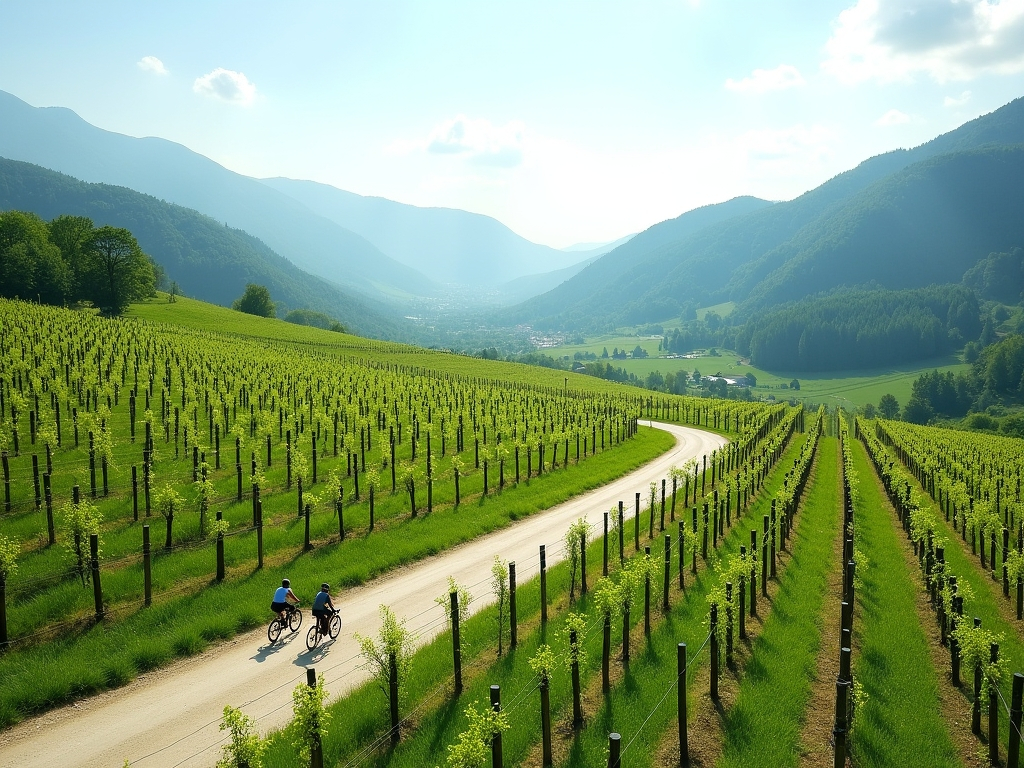
Jani’s business, Wajdušna, also organises walks and paragliding sessions, both increasingly popular in the area. He arrives at Wellba with e-bikes, and we ride through Ajdovščina to look for traces of the Roman past before climbing towards Vipavski Križ, said to be one of Slovenia’s smallest towns. We then wind back across the far side of the valley between vineyards. In the late-afternoon warmth, with steep climbs ahead, I become very grateful for the bikes’ power-assisted setting.
In many wine regions, tasting rooms, visitor centres and polished branding define the experience. In Vipava, it can still mean a meal at somebody’s table. At Vina Lisjak in Zalošče, I eat in a tiny restaurant run by two brothers. “The restaurant helps us present our wines,” Peter Lisjak explains. “Everything comes from the farm.” Large shared platters arrive with cured meats, aged cheeses from the hills, fennel frittata, slow-roasted celeriac with celery pesto and spinach. There is no hurry, just food, conversation and wine poured directly from barrels in the cellar.
From Wellba, we walk through the village to the Ferjančič vineyard, where seventh-generation producer Matic Ferjančič introduces his wines. His father expanded the family operation from five vines to 50,000. “The real work happens in the vineyard, so the cellar can stay simple,” he says. As we talk, he occasionally checks the baby monitor for the eighth generation sleeping upstairs.
Some of my best meals in Vipava are the unpretentious ones, but the valley’s cooking can also be highly ambitious. One evening, dressed as smartly as our luggage allows, we follow the narrow road to Zemono Manor for dinner at Gostilna Pri Lojzetu. Chef Tomaž Kavčič, an influential figure in Slovenian slow food, has earned a Michelin star for inventive dishes rooted in local ingredients.
We are served tender Vipava trout with fermented apricots preserved from last summer, followed by langoustine bisque from the coast. Classic dishes such as jota, a hearty stew of sauerkraut and potatoes, appear proudly rather than being disguised. There are playful moments too, including a juniper plant releasing scented vapour beside a sorbet, yet the mood remains warm and informal. Our server asks my young stepson what he might enjoy and soon returns with a substantial bowl of gnocchi. Kavčič is taking a night off, sitting with friends and a bottle of wine at the back, but he regularly circles the dining room to greet guests.
Vipava is unlikely to stay unnoticed forever. Yet the people establishing businesses here do not seem eager to turn it into the next heavily marketed wine hotspot. Their ambition is more measured, and perhaps more compelling: tourism that allows the valley to prosper while preserving the qualities that make it special.
The visit was supported by regional tourism organisations. Rooms at Wellba Planina are available from approximately £97 per night for two people.