No cars, no phone reception: Canada’s ghost island where visitors still check in
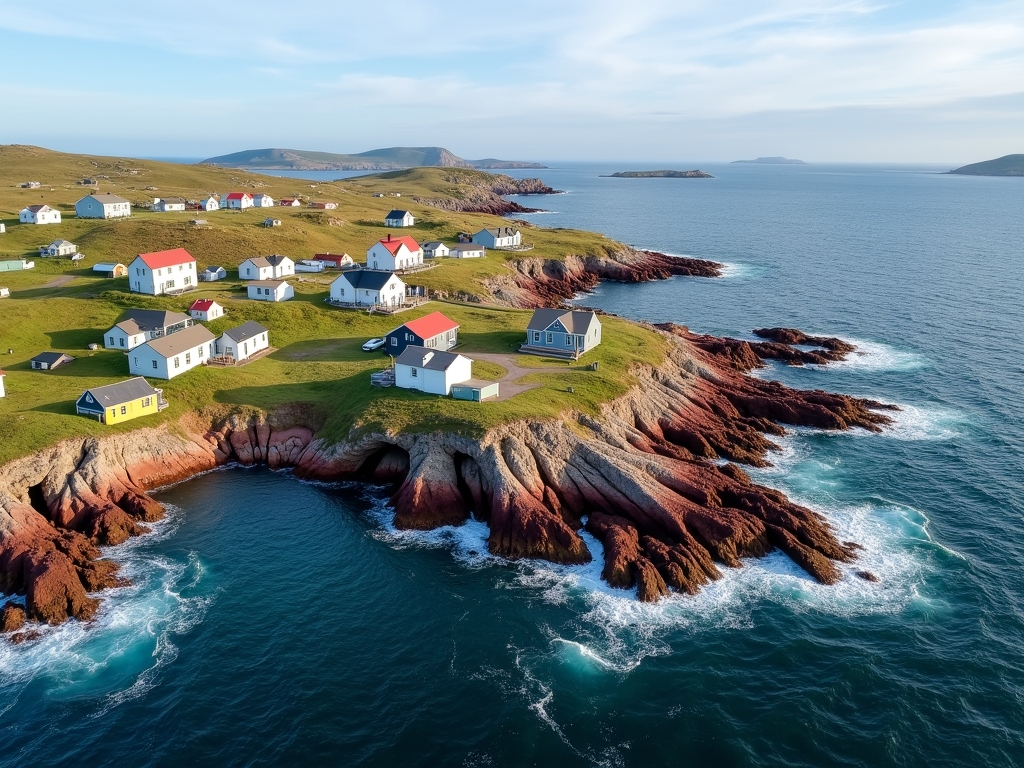
Once the bustling centre of Labrador’s fishing trade, Battle Harbour has been reborn as a remote island escape where modern life barely seems to exist.
Several fishermen gather along the wharf, sleeves pushed up as four men who once “lived here” split cod. Behind them, neatly dressed merchants and other fishers in oilskins pose outside a white clapboard building trimmed in rusty red.
Yet as our ferry nears the dock, there is something strange about the scene. Everyone is as still and grey as the clouds overhead.
I blink, then recall that Battle Harbour calls itself “nine miles from normal”. The men were indeed real around 1900, when this settlement was among the world’s great saltfish ports. Today, however, they have been lifted from old photographs and recreated as life-sized cardboard figures.
“Welcome to Battle Harbour,” says Peter Bull, executive director of the Battle Harbour Historic Trust, as we step from the ferry across a narrow wooden gangplank.
Bull immediately covers the essentials. Lunch is at 12:30. A guided walk begins at 13:30. A family of Arctic foxes lives near the old cemetery. Two historic wireless towers need restoration. There is no mobile signal, and only one shared Wi-Fi location. Sunrise is at 06:19. Wanda Fifield will show me to my room.
“This is the emergency system – you just switch this button on,” Fifield explains, pausing beside a walkie-talkie in the hallway. “If anything happens during the night, if you’re ill or injured, press the square button. Tell them what is wrong, and say you’re staying in the Merchant Building so they know which cottage to come to.”
With its restored timber houses, faded fishing stages where catches were once prepared and 16 private summer homes, Battle Harbour appears astonishingly intact. Still, nobody has lived here throughout the year for more than 50 years, and it has been even longer since it served as Labrador’s unofficial capital.
I have two nights to disappear into the past.
Reaching Battle Harbour is part of the experience. First comes a flight to Happy Valley-Goose Bay on mainland Labrador, followed by a five-hour drive along the forest-lined Expedition 51° highway, watching for moose and wishing for a roadside toilet. For much of the route, there are no services at all.
At the wharf in Mary’s Harbour, visitors board the daily passenger “ferry” – an impressive word for a vessel so compact that luggage may end up stored in the bathroom.
For 14.5km, or nine miles, the boat threads past rugged shores and low-lying islands. In fog, the landscape can feel almost unreal; beneath a grey sky, it seems stark and lonely. Gulls, kittiwakes and gannets often sweep beside the boat, while icebergs, humpback whales and minke whales sometimes appear offshore.
When the buildings of Battle Island finally emerge, it is difficult to imagine that this half-mile-long island once swarmed with merchants, crews and fishermen.
During the 1770s, English merchant John Slade established a trading business on the island, creating a route into Labrador’s lucrative fishing grounds. Cod was salted here before being shipped to Europe, the Caribbean and other markets. At its height, the community had a hospital, school, church and wireless station, with about 300 permanent residents. Thousands more seasonal workers arrived each year, including floaters who lived aboard schooners and stationers who put up temporary shelters on shore.
Eventually, Battle Harbour declined. A major fire in 1930, dwindling fish stocks and a provincial resettlement scheme in the 1960s steadily drained the settlement. By the 1970s, the last year-round residents had left.
The island suffered its final economic shock on 2 July 1992, when the federal cod moratorium shut down the fishery and abruptly left 30,000 people across Newfoundland and Labrador without work.
Today, Battle Harbour has the air of a ghost settlement, with restored buildings safeguarding a way of life that has almost disappeared. Managed by a trust, the car-free historic site welcomes guests for only about three months each summer. But for people who know it well, this is not a place that has been abandoned in spirit.
Bull’s own relationship with Battle Harbour reaches back more than a century, to the time when his grandfather fished along the Labrador coast. He has worked here since 2013, spending most of each summer on the island before returning to St John’s in September with enough cod, squid, mackerel and berries such as bakeapple and partridgeberry to last through winter.
“When I die, my ashes are going to be spread where I pick partridgeberries,” he says, “and I’m going to come back as a partridgeberry.”
Nelson Smith has a similarly deep connection to Battle Harbour. He helped restore many of its heritage buildings and has led tours here for almost 30 years.
“Every building smells different because of the different things that were stored in them,” Smith says in his strong Labrador accent. “If I use a word you don’t understand, stop me and I’ll explain it.”
In Newfoundland English, this collection of weathered structures is known as “the rooms”, while each individual “store” takes its name from its original purpose. The Pork Store carries a faint scent of molasses, while the Salt Store still holds the mineral used to preserve cod.
Our tour passes more photographic cutouts: an elegantly dressed merchant, a young fisher standing in a wooden boat and an older man seated beside a cod trap.
“The best saltfish, I likes it two years old,” Smith says, describing the process of cleaning, salting and drying cod on raised outdoor wooden platforms called flakes.
In the loft of the Salt Store, I stand where American polar explorer Robert E Peary held two press conferences in 1909, claiming that he had reached the North Pole. From the nearby Marconi station, he sent his first expedition report by wireless telegraph.
Guests can even sleep in some of these historic buildings. I am staying in the Harry Smith Room in the Merchant Building, named for a former employee of the island’s general store. There are also five restored cottages and another 12 ensuite bedrooms.
A quilt lies across my wooden bed, while a space heater works against the chill that remains inside the old building despite its careful restoration. There is no television, and silence fills the room. I settle into a swivel chair overlooking the sea and turn through the guestbook.
“Best view on the island. An iceberg was perfectly framed in our window.”
“This is somewhere you need to experience, not describe.”
“Such complete serenity.”
At dinner, communal tables are filled with Labrador char, pan-fried cod and moose pot pie. Talk turns to the Northern Lights, and I spend a restless first night looking out the window and walking onto the wraparound deck. I have more success at sunrise, following a dirt path to the old cemetery to watch foxes emerge from a den in the rocky slope.
From the cemetery, I follow the Battle Harbour Footpath for a 1.9km walk past a newer burial ground and a memorial to three men killed in a 1976 seaplane crash. Two local boys discovered the wreckage, parts of which remain nearby. One of those boys was Smith.
Toward the far end of the trail, the Marconi towers come into view: the last surviving pair of their type in North America. First built in 1906 and rebuilt in 1931, they used a wireless telegraph system based on radio waves. They once helped direct mariners and carry messages across great distances.
“They are very special, and they are an important part of the skyline here,” Bull says. The trust hopes to raise C$200,000 to repair them.
High winds cancel my plans to go cod fishing, but I manage a brief boat trip to Cape St Charles, the easternmost point on continental North America. Later, I cross the tickle, or channel, to hike on Great Caribou Island, where I meet Tanya Russell, a local postmistress and amateur photographer, in a patch of blueberries.
Russell tells me she loves “the quiet, the water, the salt air, the birds, the foxes – everything about Battle Harbour. And you gets to meet so many wonderful people.”
At my final breakfast, it is time to say goodbye to the other visitors and the life-sized figures around the island. Near my table is a cutout based on a famous black-and-white image taken here more than a century ago: a solemn boy standing between two enormous cod. The boy, Victor Croucher, is buried on the island. But in the dining hall, he becomes another quiet presence in a place that refuses to disappear.