For a Yemeni man, the World Cup stands as a symbol of war and peace
Mukalla, Yemen – A few weeks before the start of this year’s World Cup, Adel Mohsen’s backup battery stopped working. Without the money to replace it, he knew his home would be plunged into darkness whenever the frequent power cuts hit.
At the same time, a fuel shortage swept through his hometown of Mukalla in eastern Yemen. He struggled to find enough petrol for his motorbike, limiting his movement and making it harder to gather with others to watch matches.
Adel is deeply disappointed. Now 56, the devoted football fan has followed every World Cup since 1982, enduring wars, financial crises, and political upheaval. Yet this tournament feels different. More than a decade of conflict and economic collapse has left its mark on Yemen, and on him.
“This may be the worst World Cup for me,” Adel said, settling onto a wooden bench, his eyes locked on a giant public screen at a neighborhood stadium. “With all the power outages, I’ll probably miss many games.”
Although he paid for a subscription to a local broadcaster showing the matches, Adel could not afford the $200 needed for a new backup battery. Internet vouchers to stream games on his phone were also beyond his budget.
That made the local stadium his only realistic choice for watching World Cup 2026.
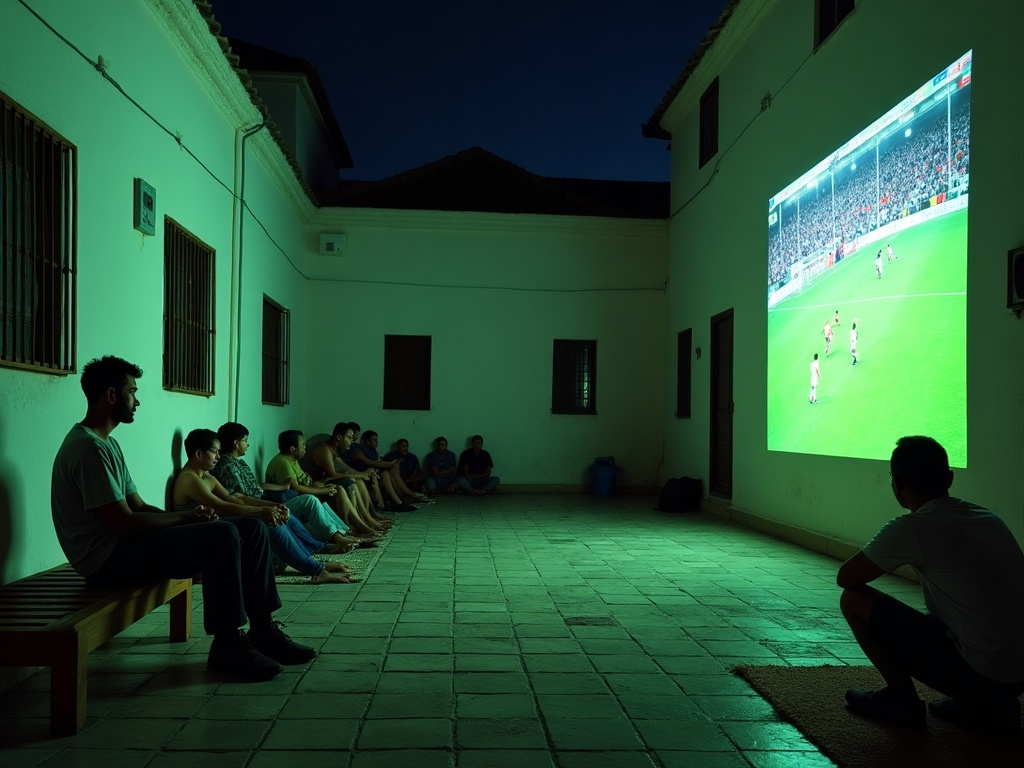
Just before the opening match between South Africa and Mexico, generators roared to life around the stadium grounds. The projector flickered on only minutes before kickoff.
The courtyard was dimly lit, its worn stone floor bearing the marks of time. Two men leaned against cement blocks, chewing qat, the mildly stimulating leaves commonly used in Yemen. Others reclined on a raised platform, scrolling through their phones between bites. The air was thick with heat and humidity, and sweat glistened on every face.
Adel quickly immersed himself in the match.
“Mexico will keep pressing until they score,” he predicted, glancing at his aging mobile phone where he had jotted notes for later commentary he hoped to share on local television or social media.
Moments later, Mexico found the net. Adel nodded with satisfaction. “I don’t watch as a casual fan anymore,” he explained. “I see the game through the eyes of an analyst. There aren’t many people here tonight because these teams don’t have huge followings. But when Brazil plays, or an Arab team, the stands are packed.”
Falling in love with football
The 1982 FIFA World Cup in Spain took place just a few years after television first reached Mukalla and other cities in what was then South Yemen.
Adel was 12 years old, and he vividly remembers the excitement and the places where people gathered to watch.
“It felt like a first love you never forget,” he said, smiling. “Even though I was just a child, I still remember the players and the stadiums. Brazil had an extraordinary team – Zico, Falcao, Eder. They were brilliant. And Italy’s defenders played so aggressively, especially Claudio Gentile, who got away with so much.”
He and his father and brothers would sit together in front of the television, captivated by every match.
“It was a family celebration,” he recalled. “Anyone who didn’t own a TV would join neighbors to watch. It brought everyone together.”
At the time, matches were recorded in Aden, the capital, and transported by bus to Mukalla. Viewers there saw the games a day late. “But because it was the first World Cup people experienced on television, it didn’t matter,” Adel said. “We watched as if it were happening live.”
Football through war
In January 1986, violent clashes between rival factions of the ruling Socialist Party devastated Aden, leaving thousands dead or injured. Later that year, as the country tried to recover, Mexico hosted the World Cup.
At 16, Adel sat in the same room of his family home, watching with greater understanding. “I was in secondary school by then,” he said. “I followed the matches more thoughtfully, not just for entertainment. That tournament belonged to Diego Maradona.”
By 1990, the year North and South Yemen unified, Adel was 20 and playing amateur football for local clubs. During the World Cup in Italy, he carefully studied tactics and techniques, trying to apply what he saw in matches across Sanaa, Aden, Hodeidah, and Taiz.
But unity soon unraveled. In 1994, civil war erupted as the United States hosted the tournament. Fear spread through Yemeni cities.
“That was the hardest World Cup for me,” Adel said. “People were anxious about the war and what would happen next. Security was fragile, and the electricity kept cutting out. I might catch one match and then miss the next three.”
As time passed, Adel gradually stepped back from playing and returned fully to being a spectator.
After the 1994 conflict ended, Yemen experienced a period of relative calm. The tournaments in 1998, 2002, 2006, and 2010 were easier for him to follow without major disruptions.
Then came the 2014 World Cup in Brazil, coinciding with Yemen’s slide into renewed turmoil. Armed groups expanded their reach, and political tensions deepened. “The country was entering another serious crisis,” Adel said.
Although Mukalla has largely avoided direct urban combat during the past 12 years of war, it has not been spared from instability. Clashes at the end of 2025 between rival Yemeni factions were a reminder of how fragile the situation remains.
More often than not, however, it is economic hardship and failing services that keep Adel from fully enjoying the sport he loves.
Despite blackouts, rising prices, and criticism from those who argue that sports are a distraction in a country facing immense suffering, Adel refuses to abandon his long-standing ritual.
“Football is a kind of relief,” he said, shifting on the bench as the bright screen cast light across his sweat-drenched face. “Some people ask why we care about football when the country has so many problems. But what are we supposed to do? Give up completely? The game gives us a brief escape from everything we endure.”
As for his prediction for this year’s champion, Adel does not hesitate: France.