Ukraine’s reconstruction to be discussed in Poland amid tensions between Kyiv and Warsaw
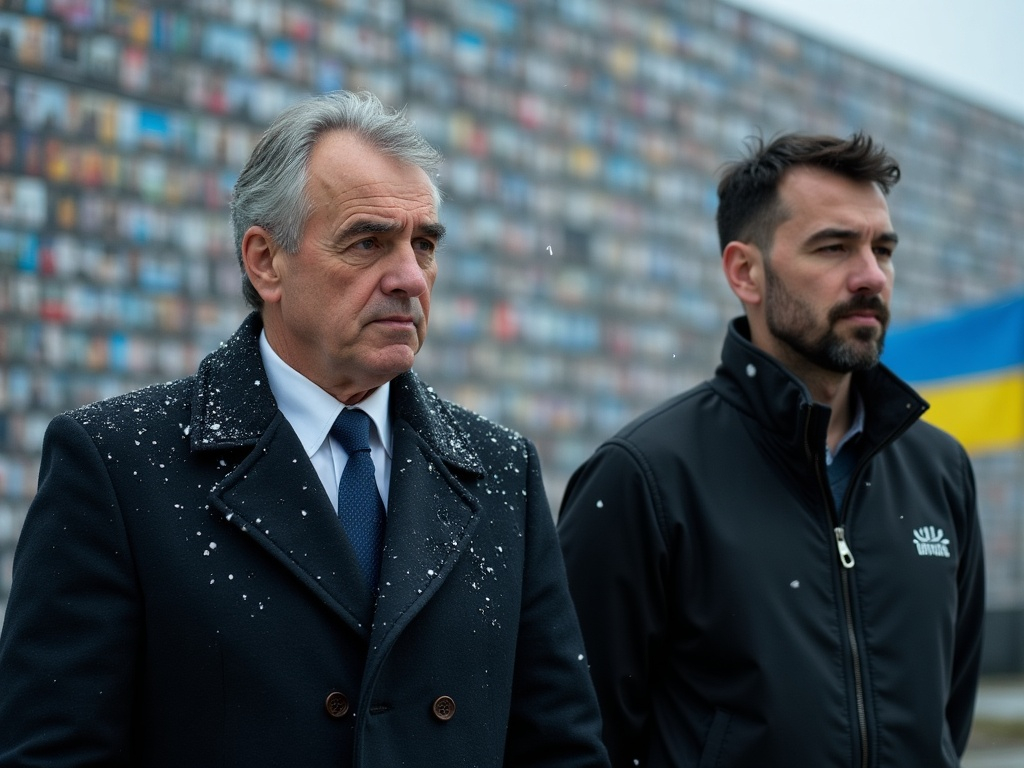
Kyiv, Ukraine – On May 22, Ukraine’s president, prime minister, parliament speaker, senior ministers and top military commanders stood in silence at a military cemetery outside Kyiv as soldiers carried the coffins of Andriy Melnyk and his wife, Sofiya, past the assembled officials.
The ceremony, Volodymyr Zelenskyy said, was intended to honour “Ukrainian heroes.” Melnyk had been a leading figure in the Organisation of Ukrainian Nationalists (OUN), a movement that sought an independent Ukrainian state. He died in West Germany in 1964.
Four days after the reburial – following the exhumation of the Melnyks’ ashes from Luxembourg – Zelenskyy announced that an elite military brigade would be renamed in tribute to “the heroes of the Ukrainian Insurgent Army,” commonly referred to by its Ukrainian acronym, UPA.
The UPA emerged from the OUN. During World War II, it fought against multiple forces and continued to resist the Sovietisation and Russification of western Ukrainian territories that had previously belonged to Poland.
Zelenskyy’s decisions triggered a sharp response from Polish President Karol Nawrocki, escalating into a diplomatic dispute that shows little sign of resolution.
Since Russia launched its full-scale invasion in 2022, Poland has served as a crucial logistical hub for Ukraine, supplying weapons and aid while also hosting millions of Ukrainian refugees.
On June 19, Nawrocki revoked Zelenskyy’s Order of the White Eagle, Poland’s highest state decoration, stating that the UPA “remains above all a formation responsible for brutal crimes against” Poles during World War II.
In retaliation, Kyrylo Budanov, Foreign Minister Andriy Sibiha and former President Petro Poroshenko returned the Polish honours they had received.
However, Anton Shekhotsov, director of the Vienna-based Centre for Democratic Integrity and a specialist on Europe’s far-right movements, said the disagreement is unlikely to weaken Poland’s backing of Ukraine, as both governments view Russia as a far greater and existential threat.
Much of present-day Poland had been under the rule of the Russian Empire for over a century, and after World War II the country became a Soviet-aligned state.
“In the Kremlin, they understand that such disputes do not change the broader reality, which is Poland’s continued military support for Ukraine,” he said.
At the same time, he warned that Russian-funded media engaged in information campaigns against Europe would likely exploit the controversy surrounding the UPA to sow discord between Warsaw and Kyiv.
On June 19, Poland’s prime minister attempted to ease tensions ahead of the Ukraine Recovery Conference, scheduled to take place in the northern Polish city of Gdansk.
“A conflict between Poland and Ukraine benefits Putin and unsettles our partners,” Donald Tusk wrote. “The real frontline lies elsewhere.”
Zelenskyy is not expected to attend the conference, with Prime Minister Yulia Svyrydenko heading Ukraine’s delegation instead.
What was the UPA?
The formation of the UPA was shaped by several factors, including strong nationalist aspirations, the upheaval of World War II and the trauma of the Holodomor – the man-made famine in the Soviet Union that killed millions of Ukrainians. Repression of religious leaders, believers and intellectuals, along with forced Russification and mass deportations, further intensified nationalist sentiment.
Some historians argue that UPA leaders initially viewed Nazi Germany as a lesser evil when it invaded the Soviet Union in 1941 and occupied much of Ukraine. The Nazis promised to dismantle collective farms and permit religious practice but had no intention of granting Ukraine independence.
Before later clashing with German forces, members of the UPA were involved in atrocities, including participation in the Holocaust and the killing of tens of thousands of ethnic Poles in western Ukraine, then part of Poland, according to historical research and survivor accounts.
“They also killed anyone who tried to protect the Poles,” said Nadiya, a 95-year-old woman from the Volyn region who witnessed the violence.
She was 12 years old when armed groups linked to the UPA entered her village on July 11, 1943, a date remembered in Poland as the Volyn Massacre.
Nadiya recalled that her father hid her in a haystack, saving her from assault and death.
She asked that her surname not be published, saying she does not feel secure in present-day Ukraine, where the UPA is widely commemorated and streets bear the names of its leaders.
Historian Ivan Katchanovski wrote in 2019 that Ukraine’s pro-Western leadership has “denied, minimised or justified” the UPA’s role in the killings.
He also stated that many UPA members assisted Nazi authorities in implementing genocidal policies against Jews, Ukrainians, Russians and Poles by helping carry out mass executions.
The glorification of the UPA, particularly its leader Stepan Bandera, has long divided Ukrainian society.
Annual marches marking Bandera’s January 1 birthday frequently prompt official protests from Poland and Israel.
These commemorations are typically organised by far-right and ultra-nationalist groups, many of whose members volunteered to fight Moscow-backed separatists in eastern Ukraine in 2014.
At that time, Ukraine’s regular armed forces were underprepared, and nationalist volunteer battalions played a significant role in pushing back separatist forces and confining their self-proclaimed “People’s Republics” to parts of the Donbas region.
‘Radical Ukrainian nationalists are a cheap force’
Some analysts suggest that the battlefield effectiveness of nationalist formations partly explains Zelenskyy’s symbolic support for the UPA, despite his own family history in the Holocaust.
“Radical Ukrainian nationalists represent a free or very inexpensive fighting force, and they actively mobilise young recruits through heroic narratives,” said Nikolay Mitrokhin, a researcher at Germany’s Bremen University who has studied far-right movements.
He added that the military units formed by nationalist groups have often performed more effectively than segments of the regular army.
Mitrokhin also argued that far-right thinkers exert influence over Ukraine’s political culture, shaping elements of the government’s ideological direction.
Another expert noted that the ongoing war with Russia simplifies public perceptions of historical figures associated with independence struggles.
“In the context of Ukraine’s fight for independence from Russia, those engaged in the current war and who value sovereignty tend to identify with earlier independence fighters,” said Vyacheslav Likhachev, an expert on Ukrainian and Russian ultra-nationalist movements.
“Other aspects of their historical record often become secondary in public memory and official policy,” he said.
“Among all the UPA’s former enemies, only one is seen as truly relevant today – the power we are fighting now, once embodied by the Soviet Union and today by Russia.”