
Roomba trailblazer seeks to reenter home market again with an AI-driven robotic pet companion
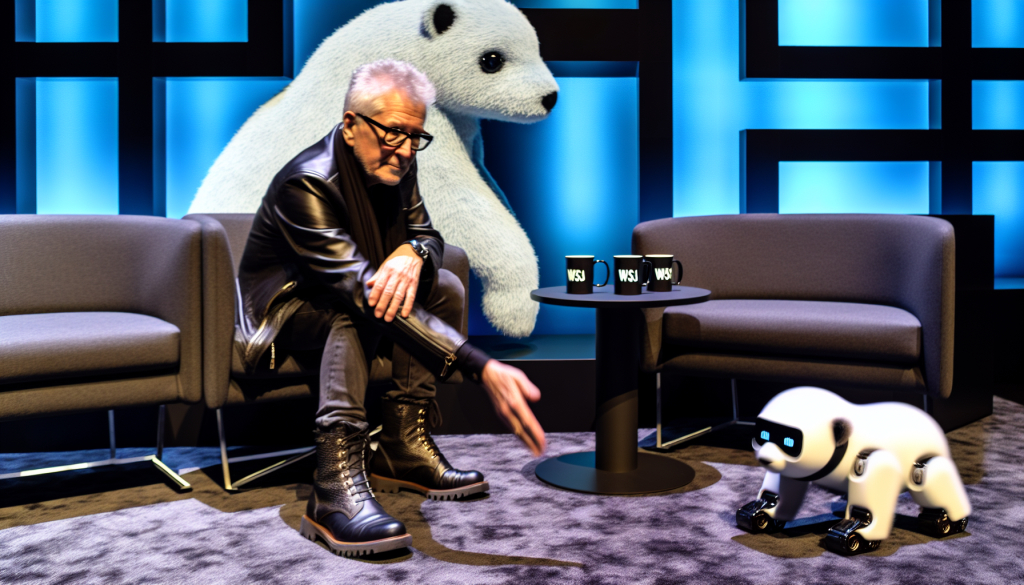
The robotics entrepreneur who helped bring the Roomba vacuum into millions of homes is now pursuing a new idea: a plush robotic companion that could one day stand in for a cherished dog or cat, trailing behind you and adjusting to your everyday routines.
On Monday, Colin Angle introduced a four-legged prototype of this artificial pet, known as the Familiar. About the size of a bulldog, it features wide, gentle eyes and rounded ears and paws reminiscent of a bear cub. The creature can stretch forward in a welcoming pose, inviting you to stroke its touch-sensitive synthetic fur.
“We deliberately avoided making it human, dog, or cat-like because we didn’t want people to bring those expectations to it,” said Angle, founder of the startup Familiar Machines & Magic and former longtime CEO of iRobot, the company behind the Roomba.
A lifelike machine of this kind — driven by today’s advanced artificial intelligence — would not have been feasible when Angle co-founded iRobot in 1990 or even when the first Roomba debuted in 2002.
Efforts to create robotic pets are not new. Sony, for example, introduced its small robotic dog Aibo in the late 1990s and later revived it in 2018. However, Angle argues that the Familiar offers something fundamentally different, something he says “hasn’t truly existed until now.”
“The goal isn’t to build a toy that performs on command,” Angle explained in an interview. “It’s about creating something you genuinely want to hold and pet. When it expresses happiness, you feel it too. And it’s big and mobile enough to follow you into the kitchen or coax you off the couch for a walk.”
According to Angle, the robot produces expressive, animal-like sounds but does not speak. Like a living pet, it has audio “ears” that pick up voices, supported by an AI system capable of understanding and learning from conversations. Powered by recent breakthroughs in generative AI, similar to those behind modern chatbots, the Familiar can gradually refine its behavior based on interactions with its household.
“Even six months ago, this wouldn’t have been possible,” Angle said.
Angle spent 25 years leading iRobot as it transformed the Roomba into the first widely embraced household robot. Over time, fierce competition — particularly from Chinese manufacturers — challenged the company’s dominance. In 2024, after Amazon abandoned plans to acquire iRobot, Angle stepped down as CEO and chairman.
Shortly thereafter, he launched Familiar Machines, operating quietly out of Woburn, Massachusetts until unveiling the prototype at a technology conference in New York.
Commercial availability may still be some time away, but Angle sees older adults — especially those hesitant to take on the responsibilities of pet ownership — as a key audience.
“It’s not that people lose their love for animals,” Angle said. “It’s that the responsibility and concern involved in caring for them can discourage people from adopting pets later in life.”
While many robotic concepts draw from science fiction, the notion of a “familiar” has roots in ancient folklore — from a witch’s cat to a wizard’s owl, and even the animal companions found in classic fantasy literature.
“It’s an old, almost forgotten word,” Angle noted, adding that he was surprised to secure it as a trademark.
Angle has assembled an advisory group of respected robotics experts. Among them are Marc Raibert, a leader in robot mobility and founder of Boston Dynamics, known for its four-legged robot Spot, and Cynthia Breazeal, creator of expressive social robots such as Kismet and Jibo.
Many of these advisers previously collaborated at the Massachusetts Institute of Technology and share doubts about the current enthusiasm for polished humanoid robots that mimic human movement but have limited practical capability.
Another adviser, Maja Matarić, a computer science professor at the University of Southern California, co-founded the field of socially assistive robotics 25 years ago. Her work focuses on robots designed to provide social and emotional support.
When she first encountered the Familiar prototype, she said she instinctively knelt beside it, hugged it, and began interacting with it to observe its responses.
Ensuring that people see the robot as charming rather than unsettling will be essential. Matarić pointed to decades of research in human-robot interaction showing that machines perceived as “cute, personalized, and slightly vulnerable” are far more appealing than those that feel cold or mechanical. Such robots could prove valuable in nursing homes or as emotional support tools, she added.
She also emphasized that recent advances in artificial intelligence have expanded what robots can achieve.
“Before generative AI, robots struggled to truly understand spoken language,” she said.



