Scientists detect a newly identified quasi-satellite orbiting close to Earth
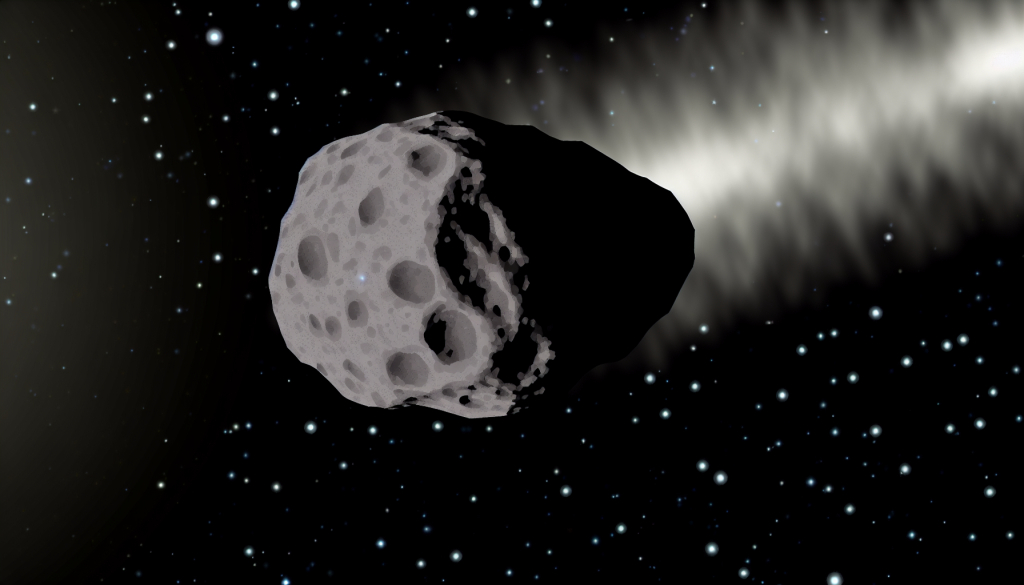
Scientists have recently identified a new quasi-moon orbiting close to Earth—a small asteroid that has likely gone unnoticed for nearly six decades. The discovery sheds light on objects that share a similar orbital path to our planet.
Named 2025 PN7, this space rock is classified as a near-Earth asteroid. It revolves around the sun in a yearly orbit much like Earth’s. What sets it apart is its consistent proximity to our planet during its journey around the sun.
Unlike temporary satellites such as 2024 PT5—believed to be a fragment from the moon that briefly orbited Earth—quasi-moons like 2025 PN7 do not actually revolve around our planet. Instead, they follow a stable path near Earth while orbiting the sun.
2025 PN7 joins a small group of known quasi-satellites that remain relatively close to our planet. One such example is Kamo‘oalewa, which is also suspected to be moon debris. This particular object is the target of China’s Tianwen-2 mission, aimed at collecting samples and returning them by 2027. In total, seven such quasi-moons are currently known, according to the European Space Agency.
The asteroid was detected by the Pan-STARRS observatory on Hawaii’s Haleakala volcano on August 29. Archival data traced its Earth-like path back several decades, despite its visual elusiveness.
Because of its small size and dim appearance, 2025 PN7 went undetected for years, explained Carlos de la Fuente Marcos, a mathematical sciences researcher at the Complutense University of Madrid. He authored a recent study on the object, which was published on September 2 in the Research Notes of the American Astronomical Society.
The asteroid occasionally comes within 186,000 miles (299,337 kilometers) of Earth, making it closer than the moon's average distance of 238,855 miles (384,400 kilometers), according to NASA.
“It only becomes visible to today’s telescopes during close approaches, like one that occurred this summer,” de la Fuente Marcos noted. “Its windows of visibility are rare, which makes it a challenging object to observe.”
Studying quasi-moons like 2025 PN7 offers valuable insights into Earth’s cosmic surroundings, according to de la Fuente Marcos.
“The Solar System constantly surprises us, and that's why we continue our search,” he said via email. “The presence of 2025 PN7 suggests there may be no minimum size for a quasi-satellite.”
A short-term partner
Researchers are still working to determine the exact size of 2025 PN7. A rough estimate puts its diameter at about 98 feet (30 meters), though it could be as small as 62 feet (19 meters), according to other observations.
Currently, it is the smallest quasi-moon observed in an orbit that closely follows Earth’s, said de la Fuente Marcos.
Over time, its orbit shifts between a tighter, Earth-like loop and a larger, horseshoe-shaped path—similar to Kamo‘oalewa’s pattern. During the latter orbit, it can reach distances as far as 185 million miles (297 million kilometers) away.
Scientists expect 2025 PN7 to remain in its nearby orbit for another 60 years before drifting back into a more distant horseshoe orbit, influenced by solar gravity.
The object’s exact makeup remains uncertain, but is likely natural and rocky, said Dr. Teddy Kareta, an assistant professor at Villanova University’s department of astrophysics and planetary science. Although his schedule to observe the asteroid has so far been set back by poor weather, Kareta said such orbits usually reveal whether an object is natural or artificial based on their movements over time.
Although it’s possible that 2025 PN7 could be a fragment of the moon, further evidence is needed to confirm any link, de la Fuente Marcos added.
He hypothesizes the asteroid originated from what’s known as the Arjuna asteroid group. Unlike the main asteroid belt between Mars and Jupiter, the Arjuna objects are small and share Earth-like orbits around the sun.
De la Fuente Marcos had previously suggested that another small object, 2024 PT5, might also have lunar origins before joining this group.
“We now believe that fragments from impacts on the moon may eventually become part of the Arjuna asteroid population,” he explained.
While such objects can pass quite close to Earth, 2025 PN7 poses no danger, he said. In fact, its potential value lies in research opportunities.
Similar to China’s Tianwen-2 mission to Kamo‘oalewa, future ventures to study quasi-moons could deepen our understanding of their origins—and support new exploration technologies, added de la Fuente Marcos.
“These types of asteroids are more accessible to robotic missions and offer a viable testing ground for new space exploration tools without requiring extensive resources,” he concluded.