Astronomers suggest Earth’s recent "mini-moon" could be a fragment of the moon itself
Subscribe to CNN's Wonder Theory Science Newsletter. Dive into updates on groundbreaking discoveries, innovative scientific research, and the mysteries of the cosmos.
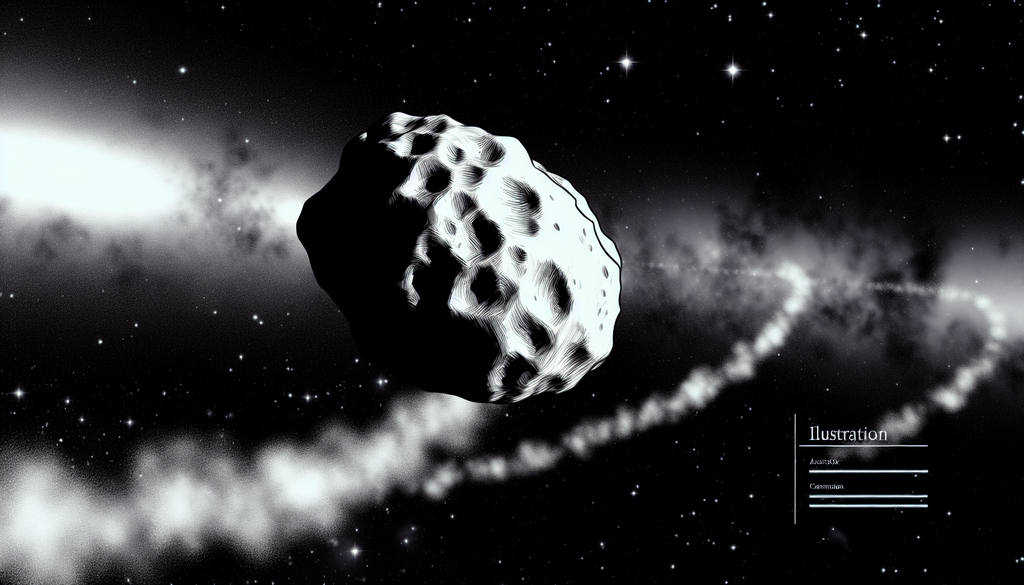
A tiny celestial object, once nicknamed Earth's temporary "mini-moon" last year, could actually be a fragment of the Moon that broke away thousands of years ago.
The near-Earth body, officially named 2024 PT5, has an estimated width of 33 feet (10 meters). Even so, researchers confirm that its trajectory poses no risk to our planet, either now or in the foreseeable decades. Following its close encounter with Earth, 2024 PT5 is gradually drifting farther away into a more distant orbit.
What intrigued scientists was that its path around the Sun closely mirrors Earth's own orbit, hinting that 2024 PT5 might have originated within our solar system neighborhood.
The asteroid was initially detected on August 7 by ATLAS (Asteroid Terrestrial-impact Last Alert System), a NASA-supported observatory located in South Africa.
Although predictions had suggested the asteroid might temporarily become a "mini-moon" for Earth, its movements followed a horseshoe-shaped orbit, which brought it close without ever fully entering an orbit around the planet. However, what makes this near-miss notable is the possibility that 2024 PT5 might be a fragment of Earth's natural satellite, the Moon, says Dr. Teddy Kareta, a postdoctoral associate at Arizona’s Lowell Observatory.
Dr. Kareta, along with his research team, presented their findings in a study published on January 14 in the Astrophysical Journal Letters.
“Though it never actually orbited Earth, the object's movement—approaching Earth, shaping its trajectory due to the Earth-Moon system’s gravitational pull, and receding in a horseshoe-shaped path—does not lend itself to catchy naming conventions,” Kareta explained via email. “It essentially traced this rare trajectory for about two months. Since this kind of orbit is so infrequent, it’s unsurprising there isn’t a proper term for it yet.”
During their observations, researchers used the Lowell Discovery Telescope and NASA’s Infrared Telescope Facility located at the Mauna Kea Observatory in Hawaii. By analyzing sunlight reflected off 2024 PT5’s surface, they noticed it bore remarkable resemblance to samples brought back from the Moon.
“We had hypothesized this asteroid might have lunar origins, but the defining evidence was its high content of silicate minerals—materials more commonly found in lunar rock than in typical asteroids,” Kareta noted. “Its relatively pristine state suggests it’s been in space for only a few thousand years.”
This discovery provides insights into an emerging category of lunar-origin asteroids, revealing how impacts on the Moon have occasionally catapulted fragments into Earth’s vicinity.
Eliminating Space Debris
Kareta and his team, who regularly study near-Earth asteroids, had turned their attention toward 2024 PT5 before rumors of its "mini-moon" status took hold.
To confirm that the object was a celestial asteroid and not a piece of human-made space debris, such as a discarded rocket booster, the team analyzed its movement under the influence of solar radiation pressure. This pressure, caused by photons (tiny particles of light), interacts differently with natural space rocks compared to hollow, lightweight objects like old spacecraft components.
For instance, photons striking a hollow rocket booster cause exaggerated motions akin to an empty tin can being blown by the wind. Conversely, denser objects like asteroids are much less influenced by solar radiation pressure. NASA’s Center for Near-Earth Object Studies (CNEOS), which monitors both asteroids and debris, verified that 2024 PT5’s movement matched that of a solid space rock.
“Asteroids and human-made debris exhibit distinct behaviors in space,” commented study coauthor Oscar Fuentes-Muñoz, a postdoctoral researcher at NASA’s Jet Propulsion Laboratory. “Unlike lightweight debris pushed around by sunlight, 2024 PT5’s motion confirms its dense nature.”
Related: Doorbell Camera Catches Rare Footage of Meteorite Striking a Front Walkway
Robert Jedicke, an expert on solar system objects at the University of Hawaii, deemed the study's lunar origin conclusions credible, noting the thoroughness of the research. Though not involved in the study, Jedicke remarked, “The idea that objects like 2024 PT5 could be Moon fragments launched by past impacts is entirely plausible.”
This aligns with prior assessments. In September, Carlos de la Fuente Marcos of the Complutense University of Madrid published research also suggesting 2024 PT5 resulted from lunar debris, supporting earlier theories proposed by CNEOS director Paul Chodas.
De la Fuente Marcos even proposed that 2024 PT5 might belong to the Arjuna asteroid group, a collection of small objects with Earth-like solar orbits. If true, this identification could redefine understanding of the group’s makeup.
Classifying Lunar Fragments
Based on the asteroid's lack of surface weathering, Kareta estimates its lifespan to be under a few million years, but likely far younger. Its reflective properties closely align with material from the bright, rugged Lunar Highlands.
If researchers can connect lunar-origin asteroids to specific Moon craters, these fragments could unlock secrets about both the Moon’s surface and its deeper layers.
To date, only one other confirmed lunar-origin object, asteroid 469219 Kamo’oalewa, was discovered in 2016. Like 2024 PT5, it’s believed to be a chunk of the Moon dislodged by an ancient impact.
Related: Astronomers Discover Two Populations of Unusual Dark Comets in Our Solar System
The recent discovery reignites hope among astronomers for identifying more lunar fragments. “With just one object, it’s easy to dismiss it as an anomaly,” Kareta observed. “But finding a second strongly suggests there’s an entire population waiting to be explored.”
Kareta and his team estimate there could be up to 16 lunar-origin asteroids already known yet awaiting confirmation.
“Studying this population can reveal valuable data on the frequency of Moon-origin fragments and their behaviors,” he added. “This information could help us piece together a broader context of lunar impacts.”
Future technology like Chile’s Vera Rubin Observatory and NASA’s upcoming space-based NEO Surveyor is expected to detect more smaller, fainter asteroids, including potential lunar-origin candidates. Kareta emphasized the need for improved methods to filter out potential candidates for observation.
“Searching for them feels like hunting for a needle in a haystack—where the needles don’t stand out from the hay until examined under a telescope,” he concluded.