The Seine was once a polluted disaster. Now it’s Paris’s trendiest new place to take a swim
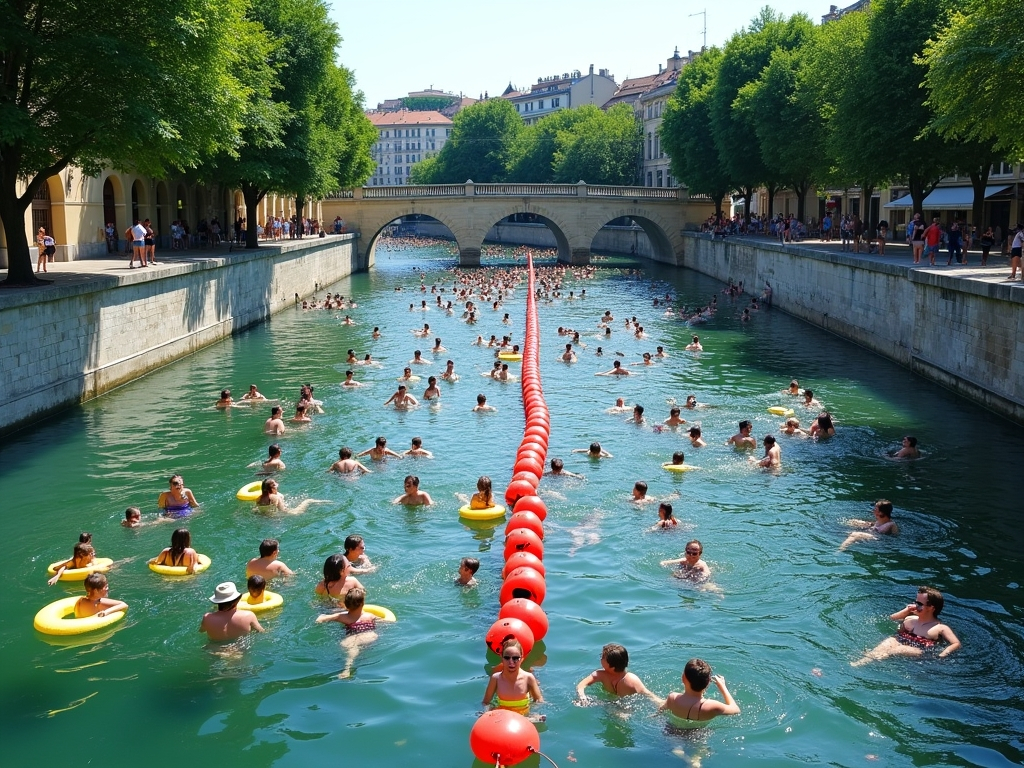
If you’re heading to Paris this summer, you might consider adding a swim in the Seine to your plans. After the intense heat the city has endured in recent weeks, it may feel less like a novelty and more like a necessity.
Paris recently recorded its hottest day ever, with temperatures climbing above 104 degrees Fahrenheit (40 degrees Celsius) in late June. As a third heatwave approaches, the reopening of three designated swimming areas along the river arrives at exactly the right moment.
Beginning Saturday, both locals and visitors can once again dive into the Seine for the second consecutive summer. A prohibition that lasted more than a century has given way to what is quickly becoming a defining feature of summer in the French capital.
This year’s opening also coincides with celebrations marking 250 years of Franco-American friendship. For American travelers, taking a dip in the Seine may be one of the most distinctly Parisian ways to celebrate the Fourth of July.
Centuries in the water
Although river swimming might seem like a recent innovation, Paris shares a long and complicated relationship with the Seine.
In the 17th century, swimming was an informal — and often nude — activity along the river’s sloping banks. Authorities banned the practice in 1716, citing concerns about public decency. By the 18th century, floating bathhouses emerged: flat-bottomed structures covered in canvas where swimmers descended ladders into a cordoned-off section of the river, protected from the current.
During the 19th century, bathing transformed from a simple way to cool off into a popular social and sporting pursuit. Upscale establishments along the riverbanks featured cafés, restaurants and swimming instruction. Among them was the famed Piscine Deligny, which became one of Paris’ most fashionable venues and even hosted swimming competitions during the 1900 Olympic Games.
However, this golden era began to wane in the early 20th century. A rise in drownings and accidents involving river traffic prompted the French government to impose a total ban on swimming in 1923.
The Deligny adapted by converting into a floating pool with filtered water, separate from the river itself, and remained a Paris landmark until it mysteriously sank in 1993. Despite the ban, some residents continued to swim illegally during hot spells, and a long-distance race established in 1905 carried on in open defiance of official rules.
Biologically dead
Ultimately, it wasn’t legislation that ended swimming culture in Paris — it was pollution.
Throughout the mid-20th century, water quality deteriorated dramatically. By the 1970s, the Seine had effectively become an open sewer, with more than half of the surrounding region’s wastewater discharged directly into the river without treatment. The environmental consequences were severe. By 1970, the Seine was considered biologically dead, its fish population reduced to just three hardy species.
Efforts to repair the damage gained momentum in the mid-1980s and led to a bold political promise. In 1988, then-mayor Jacques Chirac vowed that he would swim in the Seine within three years to prove it was clean. He repeated the pledge publicly in 1990, but never fulfilled it, and the promise became a long-running joke. The river remained heavily polluted for decades. As recently as 2013, unsafe water quality forced the cancellation of the Paris triathlon.
The billion-euro fix
The unkept promise resurfaced in 2016 when mayor Anne Hidalgo revived the goal as part of Paris’ successful bid for the 2024 Olympic Games. This time, fulfilling it required more than a billion euros and a vast infrastructure overhaul. The city upgraded wastewater treatment facilities and connected thousands of riverside residences to the sewer system for the first time.
At the heart of the project is a massive underground reservoir near Gare d’Austerlitz. This enormous concrete cylinder measures 50 meters across and 30 meters deep, supported by pillars anchored far below ground. It can store 50,000 cubic meters of stormwater — equivalent to about 20 Olympic-sized swimming pools.
Paris’ 19th-century sewer network, designed during Baron Haussmann’s transformation of the city, channels rainwater and wastewater through the same pipes. During heavy rainfall, excess flow would previously spill straight into the Seine. Now, overflow is diverted into the Austerlitz basin, where it is stored until conditions improve and then gradually pumped to treatment plants outside the capital. Officials report that major sewage discharges into the river have dropped from around 15 annually to roughly two.
Back in the water
The cleanup was completed in time for Olympic triathlon and marathon swimming events. Although some athletes later reported illness, no direct link to water quality was established. More importantly, the psychological barrier surrounding the Seine was finally broken. In the first public season in 2025, approximately 100,000 people took advantage of the opportunity to swim.
This summer, the city has fine-tuned the setup and now offers three free, clearly defined swimming areas.
At Bras Marie, located beneath the 19th-century Pont Louis-Philippe near Notre-Dame, swimmers enjoy postcard views of historic Paris.
Further west, Grenelle provides the chance to swim while facing the Eiffel Tower and a scaled replica of the Statue of Liberty.
In eastern Paris, Bercy is the largest site and ideal for stronger swimmers. One of its two pools extends 67 meters, with the National Library visible across the water.
A rite of passage
It’s worth noting that this is not the French Riviera. The water tends toward a murky khaki rather than a brilliant blue, and swimmers may spot occasional debris. The scent can also be less than fresh. Still, the novelty and symbolism of swimming in the Seine make it a memorable experience.
As at the beach, a flag system signals daily conditions. Green indicates safe swimming, yellow advises caution — often due to currents or storms — and red means the water is off-limits because of weather or quality concerns.
The system is not perfect. Last July, green flags flew on only 18 of 31 days. Water is tested daily for contamination, particularly for bacteria such as E. coli. When levels exceed safety thresholds, swimming areas close for a day or two to allow the river to recover.
Even so, enthusiasm continues to grow. Building on its renewed sporting identity, the Grenelle site will host open-water and high-diving competitions during the European Swimming Championships later this month — the first time Paris has staged the event since 1931.
Whether the enormous investment in cleaning the Seine was justified remains a subject of debate. But as another heatwave approaches and temperatures climb once more, many Parisians may soon render their verdict by stepping into the river themselves.