‘Sleeping inside a sculpture is a brilliant idea’: hiking Andy Goldsworthy’s vast art trail through Haute-Provence
At 69, I had never gone backpacking and barely knew what land art meant. Still, when my friend Jackie, a wildlife documentary-maker, asked whether I wanted to join her, Wendy and Sasha on a walking trip through the Refuges d’Art in the mountains of Haute-Provence, I answered with an enthusiastic yes. We would spend our nights beside sculptures created by the celebrated land artist Andy Goldsworthy.
Before leaving, I watched Rivers and Tides, a film about Goldsworthy’s practice, and learned that he had made delicate ice works and stone structures in Canada, where I live. His art appeared to reach something ancient and instinctive. I also began training on local hills, adding more weight to my pack each week until I could manage 9kg comfortably.
We gathered in Digne-les-Bains, an active mountain town at the heart of Haute-Provence’s Unesco geopark. It is the starting point for a 10-day, 150km hiking circuit, with seven free but bookable off-grid shelters along the way. Goldsworthy collaborated with local builders to revive old shepherds’ cabins, farm buildings, a chapel and stone shelters, placing a work made specifically for each site. During our four-day journey, we planned to see three refuges and cover roughly 45km.
Our first destination in Digne-les-Bains was Maison Alexandra David-Neél, a museum honouring the restless and remarkable traveller who, in 1924, dressed as a beggar and became the first western woman to enter forbidden Lhasa in Tibet. The refuge keys are stored there, perhaps as encouragement for walkers setting off into the unknown.
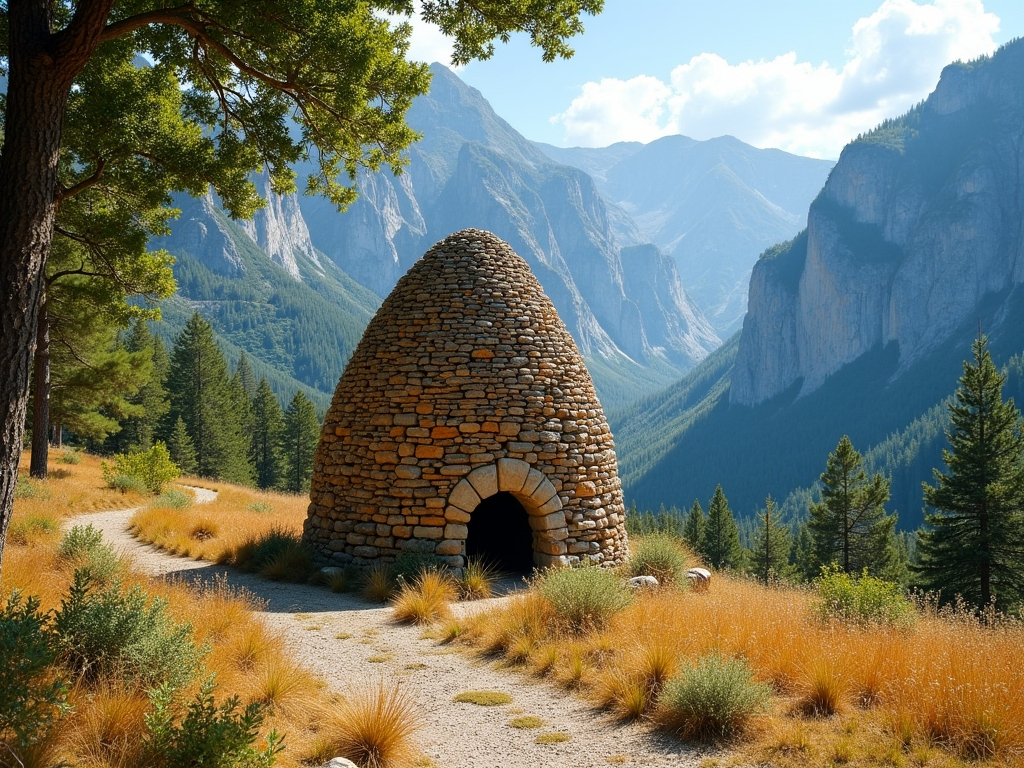
On our first day, we came across one of three sentinels along the route: giant, egg-like stone forms positioned as if they were silently guarding the landscape. Standing two to three metres high, these cairns were assembled by Goldsworthy without cement or mortar, held together only through the careful balance of stone shapes and weights.
Jackie had described the route as largely level, and at first she was right. We walked on smooth gravel, talking and laughing as we adjusted to our heavy packs. After 5km, she said we should be watching for a trail climbing the slope to our right. Looking at her satnav, she indicated what seemed to be a narrow goat track shooting directly over the rocks. I immediately felt alarmed. My rucksack became twice as heavy. Fortunately, I searched farther along the road and found a proper path marked with white and red stripes: a government-recognised grande randonnée route.
We started upward, stopping to photograph twisting, feathery plants that looked as though they belonged in a Dr Seuss illustration, along with yellow, red and blue flowers and an orange moth resting on violet scrub. Spanish broom scented the warm air. Higher up, valleys opened beneath us and strange geological shapes appeared in every direction. It was easy to picture ice-age people travelling these same hills 15,000 years ago. Walking entirely under our own power felt both humble and satisfying.
We reached our first refuge, La Forest, at sunset. The key worked, and the door opened onto cold air and darkness. Slowly, our eyes made out a table and benches ahead. A staircase on the left led to raised sleeping platforms, while a door to the right opened into a shadowy empty chamber. Within it stood a glowing cylindrical obelisk, with light falling over a single large stone that seemed to invite someone to sit. The sculpture was concave, built in pale grey stone and ending in a circular opening towards the sky. Its appearance changed with daylight, weather and season. This was art that breathed with its surroundings, and it felt almost holy.
That night, by trembling candlelight, we ate freeze-dried mushroom risotto, played cards, shared chocolate and told stories. Sasha, who works in film in Germany, taught us two useful German terms: der Salzlose, a person with no flavour or character; and Extrawurst, someone who expects special treatment. Happily, neither description fitted our group. The easy companionship was one of the journey’s greatest pleasures.
We climbed to the sleeping platforms. On Jackie’s advice, Wendy and Sasha had brought substantial sleeping mats. They arranged them carefully and we exchanged goodnights. For a moment, the silence was absolute. Then came an astonishing burst of noise. Wendy and Sasha had turned over. Their technical sleeping mats made such loud friction sounds that it seemed as though a wave were crashing through the building. Comfort, we discovered, required them to remain perfectly still like wrapped mummies.
The following morning, we descended, ate crackers, avocado and cheese beside a river, then began another climb. Sasha and I quietly agreed that it is mentally kinder to hear that a walk will be difficult, only to discover it is manageable. I reminded myself that climbing with a pack must be good for bone strength, and was certainly less tedious than exercises at a gym.
The next refuge, Le Vieil Esclangon, sat in a high meadow. Across the broad valley, an enormous uplifted fan of rock gleamed in the sunlight. Every direction revealed more peaks, ravines and folds of land. The ground floor of the refuge was a wide dark room divided by a huge fireplace. Above, the sleeping platforms faced a bright grassy bank. Opposite the hearth, a tall winding form of dried earth curled back and forth like a river crossing a landscape, rising at its highest point towards its own source.
As the wind strengthened and the air grew colder, we collected wood and made a fire. In the shifting orange glow, the sculpture seemed animated, resembling one of Plato’s enduring ideal forms. We ate freeze-dried pad thai while the flames flickered. The artwork and those passing through it were both temporary, yet for a few hours we belonged together in that warm, sheltered room.
Later, we fell asleep to wind and rain, disturbed only by what sounded like a midnight party of mice somewhere in the walls.
We reached the third refuge, La Ferme Belon, in time for a late lunch. In the basement, a series of enormous connected semicircular stone arches resembled the body of a dragon moving through the earth. Upstairs, the sleeping platforms were inviting, apart from one complication: a colony of bats hung overhead. I managed to look unconcerned because I knew that Wendy, quietly and impressively capable, would find us a pleasant bed-and-breakfast for the night. Over pizza and chilled rosé, Sasha and I admitted to Jackie that we might have preferred a more honest account of how demanding the walks would be. “But then you wouldn’t have joined me,” she replied, smiling.
Goldsworthy has said that there is a profound difference between looking at art in a museum for a few minutes and entering a work of art for a while, even sleeping inside it. To sleep in a sculpture, he suggested, is a wonderful idea.
Back in Digne-les-Bains, we returned the keys and eased our newly strengthened bodies into the town’s hot springs. By then, we had already agreed to join Jackie’s next adventure, without knowing a thing about it.