Cycling through the wild heart of the Netherlands: an autumn escape in the Veluwe
One moment I’m pedalling across a wide sweep of dusty-pink heath, with gentle sand dunes rising on the far horizon; the next, I’m gliding into a sweet-smelling Scots pine forest. Sunlight slips between the red-barked trunks, scattering shifting white patterns across the path in front of me.
I’m in Hoge Veluwe National Park, a 5,400-hectare nature reserve in Gelderland, roughly 90 minutes from Amsterdam. Around 40km of cycle routes run through its landscapes, while some 2,000 distinctive white bicycles are available free for visitors wanting to explore the park’s changing terrain.
I have travelled to the Netherlands many times over the years, and friends have repeatedly urged me to visit this park and the broader Veluwe region. This wooded belt of rolling hills and varied scenery extends for about 60km from north to south. At last, I have come to experience it for myself, spending several days walking and cycling, with stops for art, history and museums in the region’s towns.
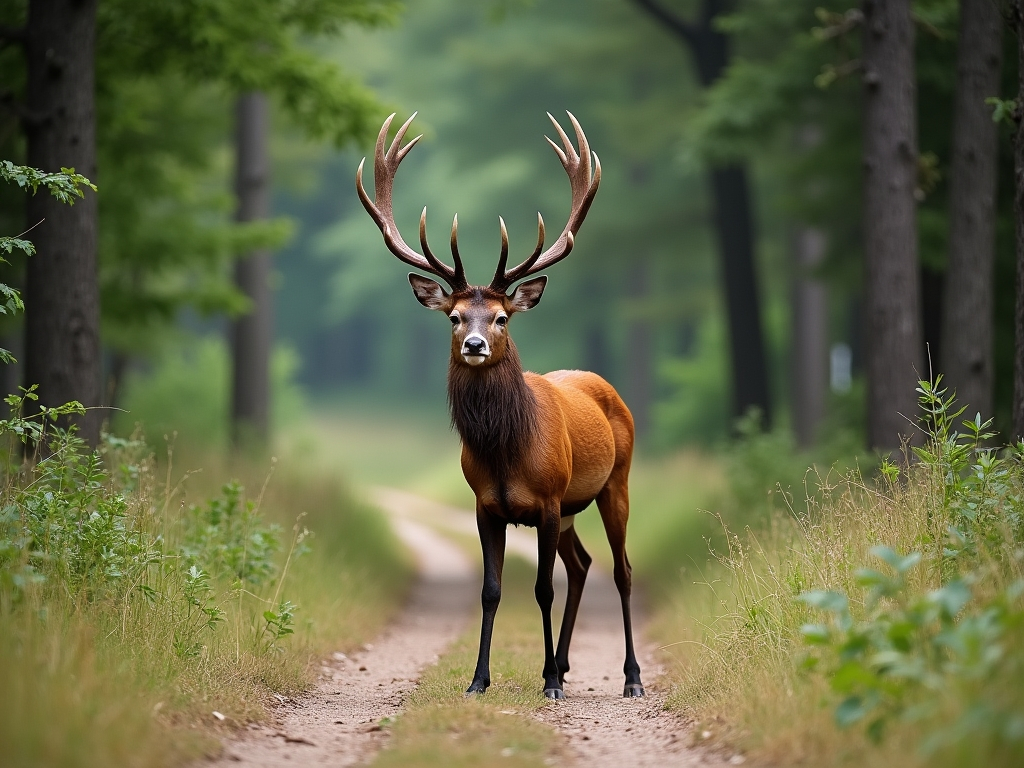
My journey begins at Natuurcentrum De Ginkel, an inviting visitor and nature centre near Ede, outside Arnhem. I meet nature guide Hanna Pol, who leads me into the woods. “The Veluwe has a great deal of biodiversity,” Pol says as we pass oak, pine and birch trees. On one side of the track, branches carry warm brown autumn leaves; on the other, wildflowers bring flashes of yellow and red. Pol lists the animals that live here: roe deer, five varieties of woodpecker, beavers, wild boar and wolves. Beneath our feet, fallen leaves crackle as we notice a little brown frog resting on a log, a woodpecker circling a trunk and the distant shapes of two reddish deer.
We continue to a wildlife viewing point, a sheltered structure with curving windows and rows of wooden seats arranged like a small theatre. “Deer come through here every evening to feed,” Pol explains. “We once watched a huge fight break out.” She has also encountered wolves, which returned to the Netherlands in 2015 after an absence of roughly 150 years. Their arrival remains contentious, particularly among farmers concerned for their animals. We do not spot any wolves, though a striking white buzzard sits alone in a tree. Behind us, shelves display natural finds including antlers, skulls, wild boar teeth and a deer hoof.
That evening, I stay in a polished, contemporary cabin at Buitenplaats Petersburg, just beyond the park boundary. Floor-to-ceiling windows look out into the forest, making the lodge feel immersed in the trees. It is a quiet retreat, with fairy lights threaded through the woodland and a welcoming Italian restaurant, Il Lupo, whose terrace overlooks the grounds.
Veluwe offers much more than open countryside and woodland. I visit Paleis Het Loo, a 17th-century royal palace in Apeldoorn that was once used as a summer home and hunting retreat by William of Orange III and Princess Mary II Stuart. The grand building contains richly decorated rooms, a staircase beneath the Netherlands’ second-largest mural, carefully balanced formal gardens and an underground museum recounting the history of the Dutch royal family.
For the night, I check into Hotel de Echoput, a modern family-owned hotel surrounded by forest. Its Grand Bistro Echo is a highlight, serving dishes centred on regional produce. I order sautéed mushrooms in a creamy Dordogne-style sauce, followed by a vegan cheesecake flavoured with basil and white chocolate.
The following morning, after a refreshing walk through almost empty woodland, I head to the historic Hanseatic city of Harderwijk on the shore of Lake Wolderwijd. With guide Marianne van Limbeek, I explore narrow cobbled lanes, sections of medieval wall and the old town hall. “Harderwijk means a shelter for shepherds,” she tells me. We meet Hendrik Kaper, a local street organ player in a flat cap, who performs an unexpected version of Bohemian Rhapsody on his compact wooden organ.
Still, Hoge Veluwe National Park is where I feel most completely at peace, although a small adder, marked with a dark zigzag down its back, briefly brings me to a halt on one trail. Visiting outside the busiest periods, as I do, means there is every chance of having long stretches of path almost entirely to yourself.
Inside the park is the Kröller-Müller Museum, an important art museum and sculpture garden established by collector Helene Kröller-Müller. Alongside her husband, shipping entrepreneur Anton Kröller, she acquired extensive land in the Veluwe, and the couple’s estate was later transferred to the state. During my visit, all 88 of the museum’s Vincent van Gogh paintings are displayed together, an unusually rare opportunity. The sculpture garden, one of Europe’s largest, spreads through lawns and woodland, with around 200 works appearing unexpectedly among the trees. A short ride away stands Jachthuis Sint Hubertus, the Kröller-Müller family’s former country house. Its watchtower rises more than 30 metres above a lake where energetic carp repeatedly leap from the water.
I pause at Restaurant De Hoge Veluwe in the Park Paviljoen for an early plate of pasta on the terrace as the sky darkens and rain threatens. Luckily, Otterlo is only a 15-minute cycle away. The village feels especially cheerful, with strings of lights and bunting decorating its red-brick homes. I spend the night at Vakantieoord Het Lorkenbos, a lovely holiday park enclosed by trees. My bungalow is small but inviting; surrounded by twinkling lights, I light a candle and look up the Dutch word for cosy. It is gezellig, and it perfectly captures the feeling left by this restorative escape into one of the Netherlands’ most untamed corners.
Entry to Hoge Veluwe National Park is charged per adult. Accommodation options in the area include forest cabins, campsites, holiday bungalows and hotel rooms, with prices varying by season and availability.