Europe commemorates 80th VE Day amid evolving security challenges on the continent
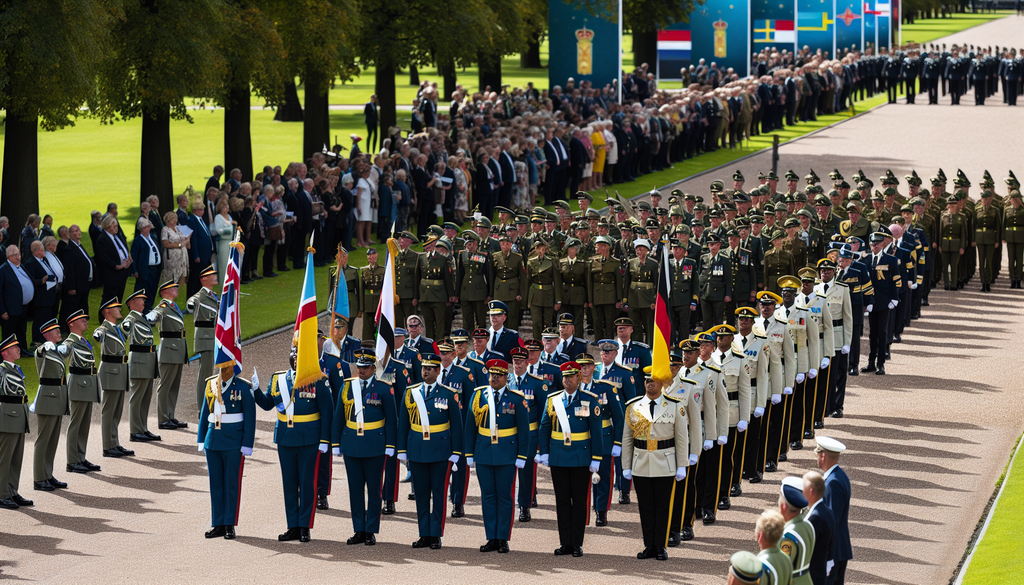
On Thursday, France will host nationwide commemorations at war memorials to pay tribute to those who lost their lives during the Second World War, as it observes the 80th anniversary of Victory in Europe (VE) Day. This remains a national holiday in France, as it is every year.
President Emmanuel Macron will lead the ceremonies in Paris, beginning with laying a wreath at the statue of Charles de Gaulle. He’ll proceed along the Champs-Élysées to the Arc de Triomphe, where he will reignite the eternal flame at the Tomb of the Unknown Soldier and review the honor guard.
The event will include a moment of silence, a performance of the national anthem, a speech by Macron reflecting on the “values that emerged victorious in 1945,” and a military display featuring service members, vintage wartime vehicles, flags, six international military bands, and a fighter jet flypast.
Surprisingly, France is one of only a few European countries to mark VE Day with such elaborate traditions. Some nations observe the day with less formality, without assigning it national holiday status, or even recognize it under a different name or date.
This year’s commemoration comes at a time when global alliances are under stress, notably with Donald Trump shaking the pillars of the postwar transatlantic relationship and war continuing to rage in Ukraine. These divisions underscore that peace in Europe is both recent and fragile.
In a statement, the French defence ministry emphasized the dual responsibility of this anniversary: “to the last eyewitnesses to the conflict, and to the younger generations.”
The ministry further reminded that the essence of VE Day in 2025 must be to “honour the sacrifices of those who endured the war—and ensure their stories and experiences are passed on to today’s youth.”
Germany shares this vision and, for the first time, is declaring VE Day a public holiday, reflecting the wave of change threatening the postwar order that delivered prosperity and democratic stability across Europe.
In Berlin, a comprehensive program of memorial events will take place throughout the city’s historic sites, including exhibitions, survivor accounts, theatrical productions, public discussions, film screenings, concerts and walking tours.
Each former Nazi concentration camp on German territory, now operating as a site of remembrance, has marked the date of its liberation this spring through solemn ceremonies featuring the few remaining survivors.
Germany’s chancellor, Friedrich Merz, recently elected, will attend a remembrance service in a Berlin church damaged in the war, as well as a wreath-laying and the official state ceremony at the Reichstag, the German parliament.
This year has brought harsh reminders of new instability. With Trump’s America drifting from shared values that once solidified the Western alliance, Europe can no longer depend on the U.S. for its defence.
The American approach to peace in Ukraine involves engagement with Vladimir Putin’s Kremlin in ways many see as overly accommodating. European Commission President Ursula von der Leyen stated bluntly, “The West as we knew it, is no more.”
Responding to these shifts, European nations are rapidly increasing their defence expenditure. Macron has committed France to raising military spending to 3.5% of GDP this year, amounting to an additional €30 billion (£26 billion) annually. Merz has proposed even greater commitments.
“Faced with growing threats to peace and freedom in Europe, we must approach defence with an attitude of ‘whatever it takes’,” Merz said. Even prior to becoming chancellor, he secured substantial funding increases for defence and infrastructure.
Other countries are following suit. Sixteen EU member states including Poland, Denmark, Finland, Belgium, the Czech Republic, the Baltic countries, and even traditionally Russia-friendly Hungary and Slovakia, have invoked budget rules to prioritize military funding.
Sign up to Headlines Europe
Stay informed with a daily email summary of Europe’s top stories from our morning edition
after newsletter promotion
It’s natural that nations closer to Russia express greater urgency and concern. This has created differences in how VE Day’s end is interpreted and commemorated across Europe, echoing longstanding divisions.
In Western Europe, including the UK, VE Day is widely associated with the restoration of democratic freedoms, the fall of Nazi occupation, and the end of both mass slaughter and the Holocaust. But styles of observance vary widely, and the dates differ.
Belgium, for instance, folds VE Day into 11 November’s Armistice Day, observing the end of World War I. Liberation Day is recognized on 5 May in both the Netherlands and Denmark. Italy celebrates Liberation from fascism on 25 April instead of 8 May.
Central and Eastern European countries often interpret the war’s end as the beginning of Soviet subjugation, not freedom.
Russia, where VE Day is marked on 9 May, commemorates with an elaborate military parade. The timing stems from the ceasefire taking effect at 11:01pm Berlin time on 8 May 1945, which was already the next calendar day in Moscow.
Highlighting Europe's political schisms, this year’s Moscow parade will be attended by Slovakia’s pro-Russian prime minister, Robert Fico, and Serbia’s nationalist president Aleksandar Vučić, drawing sharp rebuke from EU leaders. Meanwhile, a symbolic alternative event will take place in Lviv, Ukraine, with the participation of EU foreign ministers.
Though a few post-Soviet states such as Belarus and Bosnia and Herzegovina still honor 9 May, many others—like Poland, Estonia, Latvia, Lithuania and the Czech Republic—have transitioned to commemorating the date on 8 May since regaining independence, distancing themselves from Soviet-era symbolism.
As Europe reflects on the 80th anniversary of VE Day, the profound changes in its security landscape lend fresh urgency to the occasion. German historian Oliver Hilmes, while less fiery than von der Leyen, expressed a sobering view.
“Who will defend Europe?” he asked. “The legacy of 8 May 1945 is now confronting us more forcefully than ever.”