Archaeologists discover ancient Egyptian luxury vessel near Alexandria shoreline
A luxurious ancient Egyptian boat, closely resembling one described by the Greek historian Strabo in the first century, has been uncovered off Alexandria’s coast, thrilling archaeologists.
Once a glorious city with stunning landmarks such as grand palaces, towering temples, and the 130-meter Pharos lighthouse—one of the Seven Wonders of the Ancient World—Alexandria stood out in antiquity. The newly found boat, dating back to the early first century, measured about 35 meters in length and featured an ornate central pavilion, likely used for leisure and decorated for comfort.
The vessel was discovered near Antirhodos, now submerged but once part of Alexandria’s grand Portus Magnus harbor.
Strabo, who visited the city between 29 and 25 BC, noted these types of boats as being lavishly outfitted and used for royal outings and public festivities. He described scenes where crowds gathered on boats, enjoying flute music and uninhibited dancing during daily and nightly celebrations.
The boat was unearthed by archaeologists from the European Institute for Underwater Archaeology (IEASM), under the leadership of Franck Goddio, a maritime archaeology expert affiliated with the University of Oxford.
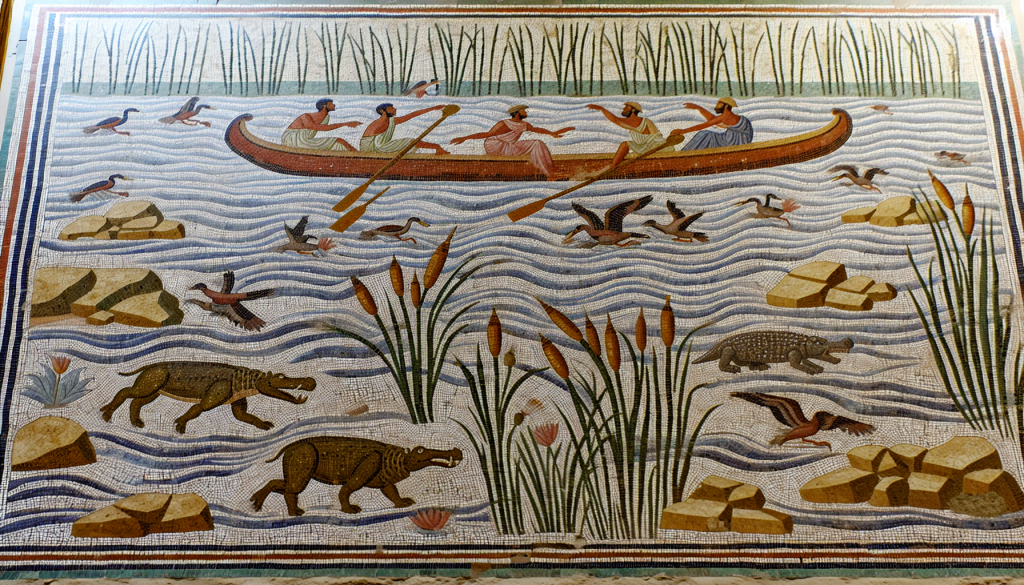
Goddio explained: “This discovery is incredibly significant as it marks the first time such a vessel has been found in Egypt. While ancient authors and art, like the Palestrina mosaic showing smaller boats used by nobles hunting hippos, mention them, none had survived until now.”
Compared to that mosaic’s 15-meter-long boat, this newly found one is significantly larger. Its broad timbers suggest a roughly 7-meter width and a crew of possibly more than 20 rowers.
Buried just seven meters below the water and beneath 1.5 meters of sediment, the wreck initially puzzled researchers. Goddio originally believed two vessels were stacked because the construction was so peculiar. “It had a flat bow and rounded stern,” he noted, “hinting it was designed to move through shallow waters.”
For decades, Goddio has led extensive underwater excavations along Egypt’s coast, particularly in Alexandria’s eastern harbor and the Bay of Abu Qir, with ongoing support from Egypt’s Ministry for Antiquities.
In 2000, his team uncovered the ancient cities of Thonis-Heracleion and parts of Canopus, in what became one of the era’s most remarkable discoveries. The finds included enormous statues of a Ptolemaic ruler and queen.
Another notable discovery came in 2019, when his team located a shipwreck near Thonis-Heracleion with design elements aligning with reports by the ancient historian Herodotus.
The recent boat was found less than 50 meters from the Temple of Isis, currently undergoing excavation by Goddio. He suspects the vessel may have sunk around AD 50 during the collapse of the temple, a tragedy likely caused by earthquakes and tidal waves that submerged Alexandria’s harbors and much of its coastline.
One theory suggests the boat served ceremonial purposes—a sacred barge linked to the temple. It might have played a role in the “navigatio iside,” a waterborne celebration honoring the goddess Isis, during which an adorned ship symbolizing her solar barque was central to the ritual.
The wreck also features Greek inscriptions etched on a central beam. These markings have yet to be decoded.
Though the investigation is still unfolding, Goddio believes the find will offer deeper knowledge of early Roman Egyptian life—its customs, religious practices, and riverborne luxury.
Recent findings from the Isis temple excavation have been published by the Oxford Centre for Maritime Archaeology.
Professor Damian Robinson, the Centre’s director, stated: “This particular ship design has never been physically found before. Although it appears in texts and artistic works, discovering it in reality is extraordinary.”
The wreck will remain undisturbed on the seabed. Goddio explained: “In line with UNESCO guidelines, it’s best to preserve such remains underwater.”
As only a small portion of the site has been explored, archaeological dives are expected to continue.