Doomsday Clock 2026: Experts reveal updated time
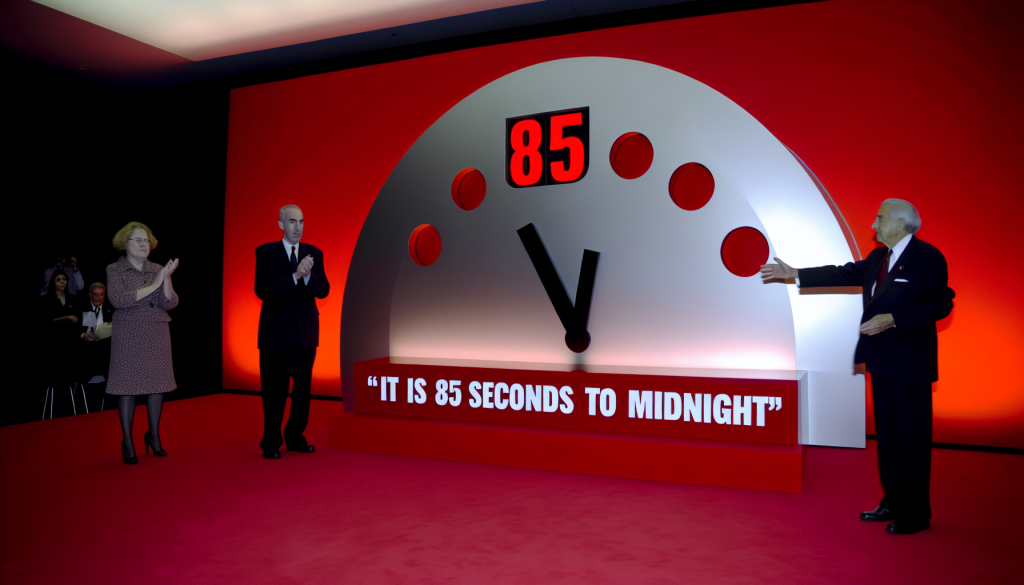
In the early days of the nuclear era, scientists introduced the Doomsday Clock as a symbolic gauge of how close humanity is to catastrophic destruction. On Tuesday, nearly 80 years later, the clock was adjusted to 85 seconds before midnight — the closest point ever, according to the Bulletin of the Atomic Scientists, which launched the concept in 1947.
Midnight on the clock symbolizes a point of irreversible global devastation caused by human actions.
Previously, in 2023 and 2024, the clock stood at 90 seconds to midnight, already an alarming milestone. This year, scientists moved the time forward due to lack of substantial progress in managing global hazards such as nuclear weapons, climate change, biological risks, and emerging technologies like artificial intelligence. The Bulletin also pointed to the growing impact of misinformation and conspiracy theories as significant contributors to global instability.
“We have not advanced enough in addressing the threats that put our future at risk,” said Alexandra Bell, President and CEO of the Bulletin. “The Doomsday Clock is a reminder of how close we are to endangering the world with our own innovations. The danger from nuclear arms, environmental collapse, and developing technologies continues to grow. Time is running out.”
“This is the reality we face,” Bell emphasized.
Dr. Daniel Holz, chair of the Bulletin’s science and security board, noted in a press briefing that last year, global leaders were urged to pursue cooperation and solutions to existential threats.
“Instead of constructive action, global powers turned increasingly combative and nationalistic,” said Holz, also a professor at the University of Chicago. “In 2025, conflicts escalated, some involving nuclear-capable nations. The impending expiration of the final treaty overseeing U.S. and Russian nuclear stockpiles, set for early February, could trigger a new–and unregulated–arms race.”
Holz also pointed to continuing threats in biological sciences, including the experimental creation of synthetic life forms. “Despite repeated warnings, there’s still no global strategy to prevent or respond to biological threats,” he said.
He added that the rapid, unregulated expansion of artificial intelligence amplifies misinformation and misinformation, further undermining global efforts and intensifying existing crises.
Understanding the Doomsday Clock
The Bulletin of the Atomic Scientists was founded in 1945 by researchers from the Manhattan Project, which developed the first atomic bombs during World War II. Originally focused on nuclear threats, the Bulletin expanded in 2007 to include climate change in its clock calculations.
Each year, for the past 79 years, the group has evaluated how near humanity is to irreversible disaster. The time is determined by the Bulletin's science and security board, with guidance from a board of sponsors created in 1948, including renowned scientists like Albert Einstein and J. Robert Oppenheimer. The current board includes several Nobel laureates in science.
Does the Doomsday Clock predict actual outcomes?
The Clock isn't an exact measurement but a visual and symbolic tool meant to spark conversation about global dangers. Some experts uninvolved with the project have questioned its effectiveness, though many still value it as a meaningful signal.
“It’s a flawed but powerful symbol,” said Dr. Michael Mann, a leading climate scientist at the University of Pennsylvania. He suggested that while different threats operate on different scales, the Clock effectively reminds the public each year how fragile life on Earth can be.
Eryn MacDonald, a global security expert with the Union of Concerned Scientists, said the Bulletin has consistently used the Clock to engage people with pressing issues. “Though I wish we could return to measuring in minutes instead of seconds, that’s no longer a reflection of our reality,” she remarked.
The Doomsday Clock has been referenced on global stages, including during climate talks in 2021 when the then-Prime Minister of the UK cited it while addressing environmental concerns.
What happens if the clock strikes midnight?
The minute hand of the Doomsday Clock has never hit midnight. Former Bulletin CEO Rachel Bronson, now a senior adviser, once said she hopes it never does.
“If the clock ever reaches midnight, it would mean the world has experienced a devastating nuclear war or intense climate catastrophe, wiping out society as we know it," she explained. “And we likely wouldn’t recognize the moment when it happens.”
Can we push back the hands of the clock?
There is still a possibility to reverse course. The Clock’s furthest setting from midnight was in 1991 — 17 minutes — following the signing of the Strategic Arms Reduction Treaty between the U.S. and the Soviet Union.
“These threats were created by humans, and it’s within our power to address them,” Bronson explained. “But it demands serious international efforts and commitment at all levels of society.”
The Bulletin encourages people to talk openly about these challenges. Citizen engagement can fight misinformation and encourage leaders to take meaningful action.
“Without facts, there can be no truth. Without truth, we lose trust,” said journalist Maria Ressa during a recent press event. “Without trust, shared reality breaks down, which in turn disables democracy and collective problem-solving.”
Individual changes can also contribute to global efforts. Altering travel habits, improving home energy efficiency, and making thoughtful food and consumption choices—like eating local produce and cutting back on waste—can positively impact the environment.
Other habits like conserving water, limiting plastic use, and recycling correctly also play a role in reducing environmental harm and fostering sustainability.