Seagulls are the pirates of the air. Here’s how to stop them from snatching your food
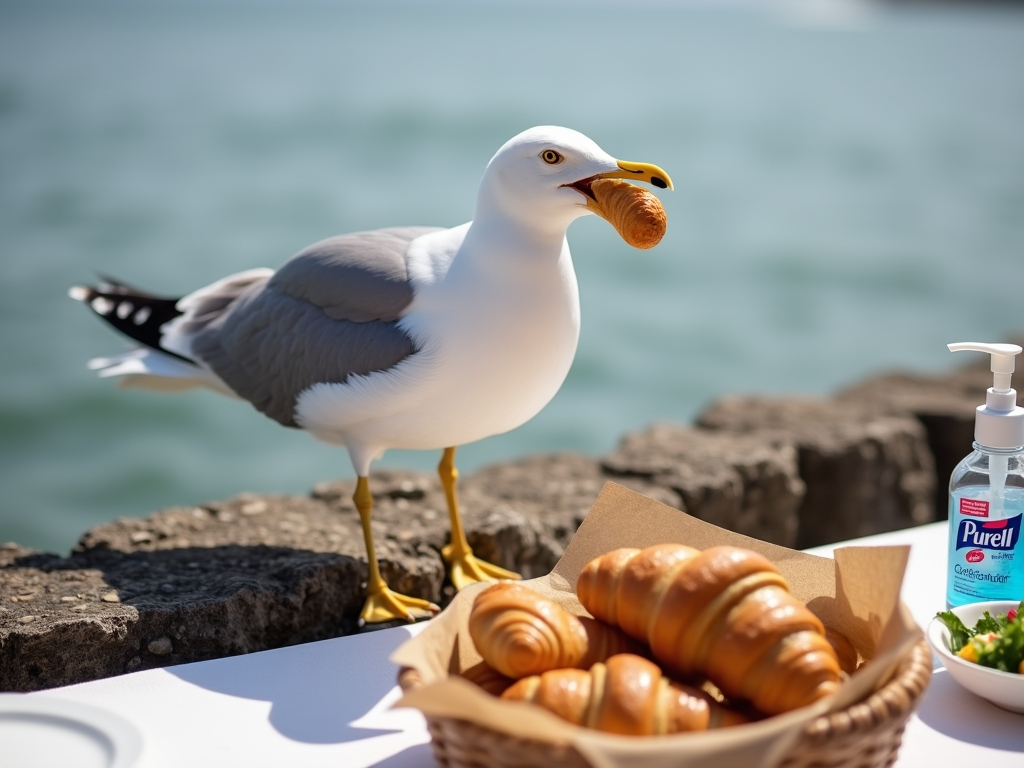
A day at the beach should be relaxing, but there’s a simple way to prevent seagulls from swooping in and stealing your lunch.
You’re basking in the sunshine, breathing in the salty air – unaware that a sharp-eyed opportunist is watching your every move.
Out of nowhere, a bird drops from the sky, its wide wings briefly blocking the Sun. Amid frantic flapping and scattered chips, a hefty herring gull snatches your meal straight from your hands.
Herring gulls – the classic “seagulls” found in coastal towns throughout the Northern Hemisphere – are impressively large. They can weigh up to 3.31lb (1.5kg) and stretch nearly 4.9ft (150cm) across the wings. When one dives toward you, it can be startling. And in recent years, such encounters have become increasingly common at seaside spots.
So what can you do to stop them?
That’s the question Laura Kelley, an animal behaviour scientist at the University of Exeter in the UK, set out to explore. Her research uncovered a surprisingly simple method to discourage these bold birds.
In 2019, Kelley conducted an experiment to see whether herring gulls hesitated more around food when they felt watched. She found that they approached more slowly when someone looked directly at them. Many animals, gulls included, display “gaze aversion,” she explains, because a direct stare can signal a potential threat.
Some species have even evolved eye-like markings, known as eyespots, to ward off predators. The more lifelike these markings appear, the more effective they are. Certain patterns even mimic the glint of sunlight in an eye.
Kelley wondered whether this same principle could protect a portion of fish and chips. She discovered that simply attaching a pair of googly eyes to food packaging was enough to deter some herring gulls from helping themselves.
Her team tested the idea in coastal towns across Cornwall, Devon and Dorset in southwest England, areas where gulls frequently snatch food from people. The birds were presented with two food boxes placed 6.6ft (2m) apart – one decorated with eyes and one plain.
“We found that gulls readily approached the plain boxes,” Kelley says. “But when it came to the boxes with eyes, the birds split into two groups. One group hesitated at first but gradually learned the eyes posed no danger. The other group refused to approach at all.”
This suggests distinct personalities among gulls, Kelley notes. Some are especially bold and inquisitive – the individuals most likely to swoop down and grab food from unsuspecting beachgoers.
“They’re responsible for the vast majority of incidents,” she says. “It’s a small subset that gives the rest a bad reputation – the troublemakers of the gull world.”
Herring gulls are scavengers, hunters and kleptoparasites, meaning they steal food from others. They often watch for opportunities, observing when another animal – or a human – has something worth taking. This adaptability has helped them thrive in towns and cities.
Although they may seem plentiful in urban areas, global populations of herring gulls are declining. In 2021, both European and American populations were added to the IUCN Red List of threatened species.
This downturn can be hard to notice because many gulls are shifting into cities, replacing their usual marine diet with human leftovers.
“Their numbers in natural habitats are dropping,” Kelley explains, citing habitat loss and reduced food supplies caused by overfishing. “Urban environments, however, offer abundant alternatives. Gulls are highly adaptable, curious and persistent, which helps them exploit new surroundings.”
Even so, they still favour natural food when possible. Adult gulls feeding chicks, for example, often return to sea to forage rather than relying on human scraps. “That suggests they turn to our food mainly when other options are limited,” Kelley says. “Sometimes, though, a bag of chips is simply the easiest meal.”
Gulls don’t just steal from humans – they also observe and copy us. This kind of learning across species points to notable intelligence.
“People once assumed seagulls were unintelligent,” says Franziska Hacker, a behavioural ecologist at the Australian National University. “But when you watch them closely, it’s clear they’re very clever.”
While living in Brighton in 2021 during her master’s studies at the University of Sussex, Hacker ran an experiment involving packets of salt and vinegar crisps to test whether gulls would mirror her food choices. The outcome surprised her.
As she ate crisps from a blue packet, she placed both a blue and a green packet on the ground nearby for a gull to choose between. “One gull called out,” she recalls, “and suddenly there were 20 more.”
Despite disliking salt and vinegar crisps, Hacker kept her expression neutral to avoid influencing the birds with facial cues. Time and again, the gulls selected the packet that matched the colour of the one she was eating from.
“They pay attention to behavioural signals, even from humans,” she explains. While some domesticated animals can interpret gestures like pointing, such abilities are uncommon in wild species.
Gulls rely on a mix of cues – visual signals, sounds, smells and the behaviour of other birds. Because much of their food comes from stealing, careful observation is essential. “To take someone’s food, you have to watch them closely and pick the right moment,” Hacker says.
After two years of research, the findings showed gulls chose the matching colour packet 95% of the time. “It’s astonishing,” she says. “They recognise what I’m eating, identify a similar item on the ground, and decide it’s worth trying. That requires complex processing – comparing objects and inferring that what’s good for me might be good for them.”
By better understanding gull intelligence and behaviour, Kelley believes we can find practical ways to reduce food theft.
She offers straightforward advice for beachgoers: sit with your back against a wall so birds can’t approach unseen from behind. Keep food covered and avoid waving it around. Maintain eye contact with nearby gulls, as they’re less likely to advance if they feel watched. And if necessary, make noise to scare them off.
Adjusting our own habits, Kelley suggests, may be the key to sharing space peacefully with these familiar coastal birds.
“They’re simply adapting to the circumstances they face,” she says. “We need to find ways to live alongside them more harmoniously. It’s about creating strategies that allow coexistence.”
And if sticking a pair of googly eyes on your lunch helps achieve that harmony, it might just be worth a try.