Banu Mushtaq of India sets milestone with International Booker triumph
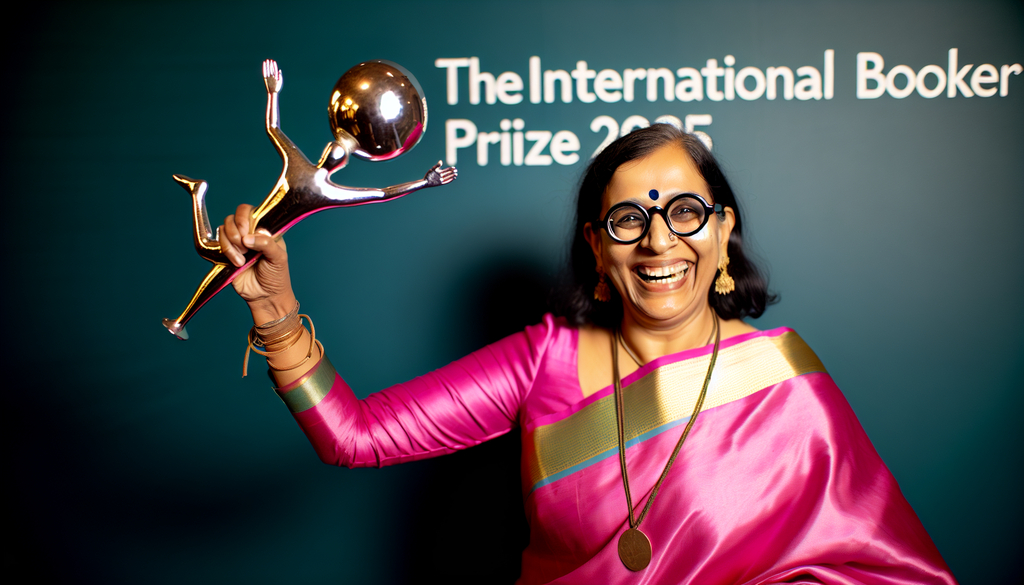
Indian author, legal professional, and social activist Banu Mushtaq has etched her name in history as the first Kannada-language writer to win the International Booker Prize, courtesy of her short story collection, Heart Lamp.
This marks the first time a short story compilation has secured the distinguished award. The judging panel praised Mushtaq's characters as “remarkable portraits of endurance and strength.”
Heart Lamp, a collection of 12 short stories penned by Mushtaq between 1990 and 2023, offers a heartfelt glimpse into the challenges faced by Muslim women in southern India.
These narratives were handpicked and translated into English from Kannada—Karnataka’s official language—by Deepa Bhasthi, who will receive half of the £50,000 prize.
During her acceptance speech, Mushtaq expressed gratitude to her readers for opening their hearts to her storytelling.
“This book was born from the belief that no story is ever insignificant; that within the grand weave of human experience, every voice holds weight,” she declared.
“In a time that often drives us apart, literature remains a rare refuge where we are invited into one another's thoughts, even if just for a few pages,” she added.
Bhasthi, who becomes the first Indian translator to earn the International Booker, shared her hope that this milestone inspires greater translation efforts involving Kannada and other South Asian tongues.
Mushtaq’s honor follows the 2022 win of Geetanjali Shree’s Tomb of Sand, translated from Hindi by Daisy Rockwell, indicating a growing global recognition of South Asian literature.
Although long respected among literary circles, this Booker achievement has drawn widespread attention to Mushtaq’s larger body of work, which reflects the struggles encountered by many women in conservative, patriarchal contexts.
Her deep awareness of these challenges has enabled her to create some of the most sensitively drawn characters and stories in recent literature.
“In a landscape where drama often takes center stage, Heart Lamp underscores the importance of attentiveness—to lives lived at the margins, to overlooked choices, to the quiet courage it takes simply to endure. That is Mushtaq’s subtle brilliance,” wrote The Indian Express in a recent review.
Growing up in a Muslim-majority neighborhood in a small town in Karnataka, Mushtaq studied Quranic scripture in Urdu during her early education.
However, her father, a government worker, sought broader horizons for her. At eight, he enrolled her in a convent school where she learned Kannada—the very language in which she would later write her literary works.
Though initially unfamiliar, Kannada became the medium through which Mushtaq would express her creative voice, launching her writing journey in school. She chose to pursue college even as her peers married and settled into domestic life.
Her first published story came at a difficult time—just a year after marrying her partner at age 26. These early years of her marriage were marked by personal turmoil, something she’s candidly discussed in multiple interviews.
In a conversation with Vogue, Mushtaq said, “I always wanted to write but had no inspiration—until after marrying for love, I was told to wear a burqa and focus solely on housework. By 29, I was a mother grappling with postpartum depression.”
Speaking to The Week, she described being confined within her home’s walls, yearning for freedom to live on her own terms.
A pivotal act of desperation changed everything.
“One day, overwhelmed by hopelessness, I doused myself in white petrol, ready to end it all. He [her husband] sensed something, embraced me, and removed the matchbox. Placing our baby at my feet, he pleaded, ‘Don’t give up on us,’” she shared.
This profound will to survive is echoed in the women of Heart Lamp, whose unwavering tenacity shines through every page.
“Mainstream Indian fiction often reduces Muslim women to tragic emblems or moral lessons. Mushtaq defies this. Her women persist, navigate, and resist—not with grand gestures, but in ways that reshape their world,” notes another review in The Indian Express.
Mushtaq also worked as a journalist for a well-known local tabloid and participated in the Bandaya literary movement, which tackled social and economic inequality through activism and prose.
Eventually, she left journalism to become a lawyer, ensuring financial stability for her family.
Over an illustrious multi-decade career, Mushtaq has penned numerous works, including six short story collections, an anthology of essays, and one novel.
Yet her bold and introspective writing has also made her a target of hostility.
In a Hindu interview, she recalled receiving threats in 2000 after advocating for women’s rights to pray in mosques.
Shortly afterwards, a fatwa was issued against her, and a man attempted an attack with a knife—only to be stopped by her husband.
Despite these threats, Mushtaq remained steadfast in her truth-telling prose.
“I have always resisted patriarchal interpretations of religion. These themes still drive my work today. Society may evolve, but the root issues remain, especially for women and marginalized groups,” she conveyed to The Week.
Mushtaq’s compelling works have received several significant honors over the years, including the Karnataka Sahitya Academy Award and the Daana Chintamani Attimabbe Award.
In 2024, her translated English volume of stories originally published between 1990 and 2012—titled Haseena and Other Stories—won the PEN Translation Prize.
Follow BBC News India on Instagram, YouTube, Twitter, and Facebook for more updates.