Ape companions and unmatched brilliance: the man Charlie Chaplin hailed as ‘the finest actor alive’
Jean Vigo’s 1934 film L’Atalante is a dreamlike and lyrical love story set aboard a canal barge, known for its emotional resonance and sensual imagery. The film stars Dita Parlo and Jean Dasté as a young couple navigating the early days of marriage in tight quarters. While their relationship forms the core of the film, it is Michel Simon’s portrayal of Père Jules, the boisterous and eccentric barge-mate, that truly captivates. Père Jules, a seafarer covered in tattoos and surrounded by oddities and unruly cats, adds a wild charm and depth to the film.
Michel Simon, the Swiss actor behind Père Jules, was one of the most recognizable figures in French cinema for much of the 20th century. With a unique blend of expressiveness, pathos, and unpredictability, Simon carved out a revered space for himself in film history. Charlie Chaplin once hailed him as “the greatest actor in the world.” Over the course of his career, Simon collaborated with prominent European directors on landmark films. For Jean Renoir, Simon portrayed a man caught up in a destructive relationship in La Chienne (1931) and the defiant vagrant of Boudu Saved from Drowning (1932). He worked on cinematic milestones like Le Quai des Brumes (1938) with Marcel Carné, The Passion of Joan of Arc (1928) with Carl Theodor Dreyer, and even appeared in John Frankenheimer’s The Train (1964). François Truffaut once remarked that with Simon’s performances, one glimpses the human heart in its rawest form. His five-decade-long career, which began in silent film, culminated in his winning Best Actor at the Berlinale in 1967 for his portrayal of a prejudiced farmer forming a bond with a Jewish child in Claude Berri's The Two of Us. Critic Renata Adler described Simon as “an enormous old genius,” full of warmth and depth.
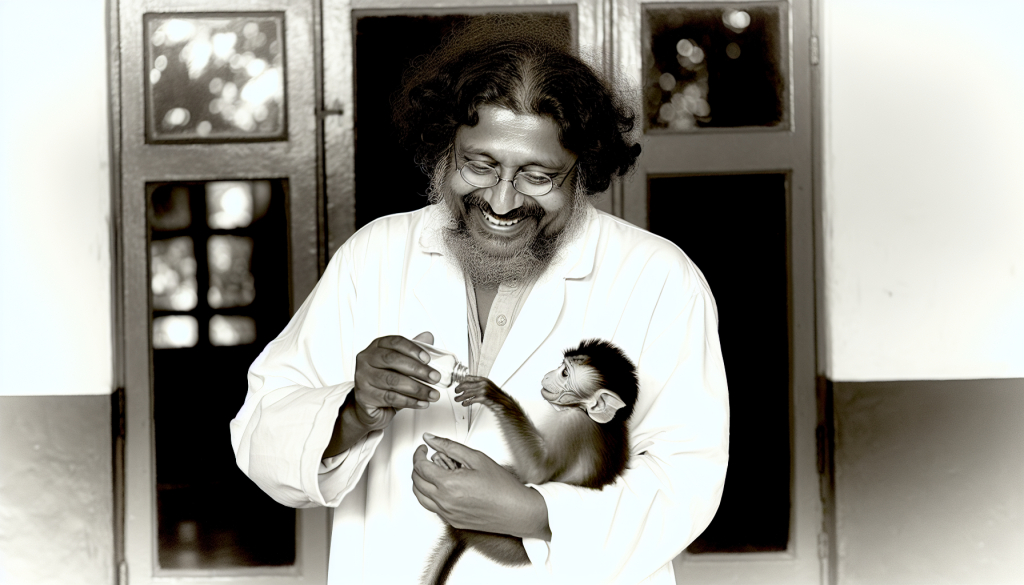
Michel Simon was not only an extraordinary actor but also a truly singular personality. A passionate animal rights advocate, he adopted many animals including the cats featured in L’Atalante. One kitten, which curled up inside a phonograph horn in the film, found its permanent home with Simon. His house, nestled in a woodland setting, was a refuge for his many pets—particularly his cherished monkeys. He constructed interconnected wire tunnels throughout the house for their free movement, creating a home filled with eccentric charm and eclectic artifacts. Among his dearest companions was a chimpanzee named Zaza, who lived with him for twenty years. Simon was deeply affected by her passing, believing she took her own life due to his prolonged absence. He often claimed that monkeys had a moral edge over humans, famously suggesting that no monkey would ever dissect a person.
This outspoken artist, coming from humble beginnings as the son of a sausage-maker, was born in Geneva in 1895. After relocating to Montmartre in Paris, he led a colorful early life—working as a boxing coach, cabaret performer, magician, and acrobat before joining the Swiss Army in 1914. Embracing the bohemian life, he began acting on stage in Paris and found early success with a role in Marcel Achard’s Jean de la Lune in 1929. Although it was a minor part, his charisma ensured that he stole the spotlight. By the time cinema transitioned to sound, his gravelly voice and expressive features made him a standout performer, fully capable of commanding both dramatic and comedic roles.
Simon’s unique screen presence made him ideal for playing boldly unconventional roles, such as Boudu, the disruptive tramp created for him by Renoir. In that film, a well-to-do bookseller attempts to civilize Boudu after rescuing him from the Seine, but meets fierce resistance from the unruly guest, resulting in a biting social satire. Initially met with backlash, the film ultimately gained recognition as a classic. Known for being somewhat rebellious himself, Simon took on the role of Père Jules in L’Atalante to offer support to Vigo, whose previous film had faced censorship. Although Jules may come off as aggressive, his tender moments—like caring for his many cats or interacting with Juliette—reveal a softer, more humane side. The character is anarchic yet never cruel, and even becomes a figure of warmth and humor. His antics, such as performing a rooftop wrestling match solo or transforming his belly into a living tableau using tattoos, remain unforgettable.
Simon imbued his characters with an aura of the unexpected—rough exteriors masking immense charm. His death in 1975 marked the end of an era, but he left behind a legacy reinvigorated by his moving performance in The Two of Us. Known on set for avoiding retakes, Simon believed in giving his all in a single take, explaining that each moment was unique and should not be recreated. “I live a scene as a moment,” he said. “And once it’s dead, God himself could not revive it.”
A 4K UHD boxset featuring Jean Vigo’s L’Atalante, Zéro de Conduite, Taris, and À Propos de Nice is scheduled for release in December.