
Trump’s comeback posed tough challenges for clean energy. So what’s fueling advocates’ optimism in 2026?
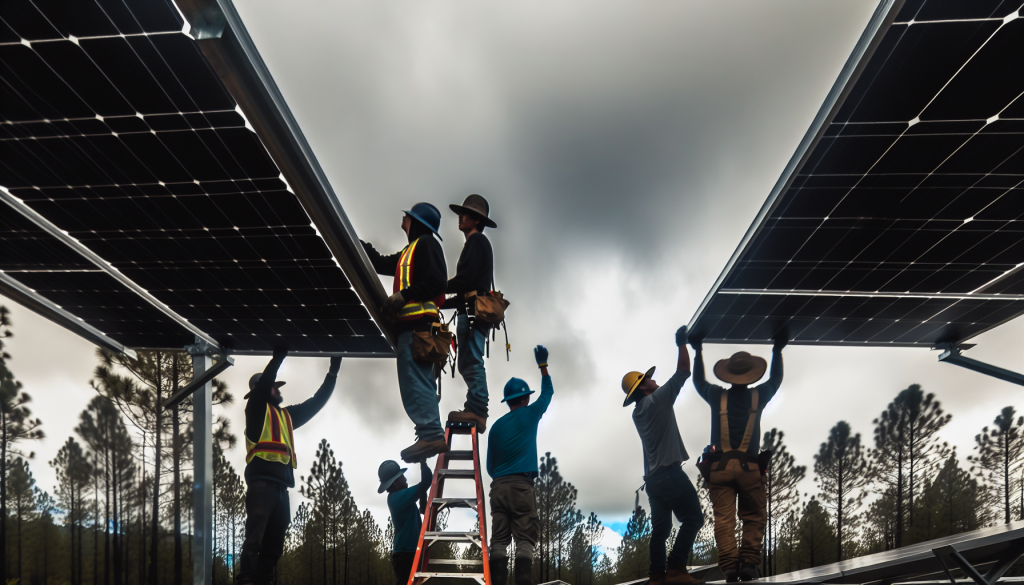
Despite numerous setbacks, clean energy experienced a few notable advancements in a year marked by profound shifts. Former President Donald Trump pushed policies favoring fossil fuels and hindered support for renewable energy sources, say many in the industry, ranging from developers to policymakers.
A poll conducted by The Associated Press revealed that 2025 was a year of instability for renewable energy. However, progress did occur as more projects were linked to the power grid. Experts emphasized the need for continued growth in clean energy to respond to rising electricity demand and to make power more affordable for Americans.
Jorge Vargas, who builds and operates solar installations, described the past year as extremely difficult due to frequent criticisms of renewable energy by Trump and a major legislative move in July that reduced tax incentives for clean energy.
"Things definitely cooled off this year," said Vargas, co-founder and CEO of Aspen Power. "But our sector is built on resilience."
Plug Power executive Jose Luis Crespo added that while policy shifts have shaken the industry, technological progress continues to push clean energy forward and will influence future developments for years to come.
2025 Energy Policy Shifts
The direction of clean energy changed significantly with the departure of former President Joe Biden. At the beginning of the year, clean energy enjoyed strong federal backing, with tax incentives and increased domestic production of project materials. Public and private demand remained strong, noted Tom Harper, a partner at consulting firm Baringa.
But by the end of the year, many of those supports were gone. Tariffs increased costs, and uncertainty made clients hesitant. Harper said the changes this year mark a fundamental shift in clean energy’s trajectory.
Trump referred to wind and solar as “a scam” and announced a halt to new project approvals. Many grants for renewable initiatives were rescinded.
A significant tax and spending bill passed by the Republicans reversed major climate policy achievements from 2022. Wayne Winegarden of the Pacific Research Institute suggested this moment forces renewable energy to prove its economic strength. (It's worth noting that fossil fuels also benefit from subsidies.)
Numerous industry leaders viewed this legislation as the year’s turning point. Lennart Hinrichs of TWAICE noted that the bill changed project economics, prompting a rush to start construction before incentives vanished and forcing developers to rethink sourcing strategies.
"It’s extremely difficult for companies to commit to large-scale investments when policies keep shifting," said Jason Grumet, head of the American Clean Power Association.
According to Brian Murray of Duke University’s Nicholas Institute, U.S. emissions reductions will now lag behind prior forecasts due to these policy changes.
A worker monitors battery storage units at Orsted’s Eleven Mile Solar Center in Coolidge, Arizona on February 29, 2024. (AP Photo/Ross D. Franklin, File)
Growth in Solar and Energy Storage
Despite the challenges, solar and energy storage led in new electricity generation during the first nine months of the Trump administration, according to Wood Mackenzie.
The strong market, cost competitiveness, and scalability of these technologies continue to drive their growth, said Mike Hall, CEO of Anza Renewables.
Sol Systems reported a record-setting year, including completion of their biggest utility-scale project. CMBlu Energy also saw notable gains, with battery storage evolving from an optional asset to a necessary component of power infrastructure.
“Trump’s attempts to sideline renewables can’t compete with their natural advantages,” said Senator Sheldon Whitehouse. “The momentum remains positive.”
According to the Solar Energy Industries Association, solar and storage will remain essential regardless of federal policy shifts.
Strong Year for Nuclear and Geothermal
Bipartisan support continued for nuclear efforts, with investments going into maintaining existing plants, reviving closed ones, and advancing new nuclear designs. Although carbon-free, nuclear energy is often categorized separately from renewables.
“Who imagined Three Mile Island would see a relaunch in 2025?” joked David Shepheard of Baringa. The historic site of the 1979 accident is now receiving a $1 billion federal loan to aid its revival.
The base of a cooling tower at Constellation’s nuclear site on Three Mile Island is shown on June 25, 2025. (AP Photo/Stephanie Scarbrough, File)
Public sentiment around nuclear energy has become more favorable, said Edelman executive Darrin Kayser, largely thanks to rapid advancements in small-scale reactor technology.
Benton Arnett of the Nuclear Energy Institute noted that today’s actions would be seen in the future as crucial steps toward a cleaner grid.
Geothermal energy also saw support under the Trump administration, as tax incentives for the sector were mostly maintained. Geothermal Rising claims this year marked a technological turning point with solid growth and production gains.
Offshore Wind Faced Major Setbacks
Though offshore wind was gaining momentum, progress came to a sudden stop. The Trump administration halted project developments, revoked permits, paused approvals, and ceased funding activities across multiple offshore wind initiatives.
Wind turbines operate off the coast of Massachusetts at Vineyard Wind 1 on July 19, 2025. (AP Photo/Carolyn Kaster, File)
These federal actions severely impacted developers and innovators in the wind sector, according to Eric Fischgrund, CEO of FischTank PR. Although capital activity collapsed this year, Fischgrund remains confident about the future given the global shift towards cleaner energy.
2026 and Beyond: Clean Energy Still Crucial
With electricity demand climbing due to growing digital infrastructure, the need for a diversified energy mix becomes essential, said former Senator Mary Landrieu, now with Natural Allies for a Clean Energy Future. She added that politicizing energy technologies is not a sustainable path forward.
Analysts expect that solar and battery storage will continue expanding in 2026 due to their cost-effectiveness and scalability. Amanda Levin of the Natural Resources Defense Council believes the market will keep ensuring that most new electricity capacity comes from renewables.
Hillary Bright of Turn Forward, a group supporting offshore wind, said the sector will play a vital role next year as demand further exposes the need for new electricity sources.
This growing demand is likely to reshape political thinking around renewable energy, noted Bright.
BlueWave CEO Sean Finnerty believes states will take a stronger leadership role, simplifying regulation and lowering costs for clean energy projects to improve accessibility and accelerate deployment.
“We’ve survived tough periods before,” said Ed Gunn, vice president of Lunar Energy. “The value of clean energy remains as strong as ever.”



