‘How can I carry on?’ Drought grips Kenya’s Turkana as abundance exists elsewhere
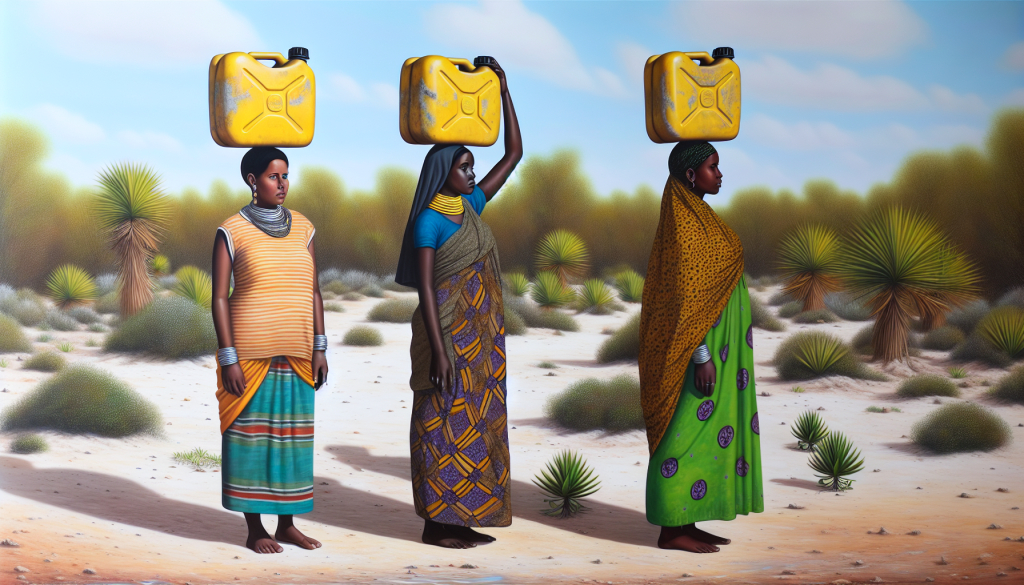
Turkana, Kenya – Under the scorching sun in Kainama, Turkana County, Veronica Akalapatan and her neighbours trek several kilometres each day to reach a shrinking well set amid the cracked, dusty plains of northern Kenya.
The shallow pit, accessed by a simple wooden ladder, is the area’s only water source. Hundreds of residents from nearby villages – along with their animals – depend on it. Many wait for hours to fill small plastic containers with limited amounts of murky water.
Recommended Stories
• list 1 of 3Drought in eastern Africa, floods in the south: Climate extremes intensify
• list 2 of 3Images: Millions face hunger as drought tightens its grip on Kenya
• list 3 of 3Could disputes over water escalate as scarcity worsens across Africa?
“When we arrive, we dig into the well and wait for water to seep in,” Akalapatan explains. “We take turns because it is so little. There are many of us, and sometimes arguments break out.”
Turkana’s terrain is harsh and expansive. Roads fade into sand, and settlements lie scattered across great distances in a county of just over one million residents.
Although it is technically the rainy season, forecasters caution that Turkana and other dry regions may see little improvement.
Officials report that drought conditions have returned, affecting nearly half of Kenya’s counties. Around 3.4 million people are struggling to access enough food, at least 800,000 children are malnourished, and livestock – central to pastoral livelihoods – continue to perish.
In Turkana alone, some 350,000 households are at risk of extreme hunger.
“We are enduring hunger,” says Turkana elder Peter Longiron Aemun.
“There is no water. Our animals have died. We have lost everything. We once relied on burning charcoal, but even the acacia trees are gone.”
Kenya is still emerging from a devastating drought that lasted from 2020 to 2023, one of the harshest in four decades. The renewed dry spell threatens to deepen the crisis.
Yet specialists point to a troubling contradiction: want amid plenty.
Food loss and food waste
While communities endure severe water shortages and hunger – with broken boreholes and dried-up rivers – Lake Turkana’s water levels have risen in recent years, forcing some shoreline residents to relocate.
Elsewhere, intense downpours unleash flash floods along usually dry riverbeds, known locally as luggas. However, the sudden surges drain away quickly, leaving the land unable to support sustained farming.
Meanwhile, even as drought shrinks harvests and reductions in donor funding limit food assistance, experts note that significant quantities of food never reach those in need.
Research indicates that although a quarter of Kenyans face acute food insecurity, as much as 40 percent of food produced annually is lost or wasted.
Losses occur during harvesting, storage and transportation, while waste happens in homes, restaurants and retail outlets.
In parts of the North Rift region, considered one of Kenya’s agricultural hubs, farmers have achieved solid harvests. Yet soaring prices and widespread poverty prevent pastoral families in Turkana from purchasing food brought in from these surplus areas.
Security concerns further complicate matters. Competition over scarce water and grazing land fuels disputes, cattle raids persist, and armed groups operate in remote zones, stretching security forces thin.
“Security is the greatest challenge in drought-affected regions,” says Joseph Kamande, a food trader in central Kenya.
Even so, he believes Kenya could meet its own food needs with improved coordination and resource management.
“The country has vast land, and some of it is fertile,” he says, adding that access to water is key.
Untapped aquifers
Despite the ongoing drought, Turkana possesses underground water reserves that remain largely unused.
Deep beneath the surface lie aquifers – layers of rock and sediment that store water. Authorities hope to develop these resources.
In 2013, two major aquifers were identified: Napuu and Lotikipi. The larger spans roughly 5,000 kilometres and is estimated to contain about 250 trillion litres of water.
It could potentially supply the country for decades.
However, much of the water is saline, and treating it is costly, slowing progress.
“Salinity is the main obstacle,” explains Turkana County Water Director Paul Lotum.
“The national government and partners are identifying areas where the water is safe. We are gradually working to make it usable for communities.”
Until sustainable solutions are realised, food aid remains critical for many households.
Government disaster teams and humanitarian organisations continue to distribute supplies, but resources are limited. Reaching remote settlements is often extremely difficult.
“Many programmes are operating at reduced capacity,” says Jacob Ekaran of the National Drought Management Authority in Turkana.
“Funding has decreased, yet efforts continue to stretch the available resources.”
‘I can’t find food’
When provisions dwindle, families turn to wild fruits and berries.
In Lopur village, Akal Loyeit Etangana gathers berries and cooks them over an open fire.
She says she has gone two weeks without a proper meal, relying on the fruit mixture to ease hunger pangs, though it offers little nourishment.
“When the rains fail, trees wither. Without water, everything dries up,” she says, noting that medical facilities are far away and require long journeys on foot.
In Napeillim village, Christine Kiepa shares similar fears.
“I search for food, but sometimes there is none,” she says. “If I cannot find food, how will I survive?”
Many settlements are gradually emptying as male herders migrate to neighbouring areas in search of pasture and water for their remaining livestock.
The elderly, women, children and the frail animals are left behind.
There have, however, been signs of progress.
Since Kenya introduced devolved governance in 2013, Turkana has seen the construction of schools and health facilities, new irrigation initiatives, drilled boreholes and improved road infrastructure. Officials argue that investments in preparedness have strengthened community resilience.
“In the past, drought often turned into catastrophe, with deaths reported,” Ekaran says. “After one of the worst droughts in decades, we did not record fatalities. That reflects improved resilience.”
Painful cycle
For generations, pastoralism has defined life in northern Kenya. But shifting climate patterns are challenging that way of life. Calls to diversify livelihoods – through irrigation, drought-resistant crops and tree planting, and large-scale water storage – are growing stronger.
“We can rethink our approach,” says Rukia Abubakar of the Red Cross in Turkana.
“We can grow drought-tolerant trees and expand irrigation. The soil can support farming.”
Such proposals resurface after every drought, echoed in policy discussions and official statements.
Yet for many residents, the hardship feels cyclical, and survival remains uncertain.
Back in Kainama, Akalapatan and her neighbours make the long walk home across the barren landscape, balancing yellow containers filled with water.
They return to their cluster of thatched homes.
Akalapatan has secured 20 litres for her family’s daily needs.
Her son eagerly drinks from a cup.
But she knows the supply will not last long, and before long she will have to undertake the exhausting journey once again.