India's enigmatic and age-old miniature chambers
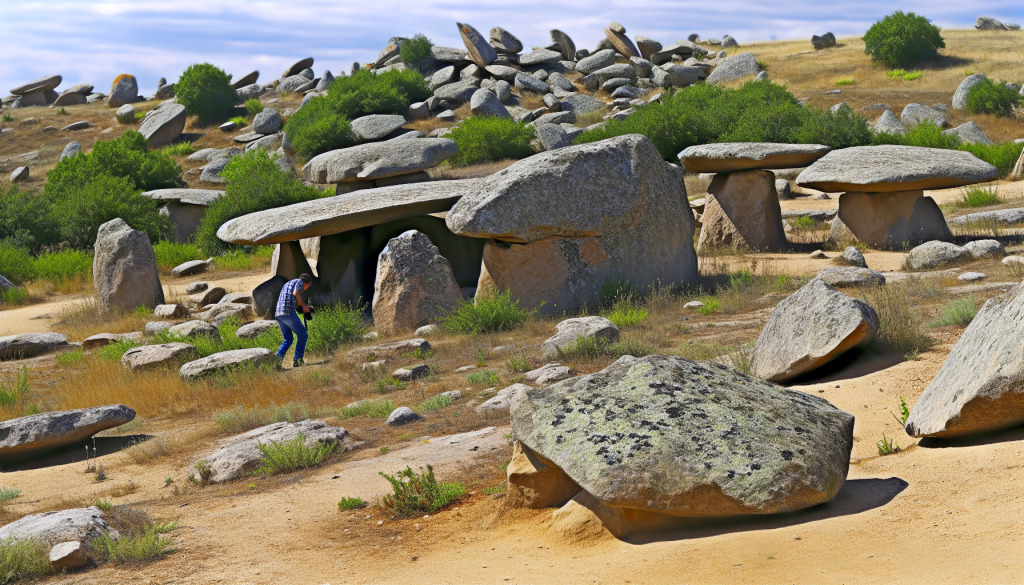
In southern India, nearly a thousand stone chambers resembling burial monuments are scattered across a place known by locals as the “Hill of the Dwarfs.” These mysterious structures, nestled in the hills around a village called Hire Benkal, are attributed by local lore to a race of small, mystical beings.
Hire Benkal, a quiet village in Karnataka, is surrounded by rugged hills, mango orchards, and fields irrigated by a nearby canal. At first glance, it appears no different from many rural communities in South India, peaceful and timeless.
However, a 90-minute trek to the top of a nearby ridge reveals Moryar Gudda — “Hill of the Dwarfs” in the Kannada language. Here lies one of India’s largest and most extensive megalithic burial sites, dating back some 2,500 years. Sprawled across the rocky plateau are nearly a thousand monumental stone structures, built as tombs or memorials for the dead. Their size and number make an unforgettable impression, evoking an ancient civilization whose rituals have long been forgotten.
The site carries a mythical feel. Massive stones are stacked in delicate balance, some forming shelters that still hold ancient red ochre art from 700-500 BCE. The paintings depict animals resembling bulls and wild boars, though their exact meaning remains unknown.
Experts believe the site served as a burial ground or a place for ancestral worship, though its full purpose is not definitively known.
While Stonehenge may be the most iconic megalithic site globally, thousands of other such ancient constructions exist worldwide. Europe has catalogued over 35,000, but India has officially documented only around 3,000. For adventurous travelers exploring Hire Benkal, the site offers a vivid impression of ancient Indian customs, including rituals and symbolic representations of animals and weapons carved or painted on the rocks.
The megalithic site at Hire Benkal spans over 20 hectares, oriented east to west, hinting at a possible ceremonial or cosmic alignment. Its most remarkable features are the dolmen — rectangular tombs made from large granite slabs capped with huge stone covers. These dolmen often cluster near a shallow stone basin at the hilltop, which may once have been a natural water source later expanded through quarrying to provide materials for building.
On the morning of a recent visit, lilies bloomed gracefully in the basin, giving the scene a serene, almost ethereal quality.
"Such an elaborate site must have taken generations to build," said Srikumar Menon, an architect and professor at the National Institute of Advanced Sciences, who has researched many Indian megaliths, including Hire Benkal.
Villagers tell stories of “moriyars,” a mythical race of diminutive but remarkably strong beings who supposedly built the dolmen. According to Chandrashekar Anegundi, a local naturalist and trek leader, legends arose partly because of the remarkable craftsmanship — particularly the perfectly cut round openings in several dolmen — which seem far beyond the tools available to early people.
"People around here believe the moriyars were tiny beings who perished in a fiery disaster," Anegundi said, though he questions the logic. "If they were small, how did they move such huge stones?"
Menon mentioned encountering similar folklore at several other megalithic sites in south India — with names like Moribetta, Morikallu, Sanna Moriyara Thatte, and Moral Parai — all associated with small mythical builders. He speculates these stories may be a distant echo of an ancient species like Homo floresiensis, a small human-like species discovered in Indonesia that may have overlapped with early Homo sapiens.
"Scientifically, we know humans built these structures," Menon noted. "But the myth of little people endures in many places."
Despite its size and importance, Hire Benkal remains relatively unknown, rarely visited by tourists even from nearby cities. It is largely overshadowed by the more famous Hampi temples just 42 kilometers away — a UNESCO World Heritage site known for its monumental ruins and religious significance.
Local guides say that only 20 to 30 people visit Hire Benkal in most months, with a small rise during the cooler months between October and February. In stark contrast, Stonehenge draws over a million visitors each year.
"People don’t even know this place exists," said Disha Ahluwalia, an archaeologist and researcher at MSU Baroda. "This site deserves recognition. A massive effort went into building it, and we need to put in double the effort to protect and study it."
She believes colonial-era dismissals of rural Indian cultural sites contributed to the legends and lack of serious study. "When these sites were first discovered by British officers in the 1800s, they weren’t documented properly. They were just seen as random stones," she said.
In recent times, some dolmen have been damaged — whether by cattle roaming through, treasure hunters hoping to strike gold, or careless visitors. Overgrowth and natural erosion have also taken their toll on the ancient stones.
"This site is delicate — and because people don’t understand it, they sometimes vandalize it," said Meera Iyer, head of the Indian National Trust for Art and Cultural Heritage in Bengaluru. Her group is advocating to have Hire Benkal included on the UNESCO World Heritage list, which would bring protection, funding, and visitor infrastructure. Proper tourism, she says, could benefit both the site and the surrounding communities.
But Iyer also warns that excessive or mismanaged tourism could harm the site. "It’s not just about bringing people here. We need good management, interpretation, and education to preserve it properly."
As the monsoon clouds rolled over the Deccan Plateau, the landscape surrounding the hill came alive. Birds flitted through green foliage. Peacocks displayed their vibrant feathers up on the ridge. Lizards sunned themselves on warm granite. Herds of goats wandered among ancient ruins. Between the rocks, golden amaltas trees bloomed in scattered bursts of color.
"This is a sanctuary — for wildlife and for us," Anegundi said, pausing to collect a few seeds from the trees.
At Hire Benkal, the ancient and the mystical intersect. The dolmen line the rocky ridgeline like stone sentinels guarding a forgotten past. Though the reasons why they were built remain unknown, the reverence woven into this place across centuries is undeniable. It stands today as one of India's most mesmerizing yet least-known prehistoric sites — a stone-built mystery hiding in the open.