‘There’s nowhere to go but up’: cycling Norway’s mountainous ‘Milky Way’
“Norway is a country of hills,” says Glenn Roar Berge with a shrug. He is right, although the description feels rather modest. I have come to Valdres in southern Norway to ride the cycling routes along the edge of Jotunheimen national park. Glenn, a mountain local who works as a guide, will be leading us through the landscape he has known all his life.
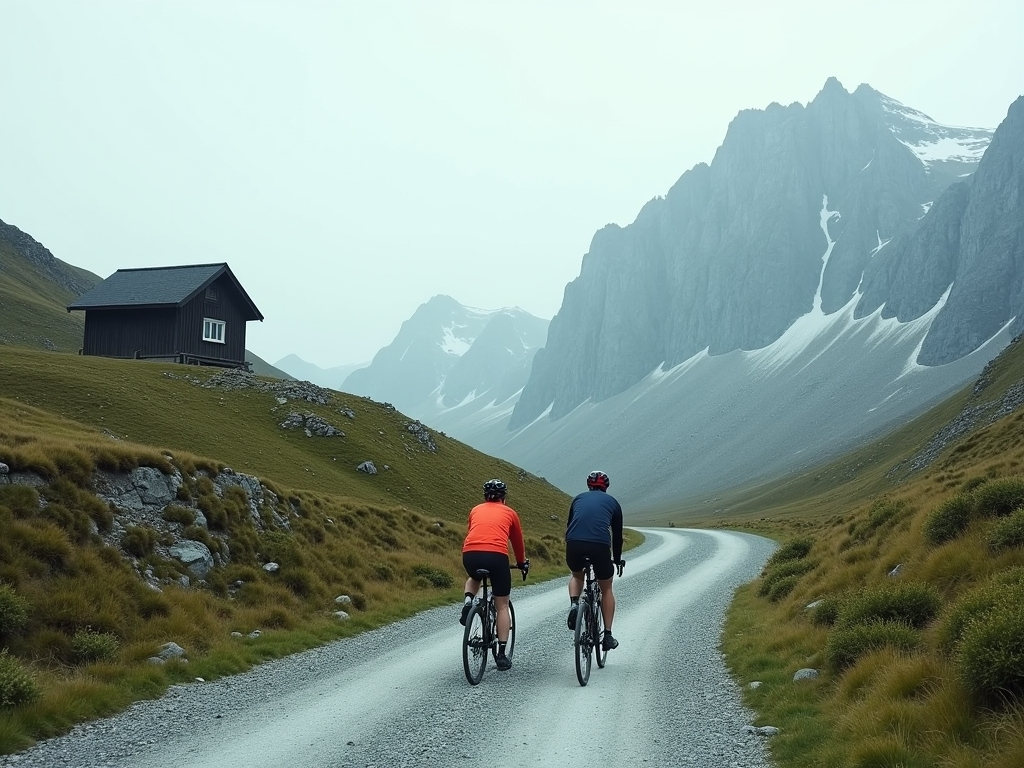
For much of our three-day journey, we will follow the Mjølkevegen, meaning Milky Way, a 155-mile (250km) route running from Vinstra in the north to Gol in the south. The road was created after the second world war, when growing demand for fresh milk required better links between remote mountain farms and the towns in the valleys. Farming still shapes the region, but the route has recently become popular with gravel cyclists—usually riders on drop-handlebar bikes who prefer tracks and unpaved roads—seeking a multi-day escape far from urban life.
Ruten Fjellstue is a traditional mountain inn catering to cross-country skiers in winter and hikers and cyclists in summer. My journey begins here, where I meet the guide and the rest of the group and collect my rental bike. The inn stands high above the valley and is painted falun red, the iron-oxide colour commonly seen on farm buildings throughout the Nordic region. Third-generation owners Berit and Arthur run the property. Because I arrive late, Arthur collects me from Vinstra railway station, roughly three hours north-west of Oslo, while Berit saves me a homemade dinner: fish with potatoes, vegetables and cream sauce, followed by apple crumble.
Small mountain inns like this are one reason cycling across the region feels so manageable. At breakfast, guests are expected to prepare sandwiches from the buffet, where ingredients and supplies are arranged for the day ahead. We are even handed reusable beeswax wraps. Riding here seems to be fuelled by sandwiches, waffles topped with sour cream and berry jam, and a steady supply of cinnamon buns—and those are merely the snacks between proper meals.
Our first morning starts with a relaxed downhill glide before the road narrows into a rough trail. A temporary closure forces us on to a rugged mountain detour. I have never ridden with drop handlebars, and it takes some time before I understand how to use the gears properly.
Silje Wilson, who promotes the area’s mountain hotels, joins our group of 12 cyclists from different parts of Europe. She tells me this is also her first time on a gravel bike, so I imagine we might keep each other company at the rear. Instead, she leads nearly every ascent and frequently disappears far ahead. That evening, she admits she has spent the summer mountain biking and trains by lifting a large stone in her garden. “A typical Norwegian woman,” Glenn remarks.
You do not need to be a “typical” Norwegian to appreciate these trails, but being comfortable with climbs certainly helps. As we descend towards Lake Vinstre, the peaks of Jotunheimen—northern Europe’s highest mountain range—rise before us. A narrow road extends into the distance, with mountains filling every direction beyond it. The lake shines a rich turquoise blue, while its shores are scattered with little wooden farmhouses painted red and yellow. Many have turf roofs, providing additional insulation and protection once the snow arrives.
At Lake Bygdin, we pause to loosen our legs and eat burgers at a mountain hotel before boarding the M/B Bitihorn passenger ferry. Our bicycles and luggage travel with us on the open deck. The vessel has crossed the lake regularly for more than 100 years. We pass the peaks of Øystre Torfinnstinden and Galdebergtinden, where waterfalls stream down sheer slopes towards the inland fjord.
After reaching Eidsbugarden at the opposite end of the lake, we return to our bikes and follow Lake Tyin towards our next mountain hotel. We ride past summer dairy farms but encounter almost nobody. Traffic is virtually absent, although wandering sheep demand attention. Twice, I have to veer sharply while descending when one suddenly dashes into the road.
Our days in the saddle are long, averaging around 45 miles (75km) and 1,500 metres (4,900ft) of climbing. There are, however, easier ways to discover the Mjølkevegen. Shorter stages allow more time to enjoy the welcoming family-run hotels or include hikes, while some visitors rent electric bikes. The principal route is clearly marked and uncomplicated to follow independently. A guide is useful for detours or more demanding alternatives. I choose to accept a slower rhythm, absorbing the vast landscape as the distance gradually passes beneath my wheels.
On the second day, we stop at Øye to examine the sharply layered roof of its stave church, one of only 28 surviving examples in Norway. Numerous Norwegian churches, including medieval stave buildings, were destroyed during more than 50 arson attacks in the 1990s linked to extremist members of the black metal scene. The original Øye church was built near the end of the 11th century and replaced in 1747. During restoration work in the 1930s, its dismantled timbers were found hidden beneath the floorboards for reasons no longer known. The church was eventually reconstructed beside the lake.
Farther along the valley, Glenn points towards a tall, triangular cave high above us. We have entered troll country. “A huge rock up there has begun to move,” he says. “It is being monitored, and sometime within the next 200 years it will fall. The cause is lang bane, the troll’s ‘long bones’. Trolls sleep for centuries, and this one is beginning to wake. The newspapers may not say so, but everyone living here knows it is the troll.”
We soon turn back into the high ground, following a detour Glenn has selected away from the principal route. It features what he describes as “the mother of all climbs”: an extended ascent of countless switchbacks that consumes every bit of cinnamon-bun energy I can find. On the Smådalen plateau, we rest among wildflowers, surrounded by steep summits climbing beyond the snow line. Moose inhabit these mountains, although our excited shouting on the descents probably ensures they remain out of sight.
By my final day, the conditions have changed. The Mjølkevegen lies between about 800 and 1,300 metres above sea level, so the weather can turn with little warning. Heavy rain drives into us as we reach the foot of the Slettefjell mountain pass. A small cafe offers temporary shelter, waffles and a chance to refill our bottles. From there, the road rises relentlessly. We must gain 600 metres in only 6km, and I can focus on nothing except reaching the next corner.
The summit is level, open and exposed, while the clouds have reshaped the mountains once again. It becomes difficult to judge distance, and the jagged boulders begin to resemble petrified trolls. I wave to them before releasing the brakes and coasting downhill for mile after mile.
In this region of Norway, mountain hotels are rarely positioned on the valley floor. “People always want a view,” Glenn explains. For cyclists, that means each day concludes with a final climb of several kilometres to reach the night’s accommodation. The effort is punishing, but it makes arriving feel even more rewarding. After all, the finest views are often the ones earned the hard way.
Three-day self-guided cycling packages on the Mjølkevegen are available from NOK7,800 (£612) per person, based on two people sharing. Packages typically include hotel accommodation, meals, luggage transfers, passenger-ferry tickets, digital maps and directions, backup assistance and carbon compensation. Bicycle rental is generally charged separately.