Planet Y? New evidence hints at unseen world within our solar system
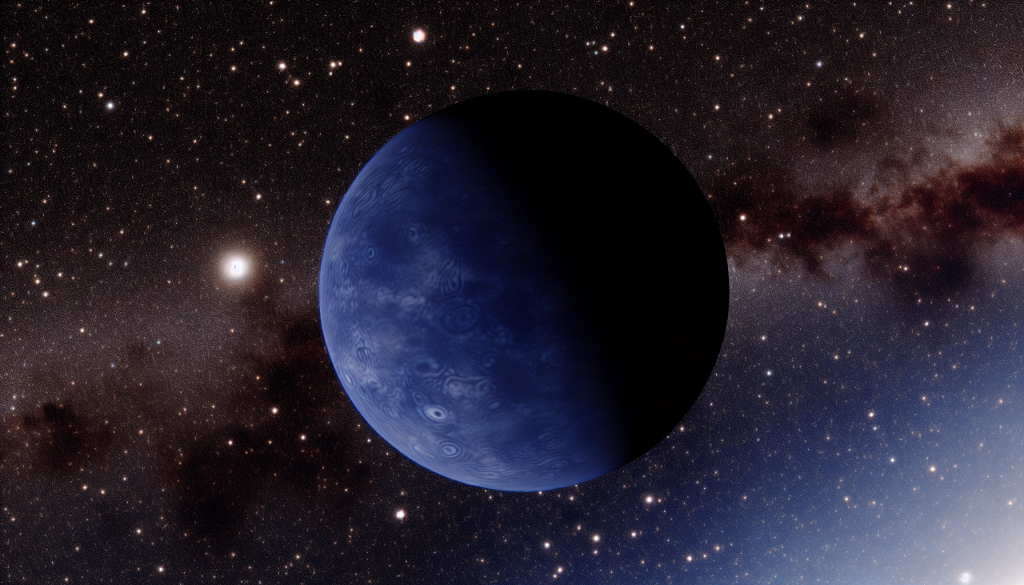
Astronomers have long been intrigued by the possibility of hidden planets beyond Neptune. A recent study introduces a new contender, tentatively called Planet Y, as a possible explanation for unusual orbital tilts observed in objects located in the Kuiper Belt—a vast region of icy bodies stretching past the orbit of Neptune.
Although Planet Y hasn't been directly seen, its existence has been proposed based on the unexpected tilt in the orbits of certain distant solar system objects. According to researchers, something must be impacting these orbits, causing the unusual angle.
“One possible cause is a so-far undetected planet, likely somewhere in size between Mercury and Earth, orbiting far out in the solar system,” said Amir Siraj, lead author of the study and an astrophysics doctoral candidate at Princeton University. “This isn’t a confirmed planet—we haven’t found it, but the data presents a compelling mystery that may have a planetary explanation.” The findings were published in the journal Monthly Notices of the Royal Astronomical Society: Letters.
Planet Y joins a list of speculative celestial bodies proposed over recent years, most of which are thought to exist within the Kuiper Belt. This region is also home to the dwarf planet Pluto, which was reclassified from planet status in 2006 after astronomers reassessed what qualifies as a planet.
The remote nature of the Kuiper Belt makes observations challenging and incomplete. However, optimism is growing with the upcoming launch of the Vera C. Rubin Observatory, which will begin a decade-long survey of the sky that could help uncover such hidden entities.
“In the first few years of its operation, the telescope could give us a definite answer,” said Siraj. “If Planet Y resides within its range, we might identify it directly.”
A Longstanding Cosmic Debate
After Neptune’s discovery in 1846, astronomers began speculating about another far-off planet, eventually known as Planet X. This concept was championed by Percival Lowell, who believed unexplained movements of Neptune and Uranus hinted at another massive object beyond their orbits.
When Pluto was found in 1930, it was initially thought to be this Planet X. But as astronomers studied its mass and influence, it became clear Pluto couldn’t account for the observed orbital anomalies. By the 1990s, data from Voyager 2 confirmed that Neptune was less massive than previously assumed, resolving the irregularities without requiring a Planet X.
Interest sparked again in 2005, when Mike Brown and his team discovered Eris, a large icy body residing in the Kuiper Belt. This led to Pluto’s reclassification as a dwarf planet and reignited the search for a true ninth planet. In 2016, Brown and colleague Konstantin Batygin introduced their hypothesis of “Planet Nine,” theorizing a massive body orbiting far beyond Pluto—potentially five to ten times Earth’s mass and located hundreds of astronomical units from the Sun.
The debate over Planet Nine, and now Planet Y, has energized the astronomical community. “The dialogue itself helped inspire our work,” Siraj said. “It’s an incredibly exciting time in planetary science, with real potential for groundbreaking discoveries.”
He added that both Planet Nine and Planet Y might exist independently. His curiosity about the structure of the Kuiper Belt led him to investigate whether the region should be aligned with the rest of the solar system. Most planets have orbits roughly on the same plane, akin to grooves on a vinyl record. The Kuiper Belt, however, defies this neat structure.
“We found that beyond about 80 astronomical units, the solar system seems to tilt by approximately 15 degrees,” Siraj explained. “This misalignment was what set us on the path toward hypothesizing Planet Y.”
To reach their conclusions, Siraj and his team used simulations that factored in existing planets along with a proposed additional body. Previous ideas, like Planet Nine, didn’t result in orbital alignments matching observations, leading them to propose Planet Y. They estimate it may be between Mercury and Earth in size, situated 100 to 200 times further from the Sun than Earth, and tilted at least 10 degrees from the known orbital plane.
Looking Ahead Through New Eyes
Given the Kuiper Belt’s remoteness and observational limitations, astronomers currently use data from a mere 50 objects to formulate their theories. This makes any conclusions about Planet Y still tentative.
“Based on the data we have, there's about a 96% to 98% likelihood that something unusual is happening,” Siraj said. “That’s compelling, but it’s not conclusive.”
This could change soon. The Vera C. Rubin Observatory, perched atop a mountain in Chile, is getting ready to start capturing panoramic views of the sky every few days. It will house the biggest digital camera ever built for astronomy.
“It’s a landmark achievement in telescope technology,” Siraj noted. “We’ll effectively create a time-lapse of the universe, with images captured every three days. This will be crucial for mapping out our solar system and possibly identifying hidden celestial bodies.”
Konstantin Batygin, though not involved in the new study, called the work an intriguing way of exploring how the distant solar system may be tilted. “The data from Rubin will vastly improve our understanding of the outer solar system's dynamics,” he said.
Samantha Lawler, an astronomy professor at the University of Regina, also reviewed the findings. While she remains cautious about the larger Planet Nine idea, she finds merit in the possibility of a smaller planet distorting distant orbits. “The evidence for a large ninth planet is weak, but there could well be a smaller body influencing some of these objects,” she said.
Patryk Sofia Lykawka, a planetary scientist at Kindai University in Japan, echoed that sentiment. Although he wasn’t involved in the research, he found the theory plausible. “The possibility of a Mercury- to Earth-sized planet shaping the Kuiper Belt orbits is definitely worth considering,” he said.
“This hypothesis strengthens the idea that an unseen planet may exist in the fringes of our solar system,” Lykawka added. “It also highlights the need to continue surveys of distant trans-Neptunian objects, as they offer vital insights into the formation and evolution of our planetary neighborhood.”