Interstellar visitor 3I/ATLAS to pass near Earth this Friday — see the newest photos
A comet from beyond our solar system, first detected in July, is now preparing to move away from our cosmic neighborhood. But before it departs, it will make a close pass by Earth, offering scientists a rare opportunity to capture striking new images.
Named 3I/ATLAS, the comet will reach its closest point to Earth this Friday, passing at a distance of about 167 million miles (270 million kilometers). However, this event will take place on the far side of the sun. To put it in perspective, Earth orbits roughly 93 million miles (150 million kilometers) from the sun.
Comet 3I/ATLAS won’t be visible without special equipment. The peak viewing period has already ended, and seeing it now requires a telescope with at least an 8-inch (20-centimeter) aperture, based on expert estimates.
New imagery is unveiling the unique path of this interstellar visitor as it makes its closest approach to Earth.
The Virtual Telescope Project plans to broadcast a live view of the comet at 4:00 a.m. UTC Friday, which is 11:00 p.m. Eastern Time on Thursday. If weather conditions interfere with viewing, the event will be postponed by 24 hours, according to Gianluca Masi, an astronomer at Italy’s Bellatrix Astronomical Observatory and head of the Virtual Telescope Project.
NASA indicates that this unusually distant comet will remain within view of telescopes and space observatories for several more months before it continues on its journey out of our solar system.
Since its discovery this summer, astronomers have been carefully studying the comet to learn more about its origins beyond the solar system and what it’s made of. Observations have covered various wavelengths, from visible light to infrared and radio waves. Recently, scientists achieved a breakthrough — capturing it for the first time through X-ray imaging.
X-ray insights from a cosmic traveler
Comets born within our solar system are known to emit X-rays, and astronomers have long questioned whether interstellar comets would do the same.
Attempts were made to detect X-rays from previous such visitors in 2017 and 2019, but those efforts did not yield results.
However, comet 3I/ATLAS is changing that expectation.
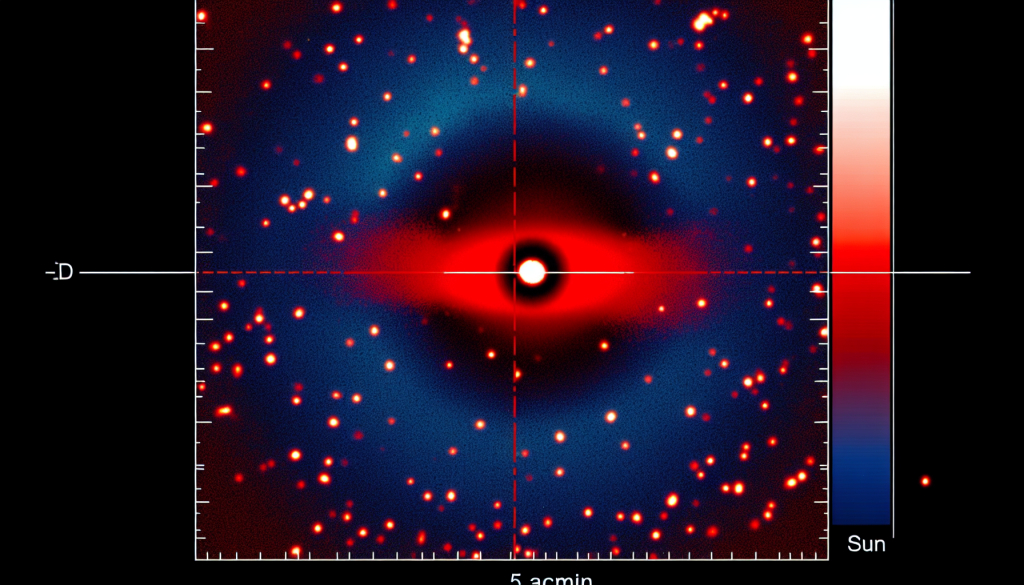
Japan’s X-Ray Imaging and Spectroscopy Mission (XRISM) studied the comet for 17 hours in late November, using its Xtend telescope. The observations revealed that X-rays extended up to 248,000 miles (400,000 kilometers) from the comet’s nucleus, likely caused by gas clouds surrounding the object, according to the Japan Aerospace Exploration Agency. Further study will be required to confirm this behavior.
These X-rays may be generated when gases such as water vapor, carbon dioxide, or carbon monoxide emitted by the comet interact with the sun’s continuously flowing solar wind — a stream of charged particles. As comets approach the sun, the heat causes them to release gases from their icy surfaces. XRISM detected the presence of elements like carbon, nitrogen, and oxygen near the center of 3I/ATLAS.
The European Space Agency’s XMM-Newton X-ray observatory observed the comet for 20 hours on December 3 using its high-sensitivity camera. These observations produced a vivid red X-ray image of the comet’s glow.
Combining the X-ray data with observations in other types of light gives scientists a fuller picture of the comet’s makeup — and helps determine how closely this traveler resembles comets native to our solar system.