"We invent gods to make sense of chaos": Ralph Fiennes, John Lithgow, and Stanley Tucci discuss fame, morality, and the Vatican thriller *Conclave*
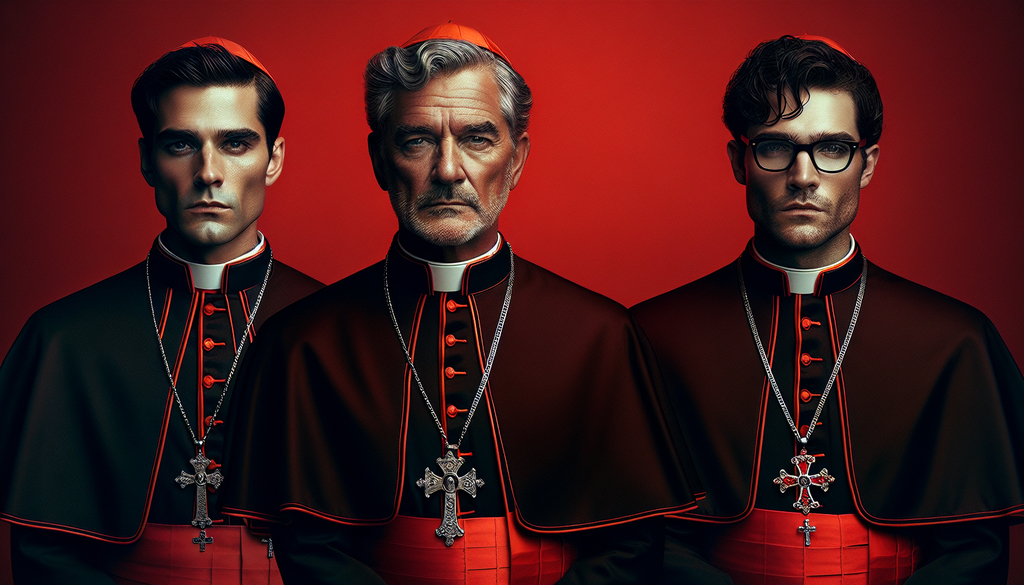
Faith, mortality, and vengeful vaping: among this year’s Oscar hopefuls, Conclave shines as the one that masterfully blends probing religious themes with a touch of theatrical side-eye. Based on Robert Harris’s novel, screenwriter Peter Straughan, known for Wolf Hall, collaborates with Edward Berger of All Quiet on the Western Front fame to direct this power-driven tale of faith, politics, and human frailty.
Ralph Fiennes steps into the role of Cardinal Lawrence, tasked with navigating his personal struggles with faith while managing 113 cardinals gathered at the Vatican after the sudden passing of the pope. These men remain cloistered until they elect the next pontiff, amidst secrets and rivalries. Stanley Tucci portrays the compassionate reformer Bellini, while John Lithgow plays the traditionalist Tremblay. Both characters harbor hidden truths—some possibly more destructive than others in this battle of belief and ambition.
Filming took place in Rome roughly 20 months ago, but aligning the stars’ schedules for this interview almost took as long. Fiennes is wrapping up an Alan Bennett adaptation and a zombie sequel, 28 Years Later. Tucci is busy with a Russo brothers project and promoting his memoir, while Lithgow is engrossed in Giant, a play where he portrays Roald Dahl.
Despite these packed schedules, the trio joined an early-morning video call from separate London locations: Fiennes in a minimalist kitchen, Tucci surrounded by the clutter of books and sketches in his home office, and Lithgow dialing in from a refined Chelsea rental.
Catherine Shoard: Did making this film impact your faith?
John Lithgow: No, but being in Rome, immersed in Renaissance Christian art, felt almost spiritual—it’s impossible not to feel awe working on a project with such weighty themes.
Stanley Tucci: Though raised Catholic, I drifted away from the church. Its core beliefs felt more like mythology to me and didn’t resonate. Yet, Roman churches, the sheer art, devotion, and history, leave an impression—though it hasn’t swayed my stance.
Ralph Fiennes: My relationship is more nuanced. Raised by a committed Catholic mother and surrounded by religious influences, faith was ever-present in my upbringing. However, as a teenager, I rejected the rigid authoritarianism of the Church, especially growing up in Ireland during the 1970s. While I no longer practice, I remain deeply curious about the concept of belief. Whether it’s through Catholic or Orthodox art, I’m moved by humanity’s persistent need for faith despite the march of science and logic.
CS: Why do you think people gravitate towards faith?
RF: Faith gives structure to life’s chaos. Human beings, seeking clarity amidst unpredictability, turn to religion for moral direction and unity. Historically, faith helped communities cohere, even those like the Inuit, who married spirituality with their environment. Organized religion has done harm, yet its foundational sense of community persists as a vital means of preserving humanity.
ST: Religion offers solace in the face of uncertainty, especially the fear of death. It creates order out of disorder—much like art. The church’s commissions birthed countless masterpieces, even if faith itself didn’t appeal to me. My faith lies in the transformative power of art.
JL: Precisely. Conclave explores the friction between commitment to faith and human ambition. It’s a story where virtue clashes with sin, eliciting profound reactions because of its universal tension. Audiences recognize themselves in this struggle.
CS: Does the drama of elections, including those within Conclave, reflect our politics?
JL: Absolutely. Leadership selection inevitably turns political. Filming coincided with the drawn-out process of electing the U.S. House Speaker—eerily echoing the film’s core tension. Historically, stories that pit the righteous underdog against corrupt forces resonate, which is why this film feels timely.
ST: So many films are designed to soothe us with happy resolutions because real life rarely does. Conclave, though trope-driven, challenges audiences with its raw complexity.
CS: Should there be an age limit for leaders or voters?
RF: Perhaps. Government might benefit from a cap—say 80—but it’s tricky. Plenty of sharp minds work well into their 80s. The film touches on gender, diversity, and modernity vs. tradition in the Church. Its themes stimulate discussion without being overtly hostile.
JL: The Catholic Church’s immense influence and conservative nature are at odds with its global good works. The key question is whether it can embrace the reforms it so desperately needs.
CS: What must the Church change?
ST: Simple. Allow priests and nuns to marry. It’s ridiculous that love and devotion to God are treated as incompatible, especially when historical bans on clergy marriage were largely financial. Restoring that freedom could anchor the clergy in reality and enhance spirituality.
CS: In an increasingly polarized world, are we regressing to patriarchal traditions?
RF: Regression often follows compelling narratives. Trump wielded a simple yet potent story, tapping into people’s fears and frustrations. That visceral connection outperformed any elite messaging. Storytelling remains a key avenue for influence—be it political or cinematic.
ST: Tyrannical figures often scapegoat others to simplify issues. Trump’s narrative exploited such tendencies effectively.
CS: Acting vs. Preaching—Doesn’t each seek to provoke thought?
RF: Priests aim to shepherd spiritual growth. Actors amplify voices through storytelling. At their best, both professions engage audiences deeply, delivering emotional impact while offering space for reflection.
JL: Exactly. Whether portraying villains or heroes, actors thrive on provoking reactions. Much like the clergy, our job often demands connecting to our audience on a profoundly human level.
CS: What themes of self-awareness and evolution resonate with you in Conclave?
ST: I’m a work in progress. Self-evolution never truly ends, though I hope any epiphanies about myself don’t arrive on my deathbed when it’s too late!
JL: I’m at peace with being a good actor, though the profession itself often feels indulgent. Still, embracing that role helps me flourish.
RF: I hope the Church evolves via meaningful dialogue. Growth, as individuals or institutions, is challenging but essential. At its best, the Church can embody communal positivity. However, much like in acting, aspirations must contend with real-world obstacles.
CS: Can this film inspire hope?
RF: Ultimately, Conclave celebrates values like integrity and spiritual depth. It reminds us to strive for ideals even during uncertain times, preserving the potential for positive transformation.
Conclave releases in the UK on 29 November.