A short journey through Earth's past on a walk across Scotland's Isle of Arran
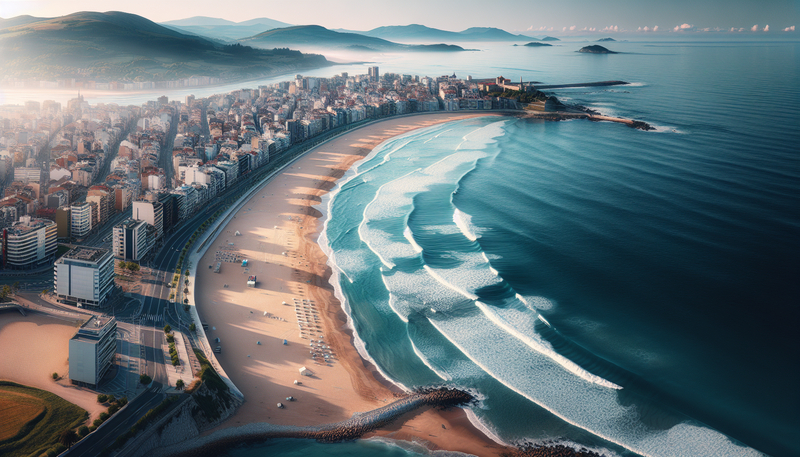
Roughly 240 million years in the past, a massive 12-foot creature known as a chirotherium tread across a stretch of sand that was then part of the Pangaea landmass. Today, that ancient shoreline exists as the edge of Kildonan village on the southern coast of Scotland’s Isle of Arran. Here, the coast is interrupted by jagged formations of black igneous rock — solidified magma that juts dramatically into the sea — while quaint cottages sit beneath rolling green cliffs.
We know of chirotherium's presence thanks to the footprints it left behind, preserved for millennia and still visible today. “These tracks predate the dinosaurs,” says Malcolm Wilkinson of the Arran Geopark, as we kneel by one of the fossilized impressions. I place my hand into one, its sheer size dwarfing my fingers, and imagine a time when Scotland sweltered by the equator under a tropical sun.
According to Malcolm, after those prints were stamped into the sand, they were shielded from the elements by silt carried by wind or water. That protective layer allowed a perfect mold to form over the years. Gradually, more sediment piled on top, compressing into solid rock — red sandstone that encased those tracks. Tens of millions of years later, when the Atlantic began to form some 60 million years ago, tectonic shifts raised the fossil layers back to the surface, revealing history underfoot.
As erosion wore down younger layers of rock, the prehistoric tracks reappeared. Discovered during the Victorian era, the chirotherium was nicknamed “hand-beast” because its prints resemble oversized human hands.
Arran, located just off Scotland’s west coast and reachable from Glasgow in just over two hours, is famed for its geology. Students regularly flock here in hard hats for field studies. In April, it received official recognition as Scotland’s newest UNESCO Global Geopark — joining Shetland and the North West Highlands — for its outstanding geological features, which chronicle shifting tectonics and ancient continental movements.
Hiking across Arran is like walking through 600 million years of Earth’s evolution. My goal is to complete the 65-mile Arran Coastal Way in six days. Fortunately, helpful signs posted by the Geopark keep the scientific storytelling accessible for casual explorers like me.
As the ferry nears Brodick, the notched ridgelines of northern Arran come into view, with a sandstone castle nestled among green slopes and the striking profile of the “Holy Isle” drawing attention to the south. The island is cleaved by a geologic boundary — the Highland Boundary Fault — which splits Scotland’s undulating lowlands from its rugged mountains.
My first day on the trail leads me up to Goat Fell, Arran’s tallest summit at 874 meters. From its peak, I take in the granite chaos of the north — sharp peaks and deep valleys sculpted by glaciers — while gentler green terrain lies to the south, shaped by softer rock.
That night I rest at the Corrie Hotel and follow a local Geopark guide to a dramatic relic — a sand dune struck by lightning 270 million years ago, creating a “fossilized fulgurite” right near the village’s center. Standing before this ancient bolt of frozen lightning feels like peering into an alien world.
Further along the coast, another trail of footprints emerges in a hidden area where Arran’s sole coal seam reaches the surface. These were made by a six-foot millipede that lived 300 million years ago — easily missed except for a discreet wooden Geopark marker. As I arrive, a pod of dolphins leaps nearby, stealing the spotlight with their playful acrobatics.
Four miles north lies one of Arran’s geological crown jewels — Hutton’s Unconformity. In 1787, geologist James Hutton, often called the father of modern geology, studied this very site at Newton Point. Seeing younger sandstone lying atop much older schist rocks at a sharp angle, he concluded that Earth’s features arose slowly over immense time periods — challenging the then-accepted belief that the planet was only a few thousand years old.
Luckily, a geologist on vacation is close by and excitedly reiterates this pivotal discovery — though he admits he’s more thrilled by a nearby otter he just spotted frolicking in the water.
After a fish and chips dinner at the community-run Lochranza Country Inn, I retire to the Lochranza Youth Hostel. A snug private bunk is all I need before tackling a 19-mile trek the next day. I wind along boulder-strewn beaches and quiet roads on Arran’s western edge, camping near King’s Cave — its walls etched with Iron Age crosses — and watch gannets plunge into the ocean at sunset with the Kintyre Peninsula silhouetted beyond.
I occasionally set aside my geological mission to soak up the island’s gentler pleasures — watching otters hunt for fish, savoring a whisky and chocolate pairing at the new Lagg Distillery, or lounging in The Lagg Inn’s riverside garden.
My journey coincides with what might be the island’s sunniest week in recent memory, making it easy to convince Malcolm to revisit Kildonan’s shoreline. “This is geology of global importance,” he says, gesturing toward the beach. As we wait for the tide to retreat and reveal the ancient chirotherium print, he explains how the black rock walls — dyke swarms — formed. “These are magma projections forced through fissures in Earth’s crust, now exposed by erosion,” he explains. “This coastline captures the moment Europe and North America were torn apart, and the Atlantic Ocean was born.”
All around, sunbathing seals soak in the warmth atop these storied rocks. “What makes Arran so remarkable,” says Malcolm, “is that it holds records from nearly every geological period over the last half billion years — and it’s all out in the open.”
Beyond the coast lies Ailsa Craig, a dome of microgranite teeming with seabirds, and Pladda, an island crowned with a scenic lighthouse atop what once was a river of molten stone.
That evening, after crossing the waterfall-laced paths of Glenashdale, I arrive in Whiting Bay. As I prepare my tent, I spot an otter darting by in the fading light. On my final day, with the tide timed just right, I follow elevated boardwalks and exposed seabeds to Lamlash, Arran’s largest village.
I pause for a dip in a hidden cove, oystercatchers chirping overhead as they bid their noisy farewells. Soon Brodick’s familiar peaks greet me. As the ferry carries me back to the mainland, I turn to gaze one last time at Goat Fell rising in majesty — and am reminded of Nan Shepherd’s immortal words: “the shortsighted cannot love mountains as the longsighted do.”
Stays: The Corrie Hotel offers double rooms from £115 with breakfast. Lochranza Youth Hostel has private rooms from £42, dorms from £20. The Lagg Inn has doubles starting at £170. More travel information can be found at Visit Arran.