In Turkey, your coffee is served with a glimpse of fate
Editor's Note: This article is part of a CNN Travel series focusing on cultural aspects of different countries. CNN maintains full editorial independence in all content production.
Describing Turkish coffee as merely a drink misses the bigger picture. It's a ceremonial act, a shared moment, and a historical treasure. With nearly five centuries of tradition, it’s even been recognized by UNESCO for its cultural significance.
In fact, the coffee story begins much earlier. According to Lani Kingston, a professor at Portland State University, a coffee bean dating to the 12th century was found in archaeological digs in what is now the UAE. By the mid-1300s, coffee-related items turned up in regions like Egypt, Persia, and Turkey.
Turkish coffee’s true journey starts in Yemen. In the 1400s, Sufi mystics reportedly drank it to stay awake during spiritual rituals. When Ottoman Sultan Süleyman the Magnificent conquered Yemen in 1538, coffee entered the empire and within a year, the beans reached Constantinople — known today as Istanbul.
Historical records show coffee’s early presence. In 1539, Ottoman admiral Hayreddin Barbarossa registered property with a "kahve odası," meaning coffee room. Harvard historian Cemal Kafadar references this in his scholarly work on the evolution of leisure in early Istanbul.
By the 1550s, Istanbul saw its first coffeehouses, or "kahvehanes," as noted by historian İbrahim Peçevi. These spaces quickly influenced social life. The method used to brew Turkish coffee — shared with Greek and Ethiopian traditions — emphasizes cooking the coffee in a pot called a cezve. Gastronomy expert Merin Sever describes this process as culinary rather than brewing; the fine grounds are cooked to produce a full-bodied, unfiltered drink.
Coffeehouses often sparked resistance. In various parts of Asia and Europe, religious figures and rulers banned them, fearing political dissent. For instance, Mecca prohibited coffee for 13 years starting in 1511. Ottoman emperors also periodically closed coffeehouses. Yet they endured. Even in 1600s England, King Charles II attempted to ban them over concerns about rebellious talk, according to London tour guide Chris MacNeil.
Interpreting the Cup
“Turkish coffee is more than a beverage,” says Seden Doğan, a cultural studies lecturer at the University of South Florida. For her, it represents a shared experience, especially in her hometown of Safranbolu, northern Turkey.
In Turkish culture, inviting someone for coffee usually involves hosting them in your home and preparing a fresh cup. It becomes an occasion to reconnect and share news, both joyful and sorrowful.
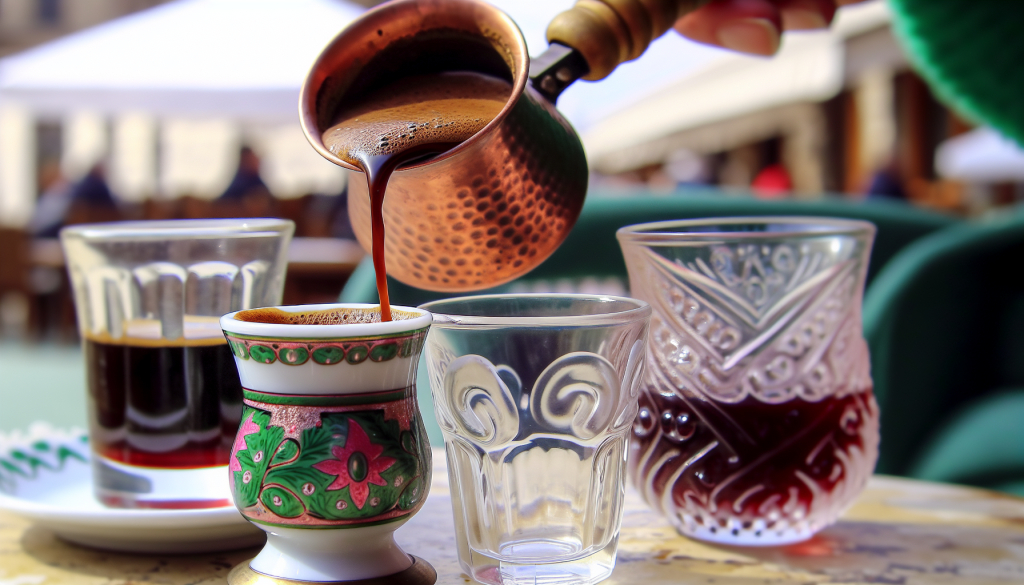
The preparation involves slowly “cooking” the finest coffee grounds in a long-handled pot. Traditionally, heat comes from coal or hot sand. The resulting foam is a sign of proper technique and quality.
A classic Turkish coffee is served with a glass of water and a piece of lokum, or Turkish delight. The water refreshes the palate, while the sweet lokum balances the rich bitterness of the drink.
Etiquette matters as well. The coffee should be sipped slowly, allowing the grounds to settle. Once finished, the leftover grounds are used in a fun tradition known as tasseography — or coffee-cup reading.
To start the reading, the cup is turned upside down on its saucer and left to cool. Once lifted, the shapes left in the grounds are interpreted — often with creative or symbolic meanings. A fish might represent luck, a bird could mean travel.
Although fortune-telling is discouraged in Islamic belief, this form of cup reading is usually taken as playful storytelling. Author Kylie Holmes emphasizes that it’s more of a communal act than serious divination.
“It’s just for fun,” says Doğan. She often engages in readings for nearly an hour, crafting uplifting stories that leave guests with a smile and a sense of connection.
Turkish coffee also appears in courtship rituals. A bride-to-be traditionally serves salted Turkish coffee to a prospective groom. His reaction — especially if he drinks it without complaint — is seen as a sign of patience and worthiness.
From Istanbul to London
Coffee's popularity didn't stop at Turkey’s borders. Through trade, it reached Italy, with Venice likely being among the first European cities to come into contact with it. However, one of the more defined connections to London’s coffee culture came via Daniel Edwards, a merchant from the Levant Company based in Izmir. In 1652, his servant Pasqua Rosée opened what is believed to be London’s first coffeehouse.
For just a penny, patrons could drink their fill while engaging in lively conversations. These early English coffee shops functioned similarly to Turkish coffeehouses — as gathering spots for discussing politics and sharing news. However, they were largely male-dominated spaces. In Turkey, and to a degree in London, women could not fully participate, although some worked in the shops.
Turkish Coffee’s Modern Renaissance
Turkish coffee, despite its heritage, hasn't achieved the global fame of espresso. Sever suggests that the drink’s association with older generations makes it less appealing to younger people.
She advocates for modernization to sustain interest; Doğan, on the other hand, believes preserving traditional practices is essential.
Nonetheless, there are efforts to reintroduce Turkish coffee internationally. In London, Ayşe Kapusuz leads coffee-making workshops. In New York, Uluç Ülgen — also known as Dr. Honeybrew — hosts immersive coffee-sharing and fortune-reading sessions.
“Despite its strong flavor, many Americans drink Turkish coffee to enjoy the experience of having their fortune read,” says Ülgen.
Where to Enjoy Quality Turkish Coffee in Istanbul
For an authentic cup in Turkey, Kapusuz suggests looking for places that prepare coffee slowly in a cezve and serve it hot with thick foam, along with water and lokum on the side.
In Istanbul, she recommends Hafız Mustafa. Sever points to Mandabatmaz on İstiklal Street and Nuri Toplar in the Egyptian Bazaar. For a more modern café experience, Hacı Bekir in Kadıköy offers a unique twist.
For tasseography, head to Istanbul’s Sultanahmet district or near the Tünel area in Beyoğlu. However, Doğan suggests asking a local for a personal reading — emphasizing that the real magic lies not in the prediction, but in the storytelling that happens between sips.